

Finding a genuinely unusual business idea is harder than finding a long list of businesses that already exist.
A subscription box, generic digital marketing agency or personalised gift shop may still become profitable, but none is particularly unique on its own. For a business idea to stand out in 2026, it needs a clearer combination of customer, problem, offer and competitive advantage.
For UK founders, feasibility matters just as much as originality. An idea may sound exciting but become unattractive once equipment costs, insurance, customer acquisition and regulation are considered.
The 12 unique business ideas below have therefore been assessed according to startup cost, customer demand, pricing potential, recurring revenue, time to first sale and UK regulatory requirements.
The startup figures are estimates for a lean launch rather than guaranteed costs. Actual spending will depend on location, equipment, insurance, software, marketing and whether the founder already owns relevant assets.
What Are the 12 Best Unique Business Ideas in the UK for 2026?
The 12 ideas covered are:
- EPR packaging-data and supplier concierge for small online brands
- AI-assisted quoting and administration setup for tradespeople
- Older-adult technology support and scam-safety visits
- Home-energy-upgrade project concierge
- Repair and upcycling collection-and-return service
- Cargo-bike delivery for independent retailers
- Returns grading and resale service for ecommerce brands
- Family photo, document and digital-legacy archiving
- Accessible website and document remediation for SMEs
- Pet-enrichment and senior-pet visit memberships
- Screen-free corporate micro-retreats and team days
- Sustainability-evidence content services for small exporters
Some could potentially produce a first sale within days. Others require greater technical expertise, insurance or regulatory checks before launch.
How Do These 12 Unique Business Ideas Compare?
| Business idea | Estimated lean startup cost | Best suited to | Model | Possible time to first sale | Revenue model | Recurring potential | Specialist skills needed? | Regulatory burden | Side-hustle friendly? |
| EPR packaging-data concierge | £250–£1,000 | Detail-oriented B2B founders | Online/hybrid | 1–3 weeks | Setup projects + retainers | High | Packaging data, spreadsheets | Medium | Yes |
| AI admin for tradespeople | £200–£800 | Automation and operations specialists | Online/local | 3–14 days | Setup fee + support subscription | High | Automation, CRM systems | Low–medium | Yes |
| Older-adult technology support | £150–£750 | Patient, trustworthy local operators | Local | 1–14 days | Visits + membership | High | Digital support | Medium | Yes |
| Home-energy-upgrade concierge | £500–£2,500 | Project coordinators | Local/hybrid | 2–6 weeks | Project fee | Medium | Retrofit knowledge | Medium–high | Yes |
| Repair and upcycling collection | £500–£3,000 | Repairers and practical founders | Local | 1–3 weeks | Repair + collection fees | Medium | Repair skills | Medium | Yes |
| Cargo-bike delivery | £750–£4,500 | Local logistics operators | Local | 1–3 weeks | Per drop + delivery contracts | High | Cycling/logistics | Medium | Yes |
| Ecommerce returns grading | £500–£2,500 | Ecommerce operators | Hybrid | 1–4 weeks | Per item + resale commission | High | Product grading | Medium | Yes |
| Family archive service | £300–£1,500 | Organised creative founders | Local/hybrid | 3–14 days | Fixed packages | Medium | Scanning/data organisation | Medium | Yes |
| Accessibility remediation | £250–£1,500 | Web developers/designers | Online | 1–3 weeks | Audit + remediation + monitoring | High | HTML, PDFs, accessibility | Medium | Yes |
| Pet-enrichment memberships | £200–£1,200 | Experienced pet carers | Local | 1–14 days | Visit packages/memberships | High | Animal handling | Low–medium | Yes |
| Screen-free corporate retreats | £400–£2,000 | Facilitators/event organisers | Local | 2–6 weeks | Per event | Medium | Facilitation | Medium | Yes |
| Sustainability-evidence content | £250–£1,000 | B2B writers/researchers | Online | 1–3 weeks | Projects + retainers | High | Research/content | Medium | Yes |
These are lean estimates. Founders should calculate their own gross margin, customer acquisition cost and break-even point before committing substantial money. UK Startup Magazine’s Unit Economics Calculator can help test whether the numbers remain attractive after variable costs and customer acquisition are included.
Rising wages, software, insurance and other operating expenses also make it worth understanding the real cost of running a UK startup before setting a launch budget.
What Makes a Business Idea Genuinely Unique?
A business does not become unique simply because it uses AI, sustainability or another growing trend.
A stronger idea normally combines a familiar business model with a specific underserved customer and a clearly defined problem.
For this comparison, each idea was assessed against eight questions:
- Does it target a clearly identifiable customer?
- Is there credible evidence that the underlying problem exists?
- Is it a problem customers already spend money trying to solve?
- Can demand be tested without a large investment?
- Is there a realistic way to differentiate the service?
- Could customers buy repeatedly?
- Is the regulatory burden manageable?
- Can a founder launch without immediately building a large team?
An idea does not need a perfect score. For example, an opportunity with strong recurring revenue may still be unattractive to a founder who lacks the technical qualifications or capital necessary to operate it safely.
How Were These Business Ideas Assessed?
Each factor can be scored from one to five. A higher total does not guarantee commercial success; it indicates that the idea appears easier to test against the criteria above.
| Idea | Customer | Demand | Paid problem | Cheap test | Differentiation | Repeat sales | Regulatory feasibility | Lean launch | Indicative total /40 |
| EPR packaging concierge | 5 | 5 | 4 | 5 | 4 | 5 | 3 | 4 | 35 |
| AI admin for tradespeople | 5 | 5 | 5 | 5 | 4 | 5 | 4 | 5 | 38 |
| Older-adult technology support | 5 | 5 | 4 | 5 | 4 | 5 | 3 | 5 | 36 |
| Energy-upgrade concierge | 5 | 5 | 4 | 4 | 4 | 3 | 2 | 3 | 30 |
| Repair/upcycling collection | 4 | 4 | 4 | 4 | 4 | 3 | 4 | 4 | 31 |
| Cargo-bike delivery | 5 | 4 | 4 | 3 | 4 | 5 | 3 | 3 | 31 |
| Returns grading/resale | 5 | 5 | 5 | 4 | 4 | 5 | 3 | 4 | 35 |
| Family archiving | 5 | 4 | 3 | 5 | 5 | 2 | 3 | 5 | 32 |
| Accessibility remediation | 5 | 5 | 5 | 5 | 4 | 4 | 3 | 5 | 36 |
| Pet-enrichment memberships | 5 | 5 | 4 | 5 | 3 | 5 | 3 | 5 | 35 |
| Corporate micro-retreats | 4 | 4 | 3 | 4 | 4 | 3 | 4 | 4 | 30 |
| Sustainability-evidence content | 5 | 5 | 5 | 5 | 4 | 5 | 3 | 5 | 37 |
These are editorial scores, not forecasts of investment returns. A lower-scoring idea could outperform a higher-scoring one where the founder has unusually strong expertise, contacts or distribution.
What Are the Best 12 Unique Business Ideas to Start in the UK?
1. EPR Packaging-Data and Supplier Concierge for Small Online Brands

UK packaging regulation has created an administrative problem that many growing ecommerce businesses would rather not manage internally.
Under the UK’s Extended Producer Responsibility rules, businesses meeting applicable thresholds may have to collect and report information about the packaging they supply. GOV.UK explains the EPR requirements for small packaging producers, including packaging activities, material and weight data.
A specialist concierge could help businesses organise supplier records, build packaging-data spreadsheets, identify missing information and prepare their internal data for reporting.
Minimum viable offer: a packaging-data readiness audit for one ecommerce brand.
Estimated startup cost: £250–£1,000 for software, insurance, website costs, templates and training.
Possible pricing: £300–£1,000 for a one-off data setup, followed by £100–£400 per month for record maintenance.
Seven-day validation test: contact 20 growing online retailers and ask who currently tracks packaging weights and supplier information. Offer three businesses a fixed-price readiness audit.
First three customers: approach Amazon sellers, Shopify brands and small product manufacturers already handling significant volumes of packaging.
Compliance: the service should organise data and administration rather than pretend to provide legal advice unless suitably qualified. The founder needs to remain current with EPR thresholds and reporting rules.
Biggest risk: regulatory work changes over time. Advice based on obsolete rules can create serious problems for clients.
How it could scale: standardise supplier questionnaires and reporting workflows before adding monthly monitoring or employing specialist account managers.
2. AI-Assisted Quoting and Administration Setup for Tradespeople

The Department for Business and Trade estimated that around 885,000 UK SMEs operated in construction at the beginning of 2025, making it the largest SME sector by business count.
Many plumbers, electricians, decorators, builders and other small trade businesses are excellent at their work but still manage enquiries, quotations, job notes and follow-ups manually.
The opportunity is not another generic “AI agency”. It is a tightly defined service that builds simple operational systems for trades.
A service could connect enquiry forms, calendars, quotation templates, customer databases and AI-assisted drafting so the tradesperson spends less time repeating administrative work.
Minimum viable offer: set up one automated enquiry-to-quote workflow.
Estimated startup cost: £200–£800.
Possible pricing: £300–£1,500 for setup plus £99–£399 per month for maintenance and workflow improvements.
Seven-day validation test: interview ten local tradespeople. Ask how long they take to reply to enquiries, prepare quotes and chase customers. Build one workflow demonstration around the most common problem.
First three customers: begin with tradespeople who already receive enough enquiries to feel the administrative pain but are too small to employ a full-time office manager.
Compliance: customer information must be handled properly. Businesses processing personal information should consider their UK GDPR obligations and use the ICO’s data protection fee assessment where relevant.
Biggest risk: selling fashionable AI tools instead of measurable business outcomes.
How it could scale: specialise in one trade and productise the same workflows across dozens of customers.
3. Older-Adult Technology Support and Scam-Safety Visits
Technology increasingly sits between people and banking, healthcare, shopping, utilities, travel and government services.
However, digital confidence is not evenly distributed.
The government’s 2025/26 public engagement research found that internet usage and confidence fell sharply among the oldest groups. Only 46% of adults aged 85 and over reported using the internet during the previous three months, while just 13% said they could complete most digital tasks without difficulty.
That creates space for a trusted local support service.
The business could help older adults configure phones, use video calls, manage passwords, recognise suspicious messages, set up accessibility features and learn how common online services work.
Minimum viable offer: a one-hour home technology check-up.
Estimated startup cost: £150–£750.
Possible pricing: approximately £40–£75 per visit, with monthly family-support memberships potentially priced around £50–£150 depending on what is included.
Seven-day validation test: speak to local community groups and 20 adults with older relatives. Ask which technology problems they currently solve repeatedly for family members.
First three customers: family referrals, community organisations and local groups can be more effective than broad paid advertising because trust is central to the service.
Compliance: use clear safeguarding practices, professional indemnity/public liability insurance where appropriate and strict rules around passwords, financial accounts and confidential information. The operator should never impersonate a regulated financial adviser.
Biggest risk: trust. One privacy mistake could damage the reputation of the entire business.
How it could scale: monthly household memberships, group workshops and partnerships with retirement communities or local organisations.
4. Home-Energy-Upgrade Project Concierge
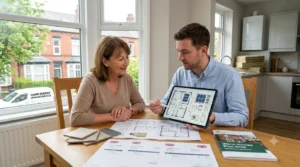
Solar panels, insulation, batteries and heat pumps can involve several contractors, different quotations and unfamiliar technical terminology.
The government’s 2026 Warm Homes Plan sets out major investment in improving UK homes, including grants, finance and measures intended to increase deployment of home-energy technology.
That creates a potential coordination opportunity.
Rather than carrying out installations, an independent project concierge could help homeowners organise surveys, compare quotations, create project timelines and keep paperwork together.
Minimum viable offer: an independent home-upgrade planning package.
Estimated startup cost: £500–£2,500.
Possible pricing: £300–£1,000+ depending on property size and project complexity.
Seven-day validation test: interview ten homeowners currently considering solar panels, insulation or heat pumps. Find out which part of the process they find hardest to understand.
First three customers: local homeowners already requesting contractor quotations are a stronger audience than cold prospects with no immediate upgrade plans.
Compliance: be extremely clear about the boundary between administrative/project support and technical, legal or financial advice. Do not advise on regulated credit without appropriate authorisation.
Biggest risk: becoming responsible in the customer’s mind for installation work performed by third-party contractors.
How it could scale: build a vetted local contractor network and standard project-management system.
5. Repair and Upcycling Collection-and-Return Service

A repair business becomes more convenient when customers do not have to find a specialist, travel to a workshop and collect the finished item themselves.
A collection-and-return model could specialise in furniture, lamps, small household items, bicycles or another repairable category.
The UK is also putting greater emphasis on circularity. Government guidance describes a circular economy as keeping resources at their highest value for longer through approaches including repair, refurbishment and reuse.
Minimum viable offer: collection, repair and return of one narrow product category.
Estimated startup cost: £500–£3,000 depending on tools and transport.
Possible pricing: £25–£50 collection fee plus the repair itself, or fixed packages such as £100–£300 for selected furniture restoration jobs.
Seven-day validation test: list five examples of repairable items with fixed prices in one local area and track enquiries before purchasing additional equipment.
First three customers: local neighbourhood groups, landlords and independent interior shops can provide early demand.
Compliance: insurance, safe electrical practices where applicable, waste rules and appropriate qualifications become more important depending on what is repaired.
Biggest risk: spending several hours repairing low-value items that customers are unwilling to pay enough to save.
How it could scale: specialise in higher-value categories, employ specialist repairers or create contracts with landlords and commercial customers.
6. Cargo-Bike Delivery for Independent High-Street Retailers

The previous version of this article suggested e-scooter rentals. That proposition carries a substantial regulatory complication.
Private e-scooters remain illegal to use on public roads, while legal rental operations are tied to government-authorised trial arrangements. The current rental e-scooter trials are due to continue until May 2028.
Cargo bikes offer a more practical proposition for an independent founder.
They are increasingly used for short urban freight journeys, and Transport for London has published dedicated guidance for businesses using cargo bikes for deliveries.
Minimum viable offer: same-day delivery for five independent retailers within a compact postcode area.
Estimated startup cost: approximately £750–£4,500 depending on whether the bike is rented, leased, purchased used or bought new.
Possible pricing: £5–£15 per local drop, higher prices for urgent or larger loads, or £200–£1,000+ monthly delivery agreements.
Seven-day validation test: speak to 20 florists, bakeries, pharmacies, boutiques and independent ecommerce businesses within a manageable radius. Ask how much they currently spend on local deliveries.
First three customers: target businesses with multiple short-distance deliveries rather than companies occasionally sending one parcel.
Compliance: ensure the cycle meets relevant electrically assisted pedal cycle requirements where applicable, obtain appropriate insurance, develop battery-charging procedures and train riders properly.
Biggest risk: poor route density. Travelling long distances for isolated low-value deliveries destroys the economics.
How it could scale: build neighbourhood micro-hubs and recurring multi-retailer delivery routes.
7. Returns Grading and Resale Service for Small Ecommerce Brands
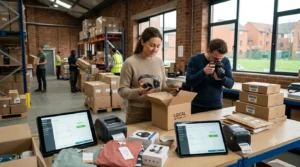
Returns can leave small online retailers with open-box, lightly used or imperfect stock that needs to be inspected, photographed, graded and resold.
Large retailers can maintain dedicated reverse-logistics teams. Smaller brands often cannot.
The opportunity is supported by the continuing scale of ecommerce. ONS figures showed that 28.3% of retail sales were made online in July 2026, while online spending remained higher than a year earlier.
A returns-processing company could receive returned products, check condition, photograph stock, grade it and prepare suitable inventory for resale through the retailer’s clearance channel or an approved marketplace.
Founders interested in online retail should also understand the broader operational requirements involved in starting an ecommerce business in the UK.
Minimum viable offer: process a batch of 25–50 returned items for one small brand.
Estimated startup cost: £500–£2,500.
Possible pricing: £3–£15 per item plus storage, photography or a percentage of recovered resale value.
Seven-day validation test: ask 20 ecommerce brands what currently happens to returned goods and how much employee time is spent processing them.
First three customers: apparel, accessories and homeware sellers with visible clearance or returned-stock activity.
Compliance: document grading criteria, consumer rights, product safety, ownership and handling of customer information.
Biggest risk: products with insufficient resale value to cover handling costs.
How it could scale: specialise by category, introduce inventory integrations and operate regional processing hubs.
8. Family Photo, Document and Digital-Legacy Archiving
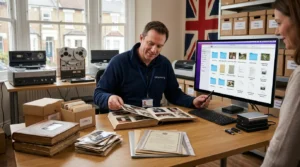
Many families have decades of photographs, letters, certificates and home videos stored across cupboards, phones, memory cards and cloud accounts.
The problem is not simply digitisation. It is organisation.
A family archiving service could collect physical material, scan it, create consistent file names, remove duplicates, organise folders and return both originals and an encrypted digital archive.
Minimum viable offer: digitise and organise one family photo box.
Estimated startup cost: £300–£1,500 for scanning hardware, storage, backup systems, insurance and secure transport equipment.
Possible pricing: £150–£1,000+ depending on the volume and restoration work involved.
Seven-day validation test: create a sample before-and-after archive using non-confidential material and offer five fixed-price pilot packages locally.
First three customers: target families organising estates, milestone birthdays, anniversaries or family-history projects.
Compliance: written privacy and retention rules are essential. Customers should know exactly where files are stored, who can access them and when working copies are deleted.
Biggest risk: loss or damage to irreplaceable originals.
How it could scale: add photo restoration, family books, genealogy organisation and annual digital-archive maintenance.
9. Accessible Website and Document Remediation for SMEs

Many businesses treat accessibility as a redesign project when smaller improvements can often remove significant barriers.
A specialist service could audit websites, forms and downloadable documents, then correct common issues involving navigation, contrast, headings, forms, alternative text and document structure.
The Equality Act requires service providers to consider reasonable adjustments for disabled customers, and government guidance specifically recognises accessible information and software among possible adjustments.
Minimum viable offer: a five-page website accessibility audit with a prioritised remediation list.
Estimated startup cost: £250–£1,500.
Possible pricing: £300–£1,200 for an audit, £750–£5,000+ for remediation and recurring monitoring retainers thereafter.
Seven-day validation test: manually review 20 local SME websites and send five businesses a short demonstration showing two or three genuine accessibility barriers.
First three customers: professional-service firms, ecommerce businesses, training providers and organisations publishing many PDFs are particularly practical targets.
Compliance: avoid promising guaranteed legal compliance unless qualified to make that assessment. Use recognised accessibility standards and document what has actually been tested.
Biggest risk: offering an automated scanner report without the expertise required to interpret it.
How it could scale: build recurring monitoring, staff training and accessible-document production into the service.
10. Pet-Enrichment and Senior-Pet Visit Memberships

A traditional pet-sitting business competes largely on availability and price.
A more distinctive proposition is a recurring membership designed around enrichment or older pets that need shorter but more frequent visits.
PDSA’s 2025 Animal Wellbeing research reported a record estimated UK dog population and highlighted continuing welfare challenges alongside the strong emotional importance owners place on their pets.
A service could offer sniff walks, structured play, feeding, mobility-friendly visits and owner updates.
Minimum viable offer: a 30-minute enrichment or senior-pet home visit.
Estimated startup cost: £200–£1,200.
Possible pricing: approximately £15–£35 per visit or £100–£300+ for recurring monthly packages.
Seven-day validation test: speak to 20 pet owners about situations where a standard dog walk does not meet their needs.
First three customers: older pet owners, commuters, hybrid workers and households with senior animals requiring daytime attention.
Compliance: appropriate insurance and animal-handling procedures are important. Additional licensing requirements can apply if the business expands into boarding, daycare or other regulated animal activities, so operators should check the official GOV.UK licence finder.
Biggest risk: expanding into clinical or veterinary advice without the required expertise.
How it could scale: recurring memberships, multiple carers and partnerships with independent pet businesses.
11. Screen-Free Corporate Micro-Retreats and Team Days

Remote team-building games are no longer unusual.
A more distinctive proposition is a deliberately screen-free, small-format company day designed for hybrid teams that spend much of their working week communicating digitally.
ONS research found that 28% of working adults in Great Britain were hybrid working between January and March 2025, showing how established mixed-location working has become.
A micro-retreat might combine outdoor problem-solving, analogue workshops, cooking, creative activities or facilitated planning without laptops or phones.
Minimum viable offer: a three-hour local programme for one team of six to twelve people.
Estimated startup cost: £400–£2,000.
Possible pricing: approximately £500–£2,500 per event depending on venue, catering and activities.
Seven-day validation test: create three sample programmes and pitch HR or operations managers at 20 local companies before paying for a permanent venue.
First three customers: businesses with hybrid professional teams are a stronger target than companies whose employees already spend every day together on-site.
Compliance: contracts, public liability insurance, risk assessments, venue requirements and food/allergy considerations need to be addressed.
Biggest risk: expensive venues can make a seemingly premium event surprisingly low margin.
How it could scale: repeat quarterly programmes, regional facilitators and standardised themed events.
12. Sustainability-Evidence Content Services for Small Exporters

Businesses increasingly publish claims about recyclable packaging, carbon reductions, responsible materials and sustainable sourcing.
The difficulty is ensuring the marketing claim can actually be supported.
The Competition and Markets Authority’s Green Claims Code states that environmental claims need credible evidence and must not mislead consumers. Updated CMA guidance published in 2026 also deals with responsibility for claims across supply chains.
A specialist content service could turn technical certificates, supplier questionnaires, test reports and environmental data into carefully evidenced web pages, product descriptions, tender documents and sales materials.
Minimum viable offer: evidence audit plus rewrite of one sustainability webpage.
Estimated startup cost: £250–£1,000.
Possible pricing: £500–£2,000+ per project or ongoing retainers for brands that frequently launch products or respond to tenders.
Seven-day validation test: identify 20 UK SMEs making broad environmental claims and offer five an evidence-gap review.
First three customers: manufacturers, exporters and ecommerce brands already making sustainability claims are more likely to understand the commercial value.
Compliance: this should not become a service for inventing green claims. Statements need evidence, and legal or technical review may sometimes be necessary.
Biggest risk: relying on a client’s marketing statement without checking the underlying evidence.
How it could scale: specialise by industry and build standard evidence-gathering workflows.
Which Unique Businesses Can Be Started for Under £500?
Several of these ideas can be tested for less than £500 when the founder already owns a laptop, smartphone or basic equipment.
The strongest candidates are:
AI-assisted administration for tradespeople: the founder mainly needs software skills and a way to demonstrate the workflow.
Older-adult technology support: equipment requirements are minimal because support usually uses the customer’s existing devices.
Accessibility audits: technically skilled founders can begin with browser tools and manual testing before purchasing more specialist software.
Sustainability-evidence content: suitable for people with strong research and B2B writing experience.
Family archiving: a small pilot can begin below £500 if existing scanning equipment is available.
Founders working with extremely limited capital may also want to compare other ways to start a business with little or no money and existing low-cost business ideas with high-profit potential.
Which Unique Businesses Can Be Started for Under £1,000?
A budget of £1,000 creates considerably more room.
Alongside the options above, founders could potentially test:
- EPR packaging-data support
- Pet-enrichment memberships
- A small repair collection service
- Sustainability compliance content
- A rented or leased cargo-bike delivery test
The important point is not to spend the entire £1,000 before demand has been tested.
A founder with £1,000 who spends £150 proving that customers will pay has a stronger starting position than someone who spends £1,000 building a polished brand without speaking to potential customers.
Which Unique Businesses Can Be Started for Under £5,000?
A £5,000 launch budget could potentially support more operational models including:
Cargo-bike delivery: especially where a suitable cargo bike can be leased or purchased used.
Ecommerce returns processing: where some secure workspace and storage is required.
Repair collection and return: where specialist tools or transportation are needed.
Home-energy project coordination: where professional insurance, training and specialist systems raise the entry cost.
Even at this level, founders should avoid assuming a larger budget automatically produces a better business. Checking whether a startup can realistically become profitable within its first year requires looking at margins and customer acquisition rather than startup spending alone.
Which Unique Businesses Are Best to Run From Home?
The strongest home-based choices are:
AI-assisted trade administration: almost the entire service can be delivered remotely.
Accessibility remediation: testing, development and reporting can usually be completed online.
Sustainability-evidence content: highly suitable for a home office.
EPR packaging-data administration: most client work involves spreadsheets, records and supplier communication.
Family archive processing: potentially home-based where valuable client materials can be stored securely.
For more conventional options, there are also several work-from-home business models that do not require customer premises.
Which Unique Businesses Are Best for Local Customers?
Local service models work particularly well where trust, logistics or physical visits form part of the competitive advantage.
Older-adult technology support, pet-enrichment memberships, cargo-bike delivery, repair collection, home-energy coordination and corporate micro-retreats all benefit from a defined geographic territory.
A founder might initially serve only two or three adjoining postcode districts. Concentration can make marketing, travel and word-of-mouth considerably more efficient.
Which Unique Businesses Are Best to Operate Online?
The strongest online options are EPR administration, AI trade workflows, accessibility remediation and sustainability-evidence content.
Returns processing is technically a hybrid model because customer acquisition and account management can happen online while physical stock must still be processed somewhere.
These models can eventually sell nationally without the founder travelling to every client.
How Can a Business Idea Be Validated in Seven Days?
A seven-day validation test should answer one question:
Will a specific customer take a meaningful action because this problem matters to them?
Likes and compliments are weak evidence. Calls, deposits, booked trials and paid pilot projects are stronger.
Day 1: Define One Customer
Avoid “small businesses”, “pet owners” or “online retailers”.
Choose a narrower segment such as:
“Independent Shopify skincare brands shipping more than 500 orders per month.”
Day 2: Define the Expensive Problem
Identify what the customer is losing through the problem.
That could be time, sales, returned inventory, missed enquiries, regulatory risk or unnecessary operational cost.
Day 3: Interview Five Potential Buyers
Do not begin by pitching.
Ask how the customer currently handles the problem, what it costs, what they dislike and whether they have tried to solve it before.
Day 4: Build the Minimum Offer
Create the smallest service someone could buy.
Do not build a full platform if a spreadsheet and manual service can test the same assumption.
Day 5: Set a Real Price
Free trials can produce misleading validation because people readily accept products they would never purchase.
Charge something.
Even a discounted pilot provides stronger evidence than dozens of positive comments.
Day 6: Make 20 Direct Offers
Contact twenty tightly matched prospects.
Record replies, calls booked, objections and purchases.
Day 7: Decide Whether to Continue
The result does not need to be “launch” or “abandon”.
A founder might instead discover that:
- the customer is wrong;
- the problem is real but not urgent;
- pricing is too high;
- the offer is too broad;
- another buyer has much stronger demand.
That is useful information.
The same evidence should eventually feed into the founder’s business planning process rather than relying entirely on theoretical financial forecasts.
How Can Founders Win Their First Three Customers?
The first customers usually require a different strategy from customer number 300.
At the beginning there is little brand awareness, few reviews and limited proof.
The fastest route is often direct access to a narrow market.
For a local business, that could mean visiting relevant companies personally.
For a B2B online service, founders can identify 50 ideal companies and write individually to decision-makers.
For a consumer service, partnerships may work better. A pet service could work with independent pet shops, while an older-adult technology service might build relationships with community organisations.
The first three customers should also produce learning.
Ask what made them buy, what nearly stopped them and what they would change.
Their language can then improve the offer and future marketing.
What UK Startup and Compliance Checks Should Be Completed?
Business regulation depends on the activity rather than simply whether a founder calls the company a “startup”.
Before trading, check the following areas.
Business structure: decide whether operating as a sole trader, partnership or limited company is appropriate. Founders choosing incorporation can review the process for setting up a limited company in the UK.
HMRC states that a sole trader generally needs to register for Self Assessment where gross trading income exceeds £1,000 in a tax year, subject to the detailed rules and exceptions. Check current requirements directly through GOV.UK sole trader guidance.
Licences: search the GOV.UK licence finder because requirements vary substantially by activity and location.
Insurance: public liability, professional indemnity, employer’s liability, vehicle, cyber or specialist cover may be appropriate depending on the model.
Data protection: businesses storing customer names, addresses, photographs, account details or other personal information should understand their UK GDPR responsibilities and check whether an ICO data protection fee applies.
Consumer rights: businesses selling to consumers should have appropriate contracts, cancellation procedures, refund processes and terms.
Food businesses: anyone adapting these concepts to include preparing, selling, storing or distributing food should check registration requirements.
GOV.UK states that applicable food businesses in England, Wales and Northern Ireland must generally register at least 28 days before trading, including businesses operating from home or online.
Financial services: founders should be extremely cautious about financial advice, investments, credit and other regulated activities. The FCA states that firms must not start regulated activities while awaiting authorisation unless an exemption or applicable temporary permission exists.
Check the FCA authorisation requirements before building a product that could enter the regulatory perimeter.That is why this updated list does not recommend an “AI financial advice app” as a straightforward beginner business.
What Common Mistakes Make Unique Business Ideas Fail?
Treating a Trend as a Business Model
“AI”, “sustainability” and “wellness” are not customers.
The founder still needs to identify who pays, what they buy and why they would choose this company.
Spending Before Validating
Web development, branding, equipment and premises can create the feeling of progress without proving demand.
Test the riskiest assumption first.
Starting Too Broadly
A company offering “AI automation for all SMEs” must compete with thousands of agencies.
“Quoting and follow-up automation for independent plumbing companies” is much easier for the customer to understand.
Copying Competitor Pricing
Two businesses offering apparently similar services may have completely different costs.
Calculate delivery cost, gross margin and customer acquisition before settling on a price.
Ignoring Recurring Revenue
One-off projects can work, but continually replacing every customer makes growth difficult.
Maintenance, memberships, repeat visits and retainers can make revenue more predictable where they genuinely add customer value.
Ignoring Regulation Until Launch
Finding out after spending £10,000 that an activity requires a licence, authorisation or specialist qualification can destroy the economics of the idea.
Check before investing.
Confusing Revenue With Profit
A £1,000 sale does not produce £1,000 of profit.
Equipment, payment fees, fuel, software, subcontractors, insurance, refunds, marketing and taxes still matter.
Which Unique Business Idea Should a Founder Choose?
The strongest business is not necessarily the most unusual idea on this list.
Choose the opportunity where three factors overlap:
Founder advantage: existing skills, professional experience, contacts or assets.
Customer pain: a narrow audience already experiences the problem frequently enough to care.
Economic viability: customers can pay enough to cover the real cost of solving it.
A founder with ten years of ecommerce operations experience may have an unfair advantage in returns processing.
A web developer may be better positioned to build an accessibility-remediation service.
Someone trusted within a local community could potentially build older-adult technology support more easily than a national technology platform.
The purpose of validation is to discover that fit before taking a large financial risk.
What Is the Best Unique Business to Start in the UK?
There is no single best business for every founder, but AI-assisted administration for tradespeople, accessibility remediation, EPR packaging support and sustainability-evidence services currently combine relatively low startup costs with identifiable B2B customers and potential recurring revenue.
The better choice depends on the founder’s skills and access to customers.
What Business Can Be Started With £1,000 in the UK?
AI administration, older-adult technology support, EPR data services, accessibility auditing, pet visits and sustainability content can potentially be tested for less than £1,000.
Avoid spending the full budget until real customers have shown interest.
Which Unusual Business Can Be Run From Home?
Accessibility remediation, AI workflow setup, EPR packaging administration and sustainability-evidence content are among the strongest home-based options because most work can be delivered digitally.
Family archive processing can also operate from home where secure storage and privacy controls are suitable.
How Can Someone Know Whether a Business Idea Has Demand?
Speak directly to the intended customer before launching.
Find out how they currently solve the problem, what they spend and whether they are willing to book or pay for a small pilot.
Search volume and industry reports can support the decision, but actual buyer behaviour is stronger evidence.
Which Business Ideas Can Generate Recurring Revenue?
AI administration support, EPR data management, pet memberships, cargo-bike contracts, accessibility monitoring and sustainability content retainers all have realistic recurring-revenue possibilities.
Recurring billing only works when the customer continues receiving measurable value.
What Is the Fastest Business to Start?
Skill-based businesses generally launch fastest because they need little equipment or inventory.
A founder who already understands web accessibility, AI workflows or B2B content could potentially begin contacting customers within a day and close a first pilot within a week.
Does Someone Need to Register as a Sole Trader?
A person can begin trading without immediately registering as a sole trader, but HMRC says registration for Self Assessment is generally required when gross self-employment income exceeds £1,000 in a tax year, subject to the detailed rules.
Check the current GOV.UK requirements for the founder’s specific situation.
How Can a Founder Check Whether a Business Needs a Licence?
Use the GOV.UK licence finder and check requirements with the relevant local authority or regulator.
Licensing depends on the activity. Animal boarding, food businesses, transport activities and regulated professional services can have very different requirements.
Final Thoughts
A unique business idea is valuable only when uniqueness makes the company easier to buy from rather than merely more interesting to describe.
For a founder in 2026, the strongest approach is to choose a narrow customer, identify an expensive problem, build the smallest viable solution and attempt to sell it before making a large investment.
The 12 opportunities above are not guaranteed businesses. They are testable propositions.
That distinction matters.
The founder who spends seven days discovering that customers will not pay has lost a week.
The founder who spends six months building something nobody wants may lose considerably more.
Start with evidence, validate with real customers, understand the regulations and only then decide whether the idea deserves serious capital.