


Yes, in many cases you can pay money into your bank account via the Post Office, provided your bank and account support the service. Most major UK banks allow customers to deposit cash at thousands of Post Office branches, usually using a debit card, PIN or bank-issued paying-in method.
However, the rules are not identical for every bank. Deposit limits, fees, cheque facilities and processing times can all vary, so it is worth checking your bank’s specific terms before carrying a large amount of cash to the counter.
How Does Paying Cash Into Your Bank Account at the Post Office Work?
Paying cash into your account at the Post Office is usually similar to making a deposit at a bank counter, although the Post Office is processing the transaction on behalf of your bank.
For most personal accounts, you will need:
- Your debit card
- Your PIN, where your bank requires it
- The cash you want to deposit
- A paying-in slip or barcode if your bank uses one
At the counter, tell the member of staff that you want to make a bank deposit. They will process the cash using the method approved by your bank and give you a receipt.
Keep that receipt at least until you have confirmed that the money has appeared correctly in your account.
The official Post Office everyday banking service currently supports everyday banking for customers of numerous personal and business account providers across the UK.
The important point is that the Post Office does not decide your banking rules. Your own bank determines which transactions are available, how much cash you can deposit and whether you need a card, PIN, barcode or paying-in slip.
Which Banks Let You Pay Cash In at the Post Office?
Most of the UK’s largest banks participate in Post Office banking, but participating does not necessarily mean every service is available.
As of August 2026, this is how cash and cheque deposits work for several widely used personal banking providers:
| Bank | Cash Deposit at Post Office | Cheque Deposit at Post Office |
| Barclays | Yes | Yes |
| Bank of Scotland | Yes | No |
| First Direct | Yes | Yes |
| Halifax | Yes | No |
| HSBC | Yes | Yes |
| Lloyds Bank | Yes | No |
| Monzo | Yes | No |
| Nationwide | No | No |
| NatWest | Yes | Yes |
| Royal Bank of Scotland | Yes | Yes |
| Santander | Yes | Yes |
| Starling Bank | Yes | No |
| TSB | Yes | Yes |
| Virgin Money | Yes | Yes |
| Co-operative Bank | Yes | Yes |
This list is useful for comparison but should not be treated as permanent. Banks can change their Post Office arrangements, deposit limits or account eligibility.
One particularly important distinction is Nationwide. Nationwide customers can currently use Post Office branches for certain services such as withdrawing cash and checking their balance, but Post Office cash and cheque deposits are not currently supported.
Digital banks should not automatically be assumed to lack Post Office facilities either. Both Monzo and Starling Bank currently allow cash deposits through Post Office branches, although their fees and limits differ from those of many traditional high-street banks.
How Do I Pay Cash Into My Bank Account at the Post Office?
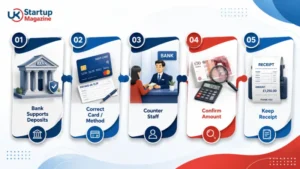
For most people, the actual transaction takes only a few steps.
1. Check Your Bank Supports Cash Deposits
Before travelling, check your bank’s website or the Post Office banking service list.
This becomes particularly important if you have a savings account, specialist account or an account with a provider that only offers selected Post Office services.
2. Take the Correct Bank Card or Paying-In Method
Most personal customers deposit cash using their debit card.
Some banks also support:
- Bank-issued deposit cards
- Barcoded paying-in slips
- Personalised paying-in slips
- App-generated or bank-provided deposit methods
Do not assume that simply knowing your sort code and account number will be enough.
3. Hand the Cash to the Counter Staff
Tell the member of staff how much you want to deposit.
Depending on your bank, you may then be asked to insert your debit card and enter your PIN. Some providers use a slightly different process. Monzo, for example, currently allows Post Office deposits using the customer’s card without requiring the PIN during the deposit process.
4. Check the Amount Before Confirming
Make sure the amount shown matches the cash you handed over.
This is especially important when depositing business takings or a mixture of notes and coins.
5. Keep Your Receipt
The Post Office will provide a transaction receipt.
Do not throw it away immediately. Keep it until the transaction is visible in your account and you have confirmed that the deposited amount is correct.
How Much Cash Can I Pay Into My Bank Account at the Post Office?
There is no single Post Office cash deposit limit that applies to every personal bank account.
Your bank sets its own limits, which may include:
- A per-transaction maximum
- A daily maximum
- A monthly maximum
- An annual or rolling 12-month maximum
- A separate limit for coins
That means two customers standing at the same Post Office counter could have completely different deposit limits because they bank with different providers.
Here are some current examples for personal accounts:
| Bank | Example Post Office Cash Deposit Limits |
| Barclays | Up to £3,000 per transaction and £10,000 a year through Post Office branches, subject to wider cash-deposit limits |
| Lloyds Bank | Up to £2,995 per month and £20,000 per year |
| NatWest | £3,000 per day and £24,000 over a rolling 12 months |
| Starling Bank | Generally up to £1,000 per day and £5,000 per calendar year for personal/joint accounts |
| Monzo | Up to £750 per month, with up to £750 deposited in one Post Office transaction |
These figures demonstrate why advice such as “the Post Office limit is £3,000” can be misleading. The correct limit depends on your bank and account.
Banks can also adjust individual limits or introduce additional controls, particularly where unusually high volumes of cash are being deposited.
Does the Post Office Charge for Paying Cash Into a Bank Account?
The Post Office itself does not normally add a counter charge simply for processing an eligible bank cash deposit.
However, your bank may charge you.
This distinction matters particularly for:
- Business bank accounts
- Sole trader accounts
- Digital banking accounts
- Accounts with cash handling charges
For example, Monzo currently charges many customers £1 per cash deposit, although customers on certain paid plans receive a number of free deposits each calendar month.
Starling’s personal and joint customers can currently deposit up to £1,000 in cash per calendar year without a deposit charge, after which a 0.7% charge applies to further eligible deposits up to the account’s limit.
Business banking fees can be different again.
Always check your account’s current tariff rather than assuming a Post Office cash deposit will automatically be free.
How Long Does a Post Office Cash Deposit Take to Reach Your Bank Account?
The method used to make the deposit usually determines how quickly the money becomes available.
The Post Office states that cash deposits made using a bank card will normally show in the account on the same day.
Deposits made using a paying-in slip will normally appear later, often by the next working day, although your bank’s processing arrangements and the branch cut-off time can affect this.
For example, NatWest currently states that cash deposited using a debit card and PIN is credited immediately. Cash deposited using a paying-in slip before the Post Office cut-off is normally credited by the end of the following working day.
Depositing after a branch’s cut-off time can add another working day.
Therefore, if the money is needed urgently for an upcoming Direct Debit, standing order or card payment, depositing by debit card where supported is normally preferable to relying on a paper paying-in slip.
Can I Pay Coins Into My Bank Account at the Post Office?
Yes, many participating banks allow customers to deposit coins, but coin rules can be stricter than rules for banknotes.
Banks may require lower-denomination coins to be placed into full coin bags.
Some banks also impose a maximum coin value per transaction. Lloyds and Starling, for example, currently apply restrictions to the amount of coins that can be deposited through the Post Office.
If you have accumulated a large jar of coins or have substantial cash takings containing change, contact your bank or Post Office branch before visiting.
Preparing the coins correctly can prevent the deposit from being delayed or declined.
Can I Pay a Cheque Into My Bank Account at the Post Office?
Many banks allow cheque deposits through Post Office branches, but cheque facilities are less universal than cash deposits.
Banks including Barclays, HSBC, NatWest, Santander, TSB, First Direct and Royal Bank of Scotland currently offer Post Office cheque deposits.
Others do not. For example, Lloyds, Halifax, Starling, Monzo and Nationwide do not currently offer Post Office cheque deposits for their standard personal banking services.
Where your bank supports the service, you will normally need:
- The cheque
- A personalised paying-in slip
- Your sort code and account number
- A bank-branded cheque deposit envelope
Post Office branches have envelopes available for many participating banks.
Place the cheque and paying-in slip inside the correct envelope, seal it and hand it over at the counter. You should receive a receipt that should be kept until the cheque has been credited.
The Post Office’s official cheque deposit guidance says most cheques take around two to three working days to clear, although the precise timetable depends on the bank and when it receives the cheque.
Can Someone Else Pay Cash Into My Bank Account at the Post Office?
You should not assume another person can pay cash into your account simply by providing your bank details.
Many cash deposits require the account holder’s debit card, PIN or bank-issued deposit credentials. Banks may also restrict third-party cash deposits for security and financial-crime prevention purposes.
Rules can differ for business accounts, where authorised employees may sometimes be able to deposit takings using a business deposit card or barcoded paying-in slip.
If another person needs to deposit cash for you, check with your bank first.
A safer alternative may be for them to deposit the money into their own account and make a bank transfer, where appropriate.
Can Businesses Pay Their Takings Into the Post Office?
Yes. Post Office banking is particularly important for UK businesses that still receive substantial amounts of cash.
Retailers, cafés, tradespeople, market sellers and other small businesses can use participating Post Office branches to deposit business takings where their bank supports the service.
Business customers may need:
- A business debit card
- A business deposit card
- A barcoded paying-in slip
- A personalised paying-in slip
Deposit limits and charges can be significantly different from those applied to personal customers.
The Post Office also states that the amount a branch can physically accept may depend on its counter configuration. For business cash deposits, open-plan counters may have a lower maximum transaction capacity than counters protected by a glass screen.
Businesses depositing substantial amounts regularly should therefore speak to their bank and local branch rather than arriving unexpectedly with a large cash sum.
This has become more relevant as traditional branches disappear from many UK towns. Our coverage of UK bank branch closures in 2026 shows why alternative face-to-face banking facilities have become increasingly significant for households and small businesses.
Why Can So Many Banks Be Used at the Post Office in 2026?
The system operates through an arrangement between the Post Office and UK banks and building societies rather than the Post Office offering its own current accounts.
The latest agreement is known as Banking Framework 4.
It runs from January 2026 until December 2030 and provides continued access to everyday banking services through the Post Office network.
According to Post Office information on Banking Framework 4, customers of 30 participating banks and building societies can use Post Office services including cash deposits, cash withdrawals, cheque deposits and balance enquiries, subject to the services supported by their individual provider.
The Post Office operates a network of more than 11,500 branches across the UK.
That extensive network has become increasingly important as high-street banks reduce their physical branch estates.
What Is the Difference Between a Post Office and a Banking Hub?
A normal Post Office branch mainly handles routine transactions on behalf of participating banks.
This can include:
- Depositing cash
- Withdrawing cash
- Paying in eligible cheques
- Checking an account balance
A Banking Hub goes further.
Banking Hubs are shared banking locations operated in communities where access to traditional branches has reduced. Customers of different banks can carry out everyday transactions, while representatives from individual banks attend on scheduled days.
That means a Banking Hub may be more useful when you need bank-specific face-to-face assistance rather than simply depositing cash.
However, neither a Post Office nor a Banking Hub should be treated as a complete replacement for every service provided by a traditional bank branch.
Services such as opening some accounts, detailed lending discussions, complex fraud cases or specialist financial advice may still need to be handled directly by your bank.
Why Might a Post Office Cash Deposit Be Refused?
A deposit can sometimes be declined even if your bank normally supports Post Office banking.
Common reasons include:
- You have reached your bank’s daily or annual cash deposit limit
- Your account is not eligible for that particular service
- Your card cannot be used for Post Office deposits
- The branch cannot safely accept the amount of cash presented
- The coins have not been prepared correctly
- Your bank requires a different paying-in method
- Additional security checks are required
Do not repeatedly attempt to split a rejected large cash deposit into smaller transactions to get around your bank’s limits.
Instead, contact the bank and ask why the transaction was declined and what deposit method should be used.
What Are the Alternatives If I Cannot Deposit Money at the Post Office?

If your account does not support Post Office deposits, several other options may be available.
Bank Branch
If your bank still operates a nearby branch, you may be able to pay cash directly over the counter.
Cash Deposit Machine
Some banks provide cash deposit machines in branches, Banking Hubs or self-service locations.
PayPoint
Some digital providers support cash deposits through PayPoint shops. Monzo, for example, currently supports both PayPoint and Post Office cash deposits, although different transaction limits apply.
Bank Transfer
If the money is already held electronically in another account, a Faster Payment or internal bank transfer is usually easier than withdrawing and redepositing cash.
Mobile Cheque Deposit
If you are trying to pay in a cheque rather than cash, check your bank’s mobile app. Many banks now allow eligible cheques to be deposited by photographing them.
Is Paying Money Into Your Bank Account at the Post Office Safe?
Post Office banking is an established service provided in partnership with participating banks.
However, normal banking precautions still apply.
Before leaving the counter:
- Check that the deposit amount is correct
- Take your debit card back
- Collect your transaction receipt
- Avoid displaying large amounts of cash unnecessarily
- Confirm the deposit appears in your account
- Contact your bank if anything looks incorrect
For larger business deposits, it can also be sensible to check in advance whether your chosen branch can safely process the amount.
Conclusion
So, can I pay money into my bank account via the Post Office? For customers of most major UK banks, the answer is yes.
Cash deposits are widely available through Post Office branches and, when processed using a debit card, often appear in the account immediately or on the same day.
The main thing to remember is that your bank sets the rules, not the Post Office. Deposit limits, fees, cheque facilities and the documents required can differ considerably between providers.
Check your bank before making a large deposit, take the correct card or paying-in documentation and keep your receipt until the transaction has cleared.
With Banking Framework 4 now running until the end of 2030, Post Office banking remains an important way for individuals and small businesses to access everyday banking services even when their nearest traditional bank branch is no longer convenient.
Frequently Asked Questions
Can I Pay Cash Into Any Bank Account at the Post Office?
No. Your bank and account must support Post Office cash deposits. Most major UK banks participate, but services vary between providers and account types.
How Quickly Does Cash Paid Into the Post Office Reach My Account?
Cash deposited using a debit card normally appears on the same day and may be credited immediately. Paying-in-slip deposits can take until the next working day or longer depending on cut-off times.
Can I Deposit £5,000 Cash at the Post Office?
It depends on your bank and account. Many personal accounts have limits below £5,000 per transaction or per day, so check your bank’s current cash deposit limit first.
Can I Pay Cash Into a Nationwide Account at the Post Office?
No. As of August 2026, Nationwide’s Post Office personal banking service supports withdrawals and balance enquiries but not cash or cheque deposits.
Can I Pay Cash Into Monzo at the Post Office?
Yes. Monzo currently supports Post Office cash deposits. Personal customers can deposit up to £750 per month, although fees can apply depending on the account plan.
Do I Need My Bank Card to Pay Cash In at the Post Office?
Usually, but not always. Many banks require a debit card and PIN, while others support deposit cards, barcoded slips or personalised paying-in slips.
Does the Post Office Charge for Cash Deposits?
The Post Office does not normally charge you directly at the counter, but your bank may apply a cash-deposit fee depending on your account and the amount deposited.