

Changing a company name through Companies House is relatively straightforward, but the legal registration is only one part of the process.
Shareholder approval, company naming regulations, trademark protection, banking arrangements and customer communications can all influence how smoothly the change takes place.
For UK limited companies, the standard online name-change filing currently costs £20, while postal applications cost £30.
Businesses needing the faster same-day registration service pay £85, subject to the service’s availability and processing requirements.
The most important point is that a company does not become a new legal entity simply because its registered name changes. Its company registration number remains the same, and its existing legal obligations continue.
Our analysis approaches the process from both a legal-compliance and business-finance perspective. We examine how directors can complete the filing, how shareholders should authorise the change, what expenses to anticipate and which operational mistakes can cause unnecessary disruption.
What Does Changing a Company Name at Companies House Mean?
A company name change is the formal process of replacing the registered legal name of an existing company on the Companies House register.
For example, suppose a company registered as Brighton Digital Solutions Ltd decides to operate under the name Brighton Technology Group Ltd.
The directors cannot complete the legal change simply by updating the website, changing the logo or informing customers.
The company must follow the appropriate approval process and register the new name with Companies House.
Once Companies House approves the application and issues the certificate of incorporation on change of name, the new name becomes legally effective.
The important distinction is between a change of legal identity details and the creation of a new legal entity.
| Company information | What happens after a name change? |
| Registered company name | Changes |
| Company registration number | Remains unchanged |
| Date of incorporation | Remains unchanged |
| Existing contracts | Continue to apply |
| Company assets and liabilities | Remain with the company |
| Shareholders | Remain unchanged unless separately altered |
| Directors | Remain unchanged unless separately altered |
| Corporation Tax UTR | Normally remains unchanged |
| VAT registration | Normally continues for the same legal entity |
| Companies House filing history | Remains associated with the company |
This legal continuity is especially important for businesses with existing customers, employees, investors, loans and long-term supplier agreements.
A name change alone does not automatically transfer assets, remove debts or create a new business.
Why Do UK Businesses Change Their Company Names?
Companies change their registered names for commercial, organisational and legal reasons.
The decision may be part of a planned growth strategy or a necessary response to a business problem.
Rebranding and Business Expansion
One common reason is that the existing company name no longer reflects the products or services the business provides.
Imagine a company originally established to offer website design services. Over several years, it expands into cybersecurity, artificial intelligence and enterprise software.
A name focused exclusively on website design may become restrictive.
Changing the name can create a broader corporate identity that better represents the company’s direction.
However, directors should distinguish between changing the registered legal name and simply introducing a new trading brand. A trading-name change may achieve the marketing objective without requiring a Companies House name-change filing.
Mergers, Acquisitions and Changes in Ownership
A company may adopt a new name following an acquisition, merger or restructuring.
For example, an acquiring business might want its newly purchased subsidiary to use a name consistent with the wider group.
The new identity can improve consistency across marketing, corporate communications and customer-facing operations.
Nevertheless, the name change itself does not merge legal entities or alter ownership arrangements. Those transactions require their own documentation and procedures.
Trademark Disputes or Naming Conflicts
Some companies discover that their registered name conflicts with an existing trademark or another organisation’s commercial rights.
This can create legal exposure, particularly when both businesses operate in similar sectors.
Changing the company name may help resolve the dispute, although an assessment of trademarks, trading names and domain rights is still necessary.
Correcting an Unsuitable Business Name
A name may be difficult to pronounce, too geographically specific, misleading about the company’s activities or simply unsuitable for a new commercial strategy.
For startups, correcting such problems early can be substantially less disruptive than waiting until the company has developed a large customer base.
Our assessment is that businesses should change their legal name only when there is a clear strategic, commercial or legal benefit that justifies the transition.
What Are the Companies House Requirements for Changing a Company Name?
Under the Companies Act 2006, a company can generally change its name using one of two mechanisms:
- A special resolution passed by its members.
- Another method expressly permitted by its articles of association.
The correct procedure depends on the company’s constitution and the authority granted to its shareholders or directors.
Shareholder Approval Through a Special Resolution
For many private limited companies, the standard route is a special resolution approved by at least 75% of the relevant voting rights.
This does not necessarily mean that 75% of the individual shareholders must agree.
Voting power depends on the company’s share structure, the voting procedure and its articles.
Consider a company with 100 ordinary shares carrying equal voting rights.
- Shareholder A owns 60 shares.
- Shareholder B owns 25 shares.
- Shareholder C owns 15 shares.
If A and B vote in favour, they hold 85% of the voting rights and can ordinarily satisfy the 75% special-resolution threshold.
If only A votes in favour, 60% would not be sufficient in a written resolution requiring approval from 75% of eligible voting rights.
At a general meeting, the calculation depends on the applicable voting procedure, including whether the vote is conducted by a show of hands or a poll.
For businesses with multiple shareholders, checking the voting rights before circulating a resolution can prevent disputes or filing delays.
Can Directors Change the Company Name Without Shareholder Approval?
Potentially, yes.
Some companies have articles of association containing specific provisions that permit directors to authorise a name change without obtaining a separate special resolution from members.
In those circumstances, the company may use Form NM04 instead of Form NM01.
However, directors should not assume that their general management authority automatically gives them permission to rename the company.
The articles must provide a valid basis for the alternative procedure.
Is There a Filing Deadline?
Special resolutions that must be filed with Companies House generally need to be delivered within 15 days of being passed.
The company should therefore prepare the resolution and name-change application as part of a coordinated process rather than approving the decision and leaving the filing until much later.
How to Change Company Name Companies House Online?
For a straightforward name change authorised by a special resolution, online filing is normally the most convenient option.
Our recommended process contains six stages.
Step 1: Check Whether the New Company Name Is Available
Before circulating a resolution or investing in new branding, confirm that the proposed name meets Companies House requirements.
Start with the official company name availability checker and search for the exact name you want to register.
Companies House has rules concerning names that are identical to existing registered names, or considered too similar to them.
Differences in punctuation, certain common words or spelling may not always make a proposed name sufficiently distinctive.
A name may also be rejected if it is offensive, misleading or includes a restricted expression without the necessary permission.
For example, words suggesting government connections or particular professional credentials can require additional scrutiny.
A successful availability search is useful, but it is not a final guarantee that the name will be accepted.
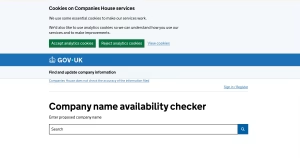
Companies House company name availability checker, showing where business owners enter a proposed name before submitting an application.
Step 2: Check Trademark and Brand Availability
A name that is available at Companies House is not necessarily safe to use commercially.
Company name registration and trademark protection serve different purposes.
Registering a company name does not automatically give the business exclusive trademark rights over that name.
Before proceeding, check the UK Intellectual Property Office’s trademark search service for identical or similar marks, particularly in the relevant classes of goods or services.
Businesses should also review domain-name availability, existing trading names and established brands operating in their industry.
For example, a proposed company name might not appear on the Companies House register but could already be associated with a protected brand.
The financial exposure could include legal fees, rebranding expenses and the loss of marketing materials that have already been produced.
Step 3: Obtain the Appropriate Company Approval
Once the proposed name has passed the preliminary checks, obtain approval under the company’s governing documents.
For the special-resolution route, the resolution should identify the existing company and clearly state the proposed registered name.
A straightforward example would be:
Special Resolution
“That the name of the Company be changed from Brighton Digital Solutions Ltd to Brighton Technology Group Ltd.”
The resolution should be properly approved and recorded in accordance with the applicable statutory procedure and the company’s articles.
Where members approve the resolution in writing, maintain the appropriate records of their consent.
Where the decision is made at a general meeting, retain the meeting documentation and voting record.
The company should preserve these governance records rather than treating the approval as an informal agreement between directors.
Step 4: Prepare Form Nm01 and Supporting Documents
Form NM01 is used to notify Companies House of an unconditional company name change authorised by resolution.
The information required includes:
- Existing registered company name.
- Company registration number.
- Proposed new registered name.
- Authentication by an authorised person.
- Supporting resolution where required.
The proposed name on the application must correspond with the name approved in the resolution.
A mismatch in spelling or company-name endings could delay the registration.
Companies House provides the official NM01 form and online filing information.
Businesses using the online service complete the relevant filing screens rather than simply emailing a paper form to Companies House.
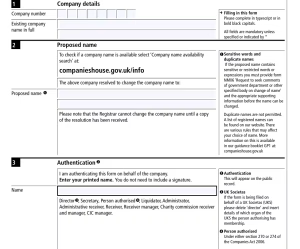
Official Companies House Form NM01, showing the company details, proposed company name and authentication sections.
Step 5: Submit the Company Name Change Online
To submit a standard name change authorised by special resolution:
- Visit the official Companies House WebFiling service.
- Sign in using the relevant account credentials.
- Access the correct company using its company registration number and authentication code.
- Select the option to change the company name.
- Enter the proposed name and resolution details.
- Review the filing and complete the relevant declarations.
- Select the available filing service and pay the applicable fee.
- Retain the submission confirmation.
Companies House may require identity verification through GOV.UK One Login as part of the filing arrangements. The exact sign-in and verification steps depend on the service and the user’s circumstances.
The standard online filing fee is £20.
Businesses requiring same-day processing can select that service where available and where the submission satisfies the relevant requirements.

Official Companies House online filing service used to submit a company name change following a special resolution.
Step 6: Wait for the Certificate of Incorporation on Change of Name
Submitting the application does not immediately make the new name legally effective.
Companies House must accept the filing, register the new name and issue the appropriate certificate.
The certificate confirms the company’s new registered name and the effective date of the change.
For online filings, it is normally provided electronically when the application is accepted.
Keep a copy with the company’s statutory and corporate records.
The existing incorporation history remains intact.
The certificate confirms that the existing company has changed its registered name; it does not establish an entirely new company.
How Much Does It Cost to Change a Company Name at Companies House in 2026?
The government filing fee depends on the submission method and the service selected.
The current Companies House fees are:
| Filing method | Companies House fee | Main consideration |
| Standard online filing | £20 | Generally the best-value route |
| Same-day digital filing | £85 | Suitable where faster registration is essential |
| Paper filing | £30 | Used for postal applications and applicable filing routes |
These are government filing charges, not prices charged by accountants, solicitors or company formation agents.
The official Companies House fee schedule confirms these amounts.
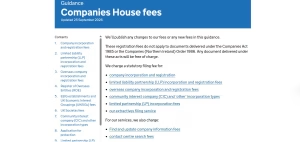
Companies House official 2026 fee schedule showing the £20 standard online filing fee, £85 same-day service and £30 paper filing fee for company name changes.
Which Filing Method Offers the Best Value?
Standard online filing costs £10 less than postal filing.
That represents a 33.3% saving compared with the £30 paper fee.
The £85 same-day option costs £65 more than standard online filing, representing a 325% premium over the normal £20 charge.
Consequently, same-day filing should primarily be considered where the timing has genuine commercial importance.
For instance, a business might require the new registered name before a contractual completion date, investment transaction or planned corporate announcement.
Where no such deadline exists, standard digital filing is generally more economical.
Our Editorial Assessment of Each Filing Method
The following ratings reflect our assessment of cost, convenience and suitability for typical small businesses. They are editorial ratings, not government performance statistics or measured customer satisfaction scores.
| Filing method | Our overall value rating | Assessment |
| Standard online | 95% | Lowest cost and straightforward for eligible filings |
| Same-day digital | 80% | Useful for urgent registration but significantly more expensive |
| Paper submission | 65% | Appropriate for required postal routes but less convenient |
The cheapest route is not always appropriate for every company. For example, a business using a name-change procedure authorised by its articles may need a different filing route.
Can You Change a Company Name Using Form NM04?
Yes. Form NM04 applies where a company changes its name using a method permitted by its articles of association rather than the standard shareholder special-resolution process.
This distinction is particularly relevant for companies with bespoke governance arrangements.
| Feature | Form NM01 | Form NM04 |
| Main purpose | Change of name by special resolution | Change of name by means permitted in the articles |
| Shareholder special resolution | Required for this route | Not necessarily required |
| Online WebFiling | Available for eligible filings | Not available through standard WebFiling |
| Standard paper fee | £30 | £30 |
| Key supporting requirement | Appropriate special resolution | Valid authority under the articles |
Companies House guidance indicates that NM04 may also be supported through compatible software filing arrangements, while the standard WebFiling name-change service is designed for NM01.
Directors should inspect their company’s articles before choosing either form.
An incorrect filing route can create delays and governance problems.
Do You Need to Update the Articles of Association After Changing a Company Name?
Not every company needs to amend its articles simply because the registered name changes.
For companies using standard model articles that do not contain provisions requiring amendment, a separate alteration to the articles may not be necessary.
However, bespoke articles sometimes expressly identify the company by name or contain provisions connected to its identity, group structure or particular business activities.
Where the name change creates an inconsistency with those provisions, legal or company-secretarial review may be appropriate.
If the articles themselves are amended, the business must follow the required approval procedure and file the relevant documents within the statutory deadlines.
A company should therefore distinguish between:
- Filing the company name change.
- Using the articles as authority for the change.
- Formally amending the articles.
These are related but legally distinct matters.
How Long Does It Take to Change a Company Name?
The time needed depends on the filing method, the accuracy of the application, any required approvals and Companies House processing capacity.
A straightforward online application may be completed relatively quickly, but businesses should not assume that every standard submission will be approved within 24 hours.
Postal submissions are generally less predictable because delivery time and manual processing are involved.
The same-day service provides an expedited option for qualifying digital applications, subject to the relevant cut-off and service conditions.
Our recommendation is to avoid scheduling an important brand launch solely around an assumed Companies House approval time.
Instead, prepare the branding and communication materials beforehand, then activate the legal-name changes when the official certificate has been issued.
This is particularly important for businesses with regulated licences, banking dependencies or contractual deadlines.
What Happens to Your Existing Contracts, Debts and Company Number?
One of the most misunderstood aspects of changing a company name concerns legal continuity.
Under section 81 of the Companies Act 2006, changing the company name does not eliminate its existing rights or obligations.
This means a name change does not, by itself:
- Cancel supplier agreements.
- Remove outstanding loans.
- Eliminate tax liabilities.
- Transfer ownership of business assets.
- Terminate employment contracts.
- Release the company from pending legal proceedings.
The company’s registration number stays the same.
For example, if a business owes £40,000 to a supplier before its name change, the debt remains payable by that company afterward.
Similarly, a £100,000 commercial loan does not disappear merely because the borrower’s registered name changes.
Do Existing Contracts Need to Be Signed Again?
Not ordinarily, solely because of the name change.
Existing contracts generally remain legally effective.
However, businesses should notify significant counterparties and provide evidence of the new name where necessary.
Some agreements may require formal notice of changes to a party’s registered details.
Others may contain provisions requiring lender consent or updated documentation in specific circumstances.
Reviewing those provisions is more appropriate than assuming every contract must be renegotiated.
Can Someone Use the Company’s Previous Name?
After a company changes its registered name, the previous name is no longer automatically reserved solely by virtue of its former registration.
Other businesses may potentially seek to register or use it, subject to the applicable naming, trademark and other legal rules.
Where the old name retains commercial value, directors should consider whether retaining trademark protection or continuing to use it as a lawful trading brand is appropriate.
Do You Need to Inform HMRC When You Change Your Company Name?
The answer depends partly on the tax registration and the type of change involved.
For companies with a Company Registration Number, Companies House generally passes the registered company name change to HMRC.
HMRC’s VAT guidance states that the updated company name should appear in the business tax account within approximately 15 days.
This means businesses should not automatically assume they must separately report the same legal-name change through every HMRC system.
However, companies remain responsible for ensuring their records are accurate.
For VAT-registered businesses, HMRC generally requires relevant business-detail changes to be reported within 30 days. Where the legal company-name change is communicated automatically by Companies House, directors should verify that the updated details have been reflected correctly.
Businesses should distinguish the registered company name from any separate trading-name change, which may require direct notification.
Where the expected update does not appear, or PAYE, Corporation Tax or other registration details require attention, contact HMRC through the relevant service.
The practical approach is to check the business tax account after the change rather than relying on assumptions.
What Should You Update After Companies House Approves the Name Change?
This is where a relatively inexpensive administrative filing can turn into a more substantial business project.
Our financial assessment is that the direct Companies House fee is usually only a small part of the overall cost of a significant rebrand.
A company may need to coordinate numerous systems, counterparties and business records.
1.Business Bank Accounts and Payment Providers
Banks and payment providers should be informed about the updated registered name.
They may request the certificate of incorporation on change of name and supporting business documentation.
If the bank account title and invoicing name are inconsistent, payments may be delayed or flagged for additional checks.
This matters particularly for businesses processing large invoices, recurring subscriptions or international transfers.
2. Accounting Software and Invoicing
The company should update its registered name within its accounting and invoicing software.
Existing invoices normally remain part of the company’s historical records.
There is generally no need to rewrite every historical invoice merely because the legal name has changed.
For new invoices, ensure that the registered company details are accurate and that VAT information remains consistent with HMRC records.
Review invoice templates, purchase orders, credit notes and automated payment reminders.
3. Contracts, Insurance and Regulatory Licences
Inform relevant insurers, finance providers, landlords, major customers and suppliers.
Some regulated businesses may also need to notify their licensing or supervisory authorities.
For example, companies with sector-specific permissions should check whether a separate notification or approval process applies.
The name change should not be treated as a substitute for any required regulatory permission.
4. Website, Email and Social Media
A business undergoing a broader rebrand may need to update its domain, website design, customer-support addresses and social-media identities.
The website should make clear which registered legal entity operates the business.
A company using a trading brand should still provide the legally required registered company disclosures.
Customers can become suspicious when a familiar business suddenly communicates through an unfamiliar domain or social-media account.
During a rebrand, businesses should take steps to verify the authenticity of their new social-media profiles and establish clear links between the official website and the accounts they control.
Where a website domain changes, implement appropriate redirects from old URLs to their equivalent new pages. Preserve important content, monitor search visibility and update business listings.
5. Company Stationery and Registered Details
UK companies are subject to rules governing the disclosure of registered company information.
Business letters, order forms and websites must generally include the company registration number, registered office address and place of registration, alongside the appropriate company-name details.
Businesses should therefore review:
- Website footers and legal notices.
- Email signatures.
- Letterheads and purchase orders.
- Invoices and customer documents.
- Company signage.
- Business directories.
- Marketing and promotional materials.
Failure to coordinate these changes can create unnecessary inconsistencies even when the Companies House filing itself is complete.
How Much Does a Company Name Change Really Cost a Small Business?
The statutory fee is relatively modest, but broader rebranding expenses can be considerably higher.
Consider a fictional small consultancy with an established website, branded materials and existing supplier relationships.
Its possible transition budget might look like this:
| Expense | Illustrative cost |
| Standard Companies House filing | £20 |
| Updated website graphics and content | £250 |
| Domain and email adjustments | £80 |
| Design changes to business documents | £120 |
| Customer communication materials | £100 |
| Professional review of important documents | £300 |
| Illustrative total | £870 |
These figures are hypothetical planning assumptions, not published UK market averages or quotations from suppliers.
In this illustration, the £20 statutory filing represents approximately 2.3% of the £870 total project budget.
The remaining 97.7% relates to the wider operational transition.
This demonstrates why focusing exclusively on the Companies House fee can underestimate the financial implications of a full rebrand.
For a small dormant company, the total cost may be close to the government filing charge.
For an established company with multiple websites, hundreds of customers, physical signage and regulated operations, the cost can be substantially higher.
Our Company Name Change Readiness Rating
Before approving a new corporate identity, directors can assess their readiness using five equally weighted categories.
Each category represents 20 percentage points of a simple internal planning score.
| Readiness check | Weight |
| Company name and trademark checks completed | 20% |
| Required shareholder or constitutional approval obtained | 20% |
| Appropriate Companies House filing prepared | 20% |
| Banking, tax and contractual updates planned | 20% |
| Customer communication and brand transition prepared | 20% |
| Total possible readiness score | 100% |
For example, if a company has completed four categories and has not yet prepared its communications, its planning score would be 80%.
This is our editorial checklist, not a legally recognised certification or a statistical measure of the chance of success.
Importantly, the statutory requirements cannot be bypassed simply because a company has achieved a high planning score. All applicable legal requirements must be satisfied.
What Are the Most Common Mistakes When Changing a Company Name?
Choosing a Name Without Checking Trademark Rights
A successful Companies House name search does not establish that the company has unrestricted rights to use the name in the marketplace.
Conducting trademark and commercial-use checks before ordering branding materials can prevent expensive disputes.
Using the New Legal Name Before Registration
Approving a resolution is not the same as completing the registered name change.
The legal change takes effect through the Companies House registration and certificate process.
Businesses may prepare marketing material in advance, but should not inaccurately represent a proposed registered name as already legally effective.
Filing the Wrong Form
Using NM01 when the change is based on provisions in the articles, or using NM04 without the appropriate constitutional authority, can create problems.
Identify the source of the company’s approval authority before submitting the application.
Incorrect Shareholder Approval
A director should not assume that every shareholder has one identical vote or that their own approval is sufficient.
The company’s share structure, articles and voting procedure determine the correct approval process.
Failing to Update Banking and Payment Information
Operational inconsistency can create more immediate problems than the name-change filing itself.
A company may have completed its legal registration but still experience payment delays because its bank and customer records show different names.
Confusing a Trading Name With a Registered Company Name
A trading name is not automatically a separate legal entity.
Businesses using several brands should establish which registered company owns contracts, handles payments and carries legal responsibility.
This distinction is also important when assessing the legal company behind a trading or online brand, especially when similar names are associated with different organisations.
Should You Change Your Legal Company Name or Just Your Trading Name?
A complete registered-name change is not always necessary.
Suppose a company named Northfield Business Services Ltd wants to launch a marketing agency under the brand Northfield Creative.
It may be possible to use Northfield Creative as its trading name while Northfield Business Services Ltd remains the registered legal entity.
The business would still need to meet the legal disclosure requirements applicable to its trading activities.
| Consideration | Change registered name | Use a trading name |
| Companies House name-change filing | Required | Normally not required solely for a trading name |
| Registered legal identity | Updated | Remains the same |
| Company registration number | Unchanged | Unchanged |
| Ability to operate under a different brand | Yes | Yes |
| Trademark considerations | Apply | Apply |
| Customer communication | Usually necessary | Often necessary |
| Administrative effort | Generally greater | Can be lower |
For some startups, retaining the registered name while introducing a new trading brand can reduce administrative work and protect business continuity.
For others, especially companies consolidating their activities under one corporate identity, changing the registered name may be more appropriate.
The decision should follow the company’s commercial objectives rather than branding preferences alone.
What Happens if Companies House Rejects Your Name Change?
Companies House may reject or return a filing if the proposed name does not comply with the relevant rules or the documentation is incomplete or inconsistent.
Potential reasons include an unavailable company name, restricted expressions without appropriate supporting information, or errors in the application.
Where the name change is rejected, review the notification carefully before submitting corrected information.
For rejected online name changes paid by debit or credit card, Companies House’s WebFiling guidance indicates that payment is normally refunded automatically, although it may take several days to appear on the card account.
Businesses should not assume that every revised submission or filing arrangement will always be free of further charges.
Confirm the applicable payment and resubmission arrangements before proceeding.
How Can Entrepreneurs Make the Name Change More Successful?
A well-managed company name change should support business growth without weakening commercial relationships or disrupting normal operations.
We consider three questions especially important from a founder’s perspective.
Does the Proposed Name Solve an Identifiable Business Problem?
A name change should have a clear purpose, such as improving brand clarity, supporting expansion or resolving a legal conflict.
Changing a name without a defined commercial objective can consume money and management time without producing a corresponding benefit.
Can Customers and Suppliers Recognise That the Business Remains the Same?
Communication should emphasise legal continuity where applicable.
Businesses can explain that the registered name has changed while the company number, contractual obligations and ownership structure remain unchanged, provided those statements are accurate.
Have the Hidden Administrative Costs Been Considered?
Website changes, accounting records, bank verification, customer communication and professional advice may exceed the original filing fee.
For companies with limited resources, these expenses should form part of the decision before the change is approved.
Conclusion
Changing a company name through Companies House is generally a manageable process when businesses prepare the correct documentation and understand the legal requirements.
For many UK limited companies, the process involves checking the proposed name, securing a special resolution with the required 75% approval, completing the NM01 filing and paying the relevant fee.
The standard online filing costs £20, while businesses requiring faster registration may choose the £85 same-day option where available.
However, the legal filing is only one part of a successful name change.
Business owners should also consider trademark protection, banking arrangements, accounting records, contracts, website disclosures and communication with existing customers.
Our assessment is that the most effective approach combines accurate statutory filing with a carefully managed transition plan.
When those elements are coordinated properly, a company can introduce a new corporate identity while preserving the continuity, obligations and commercial relationships of its existing business.
Frequently Asked Questions About Changing a Company Name at Companies House
Can I change my limited company name online?
Yes. Companies House provides online filing for eligible company name changes authorised by special resolution using the NM01 process.
How much does it cost to change a company name in 2026?
The standard online fee is £20, the paper fee is £30, and the digital same-day service costs £85.
Do I need 75% shareholder approval to change the company name?
A special resolution generally requires a 75% majority under the applicable voting rules. An alternative method may be available if permitted by the company’s articles of association.
Can I change my company name without changing my company number?
Yes. The company registration number remains unchanged because the company is the same legal entity.
Does changing my company name affect Corporation Tax?
A registered-name change by itself does not normally create a new company or a new Corporation Tax liability. The company continues to have its existing tax obligations, and its tax records should reflect the updated name.
Will my VAT number change if I rename my company?
A straightforward name change involving the same legal entity does not ordinarily require a new VAT registration number. Verify that the updated legal name appears correctly in HMRC records.
Will changing the company name cancel existing contracts?
No. The Companies Act 2006 preserves the company’s rights and obligations following a name change. Relevant parties should nevertheless be informed where contractual notice requirements or operational circumstances make this necessary.
Do I need to change my articles of association?
Not necessarily. Review the articles to establish whether an amendment is required or whether they contain an alternative name-change procedure.
Can I change my company name more than once?
Yes. A company can change its registered name more than once, provided each change satisfies the relevant statutory and constitutional requirements.
Can I reserve a company name before submitting the application?
Companies House does not provide a general standalone name-reservation service. Checking that a proposed name is available does not guarantee that it will remain available until registration.
Is a company name change the same as setting up a new company?
No. A change of registered name does not create a new legal entity. Incorporating another company is a separate process.
Can I continue using my old company name?
The old name may potentially continue as a trading name, subject to the applicable naming, trademark and disclosure rules. It should not be presented as the company’s current registered legal name after the change has taken effect.
What certificate will I receive?
Companies House issues a certificate of incorporation on change of name confirming the new registered name and the effective date.