

How much does a Costa Coffee franchise cost in the UK in 2026? Industry estimates commonly suggest that establishing a full Costa-style coffee shop could require an investment of approximately £250,000 to £800,000 or more, depending on the property, location, store format and development requirements.
However, there is an important distinction investors must understand: Costa Coffee has established franchise operators in the UK, but it does not currently publish a standard single-store franchise opportunity with officially confirmed investment requirements.
This makes Costa different from some traditional franchises that advertise a fixed joining fee, minimum capital requirement and application process.
In our analysis of the UK coffee franchise market, we examined the published partnership arrangements, existing franchise operators, startup costs and commercial factors that influence profitability.
We also considered how an entrepreneur should approach the investment from a financial perspective, particularly when operating costs, property commitments and working capital can substantially affect returns.
For anyone comparing franchise business opportunities in the UK, understanding the difference between a franchise agreement, a commercial coffee partnership and an estimated store development budget is essential.
How Much Does a Costa Coffee Franchise Cost in the UK in 2026?
The frequently quoted £250,000–£800,000 investment range is a useful starting point for evaluating the financial scale of a fully operated coffee shop, but it is not an official franchise price published by Costa Coffee.
The actual investment would depend on whether an approved operator is developing a new store, acquiring an existing location or negotiating a broader commercial agreement.
| Investment Component | Indicative Cost or Status |
| Full coffee shop development | £250,000–£800,000+ industry estimate |
| Initial Costa franchise fee | Not publicly confirmed |
| Minimum personal investment | No published standard UK requirement |
| Liquid capital requirement | Not publicly confirmed |
| Royalty payments | Contract-specific; no verified universal rate |
| Marketing contribution | Contract-specific |
| Commercial property | Location and lease dependent |
| Equipment and fit-out | Determined by store specification |
| Initial working capital | Required according to operating forecast |
| Costa Coffee Professional solutions | Customised commercial packages |
Some franchise websites quote initial fees of £30,000–£60,000, royalties of 6%–8% and marketing contributions of 1%–2%.
These figures should not be treated as Costa’s confirmed current UK charges. We could not establish them as universal terms from Costa’s publicly available information.
An investor must obtain written confirmation of any actual fees before including them in a financing proposal.
The £250,000–£800,000 range also does not guarantee that a franchise licence is available for purchase.
Why Does the Total Investment Vary So Much?
Several factors determine the financial commitment involved in a branded coffee shop.
A compact outlet situated within an existing retail development may require less infrastructure than a newly constructed drive-thru.
Similarly, operating in central London can involve considerably different property costs from opening a café in a regional shopping destination.
The most significant variables include:
- Commercial rent and lease deposits.
- Store floor area and seating capacity.
- Planning permission and construction requirements.
- Coffee machinery and specialist equipment.
- Kitchen facilities and refrigeration.
- Branding, furniture and signage.
- Recruitment and employee training.
- Initial inventory and packaging.
- Insurance and professional fees.
- Working capital and contingency reserves.
Our financial assessment indicates that entrepreneurs should consider the total project cost rather than concentrating exclusively on an advertised franchise fee.
For example, a £400,000 development budget can quickly become inadequate if building works exceed expectations and the operator has insufficient capital to cover wages during the opening months.
Can You Actually Buy a Costa Coffee Franchise in the UK?
Costa Coffee operates franchised stores in the UK, but this does not automatically mean that an individual entrepreneur can apply to purchase a single location.
Existing operators demonstrate that franchising is part of Costa’s business structure.
However, the company does not publicly advertise a conventional single-unit franchise package containing confirmed fees, franchise territories and qualification criteria.
Its business-facing operations also include partnerships that allow other organisations to offer Costa products within existing premises.
The distinction is important because three different business arrangements are sometimes described incorrectly as the same franchise opportunity.
| Business Model | What It Involves | Accessibility |
| Full Costa franchise | Operating a branded Costa store under an approved agreement | No standard public UK single-store offer |
| Multi-site franchise operation | Managing several Costa outlets through a corporate operating structure | Negotiated commercial arrangements |
| Costa Coffee Professional | Providing branded coffee through equipment and service packages | Business enquiries accepted |
| Costa Express | Hosting automated self-service coffee equipment | Subject to location and commercial approval |
| Existing-store acquisition | Potential acquisition of an operating business or assets | Requires availability, contractual rights and approvals |
Costa’s official business and franchise information directs enquiries towards its wider business operations rather than offering a publicly priced individual franchise application.
What Does a Real Costa Coffee Franchise Operator Look Like?
One useful example is Scoffs Group, an established UK Costa franchise operator.
The business was founded by Antony Tagliamonti in 2012, beginning with three Costa locations before expanding through acquisitions and additional development.
Its published company information describes an operation involving more than 100 stores, supported by central management, staff development and operational infrastructure.
This provides a valuable insight into the type of business structure associated with major Costa franchise operations.
Rather than relying exclusively on one store manager, large operators can develop centralised systems covering:
- Recruitment and workforce management.
- Procurement and inventory controls.
- Property acquisition and lease management.
- Financial reporting.
- Staff training.
- Maintenance and refurbishment.
- Performance monitoring across locations.
From an investor’s perspective, the important lesson is that a successful franchise network requires more than access to a popular brand.
It also needs management capacity and enough capital to maintain operational standards across different sites.
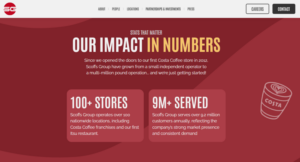
Scoffs Group’s official franchise and partnership information, demonstrating the scale of an established Costa Coffee operator.
What Is Included in the Initial Costa Coffee Franchise Investment?
Because Costa does not publish a universal development cost breakdown, we have constructed an illustrative commercial coffee shop budget.
The following example assumes a fully fitted retail location requiring substantial investment. It is a financial planning exercise, not an official Costa quotation.
| Startup Expense | Illustrative Budget |
| Property deposits, surveys and legal fees | £55,000 |
| Store construction, design and fit-out | £170,000 |
| Coffee machinery and kitchen equipment | £65,000 |
| Furniture, signage and interiors | £30,000 |
| POS technology and IT systems | £15,000 |
| Recruitment and pre-opening training | £20,000 |
| Opening inventory and consumables | £10,000 |
| Initial working capital | £60,000 |
| Construction and launch contingency | £25,000 |
| Total indicative development budget | £450,000 |
This £450,000 example excludes any separately charged franchise or licence fee that has not been confirmed, financing costs and additional VAT cash-flow requirements. Property purchases would also change the calculation considerably.
Property and Store Development
Property costs can become one of the largest components of a coffee shop investment.
A retail outlet might need new drainage, electrical infrastructure, counters, accessibility improvements, ventilation and customer seating.
A drive-thru adds further considerations, including vehicle access, planning requirements, queuing capacity and external infrastructure.
Investors should obtain independently priced construction estimates before signing a lease.
Coffee Equipment and Technology
Commercial coffee equipment must be suitable for the expected transaction volume.
Depending on the operating model, capital expenditure may involve espresso machines, grinders, refrigerators, ice machines, water treatment systems, ovens and payment terminals.
Technology also affects operating efficiency.
Accurate sales and stock reporting allows operators to monitor wastage, identify profitable products and manage ordering.
Entrepreneurs can use a unit economics calculator to examine how individual product margins contribute to overall store profitability.
Working Capital
Working capital is frequently underestimated in hospitality investment forecasts.
A coffee shop can generate substantial sales while still experiencing cash-flow pressure from payroll, rent, VAT payments and supplier commitments.
We would therefore separate the opening budget from the cash reserve used to support trading.
For example, if a business requires £45,000 per month to cover its unavoidable operating obligations, a three-month gross cash requirement would amount to £135,000 before allowing for incoming receipts.
The actual reserve should be calculated from a rolling cash-flow forecast, not an arbitrary percentage of construction expenditure.
What Are the Ongoing Costa Coffee Franchise Fees?
The precise ongoing payments made by a Costa franchise operator depend on the individual agreement.
Costa does not publicly disclose one standard royalty or marketing fee applicable to every UK franchisee.
Nevertheless, investors should understand how such charges could influence a franchise’s profitability.
| Potential Ongoing Cost | Financial Impact |
| Royalty or licence payments | May be linked to sales or another contractual arrangement |
| Marketing contributions | May reduce retained revenue |
| Rent and service charges | Fixed or partly variable property expenditure |
| Employee salaries | Significant recurring operating expense |
| Employer National Insurance | Additional payroll cost |
| Stock purchases | Driven by customer volume and product mix |
| Electricity and water | Influenced by equipment and opening hours |
| Maintenance and repairs | Necessary to prevent interruptions |
| Insurance | Business-specific coverage requirements |
| Loan repayments | Depend on borrowing amount, interest and term |
To understand why contractual percentages matter, consider a purely hypothetical store generating £500,000 in annual revenue excluding VAT.
If its agreement required a 7% royalty and a separate 2% marketing contribution, the combined annual payment would be £45,000.
That would represent 9% of turnover before wages, rent, ingredients and other operating expenses.
These percentages are modelling assumptions, not verified Costa Coffee franchise fees.
For an entrepreneur, this distinction changes how the investment should be assessed.
A business generating attractive gross sales might still produce disappointing returns if contractual payments and fixed costs absorb too much revenue.
What Types of Costa Coffee Business Partnerships Are Available?
Costa Coffee’s business operations extend beyond traditional café franchising.
Its Costa Coffee Professional proposition is particularly relevant to existing businesses interested in adding a recognised coffee brand to their customer offering.
Costa Express
Costa Express uses automated, self-service coffee technology.
These machines are commonly associated with convenience-led environments such as petrol stations, supermarkets and travel locations.
Unlike a conventional coffee shop, a machine can operate without a dedicated team of baristas serving every order.
Potential commercial advantages include:
- Lower direct staffing needs.
- Reduced floor-space requirements.
- Integration with an existing business.
- Opportunities to increase customer spending.
- Less complex front-of-house operations.
However, hosting a machine does not provide ownership of the Costa Coffee brand or equivalent rights to a traditional franchise.
The financial return also depends on sales volume, operating arrangements and the revenue-sharing terms.
Costa Coffee Professional and Branded Coffee Solutions
Costa Coffee Professional offers coffee machines, service support and related products for businesses including hotels, workplaces, convenience stores and hospitality venues.
Costa’s published FAQs state that certain commercial solutions are offered without an upfront investment from partners, although the available packages and requirements vary.
Its professional arrangements typically involve contracts lasting approximately three to five years, subject to the specific partnership.
This is a particularly important difference from the £250,000–£800,000 figures associated with full store development.
Businesses should not assume that the cost of installing a Costa coffee machine is the same as the cost of establishing a standalone Costa café.
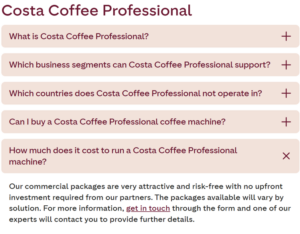
Costa Coffee Professional’s official information explaining commercial machine packages, upfront investment and typical contract duration.
Which Partnership Is More Suitable?
| Business Situation | Model Worth Exploring |
| Established convenience shop | Costa Express or Professional |
| Hotel or leisure venue | Costa Coffee Professional |
| Petrol station operator | Costa Express |
| University or workplace | Commercial coffee solution |
| Experienced multi-site hospitality group | Potential corporate discussions |
| First-time entrepreneur wanting one café | Independently operated café or an actively recruiting franchise |
Our analysis suggests that existing businesses may find a hosted coffee solution more accessible than attempting to establish a full branded Costa store.
That does not mean every business will qualify. Costa assesses prospective partnerships according to commercial and operational requirements.
How Much Profit Could a Costa Coffee Franchise Make?
Profitability is arguably more important than the initial investment headline.
A branded coffee shop may attract significant customer traffic, but revenue alone does not establish whether the business is financially successful.
The financial outcome depends on average customer spending, daily transaction volumes, gross profit margins, employee costs, property expenses and contractual fees.
Because Costa does not publish a universal UK franchisee profit figure, we have prepared a hypothetical store-level profitability model.
Example: A Coffee Shop Generating £431,250 in Annual Net Sales
Assume a business achieves the following:
| Financial Assumption | Amount |
| Average customer transaction including VAT | £5.75 |
| Daily customer transactions | 250 |
| Trading days per year | 360 |
| Annual sales including VAT | £517,500 |
| Annual revenue excluding VAT | £431,250 |
| Cost of goods sold | 30% of net sales |
| Hypothetical licence and marketing charges | 9% of net sales |
| Other variable operating costs | 3% of net sales |
| Annual fixed operating costs | £229,000 |
This simplified example assumes every transaction is subject to 20% VAT. Actual VAT treatment varies according to the products sold and where they are consumed.
Under these assumptions:
- Annual revenue excluding VAT: £431,250.
- Variable expenses at 42%: £181,125.
- Revenue remaining after variable expenses: £250,125.
- Fixed operating costs: £229,000.
- Illustrative annual EBITDA: £21,125.
- Illustrative EBITDA margin: 4.9%.
EBITDA is earnings before interest, tax, depreciation and amortisation. It is not the amount of cash an owner can withdraw.
This calculation also excludes debt repayments, capital expenditure and corporation tax.
The 9% commercial fee assumption must not be interpreted as Costa’s published royalty structure.
What the example demonstrates is that strong turnover does not necessarily translate into equally strong profitability.
A relatively modest change in operating costs or sales volume can affect financial returns considerably.
What ROI Could Investors Expect From a Costa Coffee Franchise?
Return on investment should be evaluated using several trading scenarios.
A single projected profit figure can create an unrealistic impression of certainty, particularly when the store has no established trading history.
For our financial model, we use an illustrative £450,000 development investment, with a £5.75 customer transaction value including VAT.
Variable expenses remain at 42% of net sales, including the hypothetical contractual fee allowance.
| Financial Metric | Lower Sales | Base Case | Higher Sales |
| Daily transactions | 175 | 250 | 350 |
| Annual net sales | £301,875 | £431,250 | £603,750 |
| Variable expenses | £126,788 | £181,125 | £253,575 |
| Fixed operating costs | £229,000 | £229,000 | £245,000 |
| Estimated EBITDA | -£53,913 | £21,125 | £105,175 |
| EBITDA margin | -17.9% | 4.9% | 17.4% |
| EBITDA as % of £450,000 investment | Negative | 4.7% | 23.4% |
Figures are rounded and illustrative. They are not historical or forecast results for an actual Costa franchise. The increased fixed costs in the higher-sales scenario allow for additional operating capacity.
The difference between these outcomes is substantial.
In the lower-sales scenario, the store produces an operating loss before depreciation, interest and tax.
In the base scenario, the business produces positive EBITDA, but the return is modest relative to the initial capital invested.
In the higher-sales scenario, the EBITDA-equivalent return reaches approximately 23.4% of the initial investment.
At that level, dividing the investment by annual EBITDA suggests a simple theoretical recovery period of approximately 4.3 years.
However, this is not a reliable cash payback forecast. It excludes loan servicing, tax, maintenance capital expenditure and changes in working capital.
A proper investment appraisal should use free cash flow rather than EBITDA alone.
How Many Customers Would the Coffee Shop Need to Break Even?
Using the base assumptions above, a store needs enough annual contribution to cover £229,000 of fixed operating expenses.
With variable costs representing 42% of net revenue, the contribution margin is 58%.
The basic calculation is:
Break-even revenue = Fixed costs ÷ Contribution margin
£229,000 ÷ 0.58 = approximately £394,828 annual revenue excluding VAT.
At an average transaction of £5.75 including VAT and 360 trading days, that equates to approximately 229 customer transactions per day.
This is an operating break-even estimate before financing, depreciation and tax, not a guaranteed sales target.
The calculations reveal why location quality and customer traffic should be investigated before committing to a commercial lease.
What Factors Have the Biggest Impact on Costa Coffee Profit Margins?
Location and Footfall
A coffee shop must attract enough customers throughout the trading day.
High visibility does not always translate into profitable sales.
An expensive high-street location might generate greater revenue than a suburban site but also carry substantially higher rent, service charges and labour costs.
Our preferred approach is to assess occupancy cost as a percentage of revenue.
For example, a store paying £60,000 in annual property costs and generating £500,000 in net revenue has a 12% occupancy-cost ratio.
If revenue falls to £400,000 while property costs remain unchanged, that ratio rises to 15%.
The extra three percentage points can materially reduce profitability.
Labour Costs
Employees are central to the café customer experience, but staffing also represents a significant recurring expenditure.
From 1 April 2026, the UK National Living Wage for eligible workers aged 21 and over increased to £12.71 per hour, a 4.1% rise from £12.21.
Employers must also consider National Insurance, pension contributions, paid leave and other employment costs.
A café operating long opening hours requires sufficient employees to cover different shifts, holidays and busy periods.
For financial planning, a business should estimate its fully loaded employment cost rather than multiplying the minimum hourly wage by expected working hours alone.
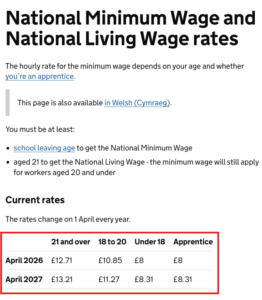
Official UK National Minimum Wage rates from April 2026, including the £12.71 National Living Wage.
Product Margins and Customer Spending
Coffee shop margins depend on the combination of beverages, food, add-ons and promotional discounts.
A higher average transaction value can significantly improve sales without requiring an equivalent increase in customer numbers.
Consider a hypothetical business serving 250 customers daily.
If average spending rises from £5.75 to £6.25, annual sales increase by £45,000 including VAT over 360 trading days.
That is an increase of approximately 8.7%.
However, the business must evaluate whether the extra revenue comes from profitable product combinations.
Selling additional items at heavily discounted prices may increase turnover while producing little extra contribution.
Competition and Customer Retention
Costa competes for customer spending with other branded cafés, independent coffee shops, bakery chains, convenience stores and foodservice operators.
Brand awareness can encourage customers to try a store, but maintaining repeat business requires reliable service and a convenient location.
Investors should assess nearby competitors, opening hours, pricing and customer behaviour before making an acquisition decision.
How Much Capital Would You Need to Qualify for a Costa Franchise?
There is no publicly confirmed universal minimum liquid-capital requirement for opening a new UK Costa Coffee franchise.
The £250,000 figure sometimes described online as the minimum personal capital requirement should therefore not be presented as an official Costa qualification rule.
Established multi-site operators naturally require substantial financial resources, but their capital requirements are linked to negotiated development plans.
An applicant’s financial position may be assessed through:
- Available cash and liquid assets.
- Net worth and existing financial commitments.
- Banking relationships.
- Operating experience.
- Business profitability.
- Debt serviceability.
- Management resources.
- Proposed expansion plans.
A prospective investor should distinguish personal wealth from immediately available capital.
For instance, owning property valued at £500,000 does not mean an investor has £500,000 available to finance construction or operating expenses.
Similarly, borrowing to cover the full investment can increase financial risk.
Can You Get a Business Loan to Finance a Costa Coffee Franchise?
Commercial lending can help established businesses finance property improvements, equipment, acquisitions and expansion.
However, the availability of funding does not confirm that a Costa franchise licence can be purchased.
Banks generally need to understand the proposed operating arrangement and the borrower’s ability to repay.
A strong financing proposal should include independently verified development costs, realistic forecasts and adequate working capital.
Potential funding structures include:
| Financing Method | Potential Application | Main Financial Risk |
| Commercial business loan | Store development or acquisition | Interest and repayment obligations |
| Asset finance | Machinery and eligible equipment | Finance costs and contractual restrictions |
| Investor equity | Expansion funding | Ownership dilution |
| Retained company profits | Expansion by established operators | Reduced available cash reserves |
| Property finance | Suitable property acquisition | Security and borrowing exposure |
| Government-backed startup lending | Smaller eligible business requirements | Usually insufficient for a major café development alone |
First-time entrepreneurs may also want to understand startup business loans before approaching commercial lenders.
Our financial perspective is that debt should be evaluated against conservative cash-flow projections rather than the most optimistic sales scenario.
A highly leveraged store could generate accounting profits but still struggle to meet its monthly finance obligations.
How Can You Apply for a Costa Coffee Franchise or Business Partnership?
The most practical route depends on the type of opportunity being pursued.
For a new standalone UK franchise, prospective investors should first confirm directly with Costa whether it is considering new operating partners and what, if any, eligibility criteria apply.
A business seeking branded coffee equipment can instead explore Costa Coffee Professional’s published business enquiry process.
The process should involve:
- Identify the operating model: Decide whether the objective is a standalone franchise, a business-to-business coffee solution or an investment in an existing operator.
- Prepare financial information: Establish available funding, relevant business experience and the proposed investment scale.
- Research the location. Assess customer demand, competitors, property costs and operational feasibility.
- Contact Costa through its official channels: Ask which business arrangements are currently available.
- Request written commercial terms: Confirm installation costs, service obligations, equipment ownership, contractual charges and termination conditions.
- Conduct due diligence: Obtain professional advice and independently assess the projected return.
- Proceed only after approval: Do not commit to a property or incur substantial development expenditure on the assumption that Costa will subsequently approve a franchise arrangement.
The official Costa Coffee Professional contact form can be used for UK business coffee-solution enquiries.
This form should not be mistaken for a guaranteed application route to a standalone Costa franchise.
What Should Investors Check Before Signing a Costa Franchise Agreement?
A franchise investment involves contractual rights as well as financial commitments.
The precise arrangements should be established with the franchisor and reviewed by an appropriately qualified commercial solicitor.
Important considerations include:
- Territory rights: Whether the operator receives any geographic protection or faces competition from other outlets within the same brand.
- Agreement duration: How long the right to operate continues and whether renewal is available.
- Transfer and exit rights: Whether the business can be sold and what approvals or fees apply.
- Supplier obligations: Whether approved products, equipment and purchasing arrangements are mandatory.
- Refurbishment requirements: Whether periodic investment in store improvements is required.
- Performance requirements: What commercial and operational standards the operator must maintain.
- Termination conditions: The consequences of serious contractual breaches and the financial liabilities that may arise.
An existing franchise resale also requires careful examination of property leases, historical accounts, outstanding liabilities and the terms under which operating rights may transfer.
An asset purchase does not automatically transfer an existing franchise agreement.
From a valuation perspective, historical EBITDA, lease duration, necessary refurbishment and transfer restrictions may all influence the price an investor is willing to pay.
The same principles are useful when assessing the market value of an established business through a startup valuation calculator, although a professional business valuation requires much more detailed information.
Is Costa Coffee a Better Investment Than Other UK Franchises?
Costa benefits from considerable consumer recognition and an established retail presence.
However, brand recognition alone does not establish that a particular franchise is financially suitable or accessible.
An investor should compare different brands using actual available opportunities rather than relying exclusively on advertised investment estimates.
| Franchise or Business Model | Investment Consideration | Main Difference |
| Costa Coffee | Substantial store-level investment may be required | Standard UK individual licence not publicly advertised |
| Starbucks | Licensed and corporate partnership structures | Not equivalent to a straightforward single-shop purchase |
| Subway | Publicly discussed franchise ownership structure | Different commercial and operating requirements |
| Cake Box | Specialist bakery-focused franchise | Different product mix and store economics |
| Wingstop | Restaurant franchise investment | More extensive food preparation and kitchen operations |
| Independent coffee shop | Owner determines concept and branding | Greater control but no established national franchise brand |
An entrepreneur considering another major coffee chain can examine the Starbucks franchise cost, including its licensing arrangements.
For a more conventional foodservice comparison, the Subway franchise cost in the UK offers a different perspective on franchise entry and operating responsibilities.
The Cake Box franchise cost is another relevant reference for investors considering branded high-street food retail.
Higher-capital investors may also compare the Wingstop franchise cost and KFC franchise cost.
These are comparisons of business formats, not claims that every brand is currently accepting applicants on the terms shown in older listings.
What Is Our Investment Rating for Costa Coffee in 2026?
We assessed Costa Coffee from the perspective of a new UK entrepreneur seeking to purchase a single franchise outlet.
Our editorial score considers brand recognition, the visibility of current entry opportunities, publicly disclosed financial terms, potential to expand and capital flexibility.
These are subjective editorial ratings, not measured customer satisfaction percentages, verified franchise success rates or findings from an investor survey.
| Assessment Factor | Maximum Score | Our Editorial Score |
| Brand recognition | 25 | 23 |
| Accessibility to new individual operators | 25 | 3 |
| Public transparency of franchise fees | 20 | 2 |
| Expansion potential for qualified operators | 15 | 11 |
| Capital flexibility | 15 | 2 |
| Total | 100 | 41/100 |
Our editorial investment-accessibility rating: 41%.
This score reflects the limited public accessibility and fee transparency of a new individual franchise opportunity. It is not a judgment that existing Costa franchise operators achieve poor financial returns.
Costa’s recognition and established operating network are clear strengths.
The more significant difficulty for an individual entrepreneur is obtaining verified commercial terms and confirming whether a suitable opportunity is actually available.
For established multi-site operators, the commercial assessment could be substantially different.
What Are the Biggest Risks of Investing in a Costa Coffee Franchise?
High Capital Commitment
Full coffee shop development can require substantial capital before a single customer is served.
Unexpected construction costs or prolonged opening delays can increase the initial funding requirement.
Commercial Property Exposure
Long-term leases can create fixed financial commitments even when sales fall below expectations.
A store with disappointing revenue may remain responsible for rent and contractual obligations.
Labour and Inflation Pressure
Wage increases, supplier costs, utilities and property expenses can all reduce operating margins.
A business must generate sufficient gross profit to absorb these costs without depending entirely on continual price increases.
Franchise and Contractual Restrictions
Approved operators may have limited flexibility over products, branding, operating procedures or store design.
Restrictions can protect brand consistency but may limit the owner’s ability to respond independently to changing local conditions.
Market Saturation
Competing coffee chains and independent businesses can reduce the customer volume available to a new store.
The presence of a well-known brand does not eliminate this risk.
Entrepreneurs evaluating why some startups succeed while others fail should pay particular attention to financial reserves, operating margins and demand forecasts.
Is a Costa Coffee Franchise Worth the Investment in 2026?
Costa Coffee offers exposure to a widely recognised brand with established UK franchise operators.
For businesses possessing significant capital, hospitality experience and multi-site management capabilities, a suitable commercial agreement could offer opportunities for expansion.
However, that possibility should not be confused with the availability of a standard franchise package for new individual investors.
Our review suggests three practical conclusions.
First, the £250,000–£800,000 investment range should be understood as an industry-level development estimate, not Costa’s official joining price.
Second, profitability depends on customer transactions, property costs, employee expenses and contract-specific payments rather than brand recognition alone.
Third, businesses already operating suitable premises may have more practical reasons to explore Costa Coffee Professional or Costa Express than to pursue a standalone franchised shop.
Someone with a smaller budget may also investigate more accessible models, such as the Pepe’s franchise cost, while verifying current recruitment terms and eligibility directly with the relevant brand.
Our overall assessment is that Costa represents an established franchise operating network, but not a publicly available, fixed-price franchise product that any new UK entrepreneur can simply purchase.
An informed investment decision must therefore begin with confirming access to a genuine commercial opportunity, followed by a detailed financial and legal review.
Frequently Asked Questions About Costa Coffee Franchise Cost
How much does it cost to open a Costa Coffee franchise in the UK?
Industry estimates commonly place full coffee shop investment at approximately £250,000–£800,000 or more. Costa does not publish a universal current UK franchise price, so actual costs must be confirmed through an approved commercial arrangement.
Is Costa Coffee offering franchises in the UK in 2026?
Costa operates through established UK franchise partners, but a standard individual single-store franchise package is not publicly advertised. Prospective investors should confirm current opportunities directly with the company.
What is the initial Costa Coffee franchise fee?
There is no publicly verified standard current UK fee. Figures such as £30,000–£60,000 found on some franchise websites should not be treated as official Costa charges.
How much profit can a Costa Coffee franchise make?
Profit depends on revenue, wages, rent, supplies and contractual charges. No universal verified franchisee profit figure is published, and financial projections should be based on individual store economics.
Does Costa Coffee require £250,000 in liquid capital?
Costa does not publish £250,000 as a universal current minimum liquidity requirement for new UK applicants. Financial eligibility will depend on the arrangement under consideration.
Can I open a Costa Coffee franchise with £100,000?
There is no standard publicly available individual franchise package at that price. A business with a smaller budget may investigate Costa Coffee Professional solutions or alternative actively recruiting franchises.
Is Costa Express cheaper than opening a Costa Coffee franchise?
Costa Express uses a different partnership structure. Certain Costa Coffee Professional solutions may have no upfront machine investment, but eligibility and commercial terms vary.
Can I buy an existing Costa Coffee franchise?
A potential acquisition would depend on an existing operator’s willingness to sell and the necessary contractual approvals. Buying business assets does not automatically confer Costa franchise rights.
How long does it take to open a Costa Coffee franchise?
There is no published universal timeline for a new UK standalone franchise. Development can involve commercial approval, property negotiations, planning, construction and recruitment.
Is Costa Coffee a profitable franchise?
Existing operators demonstrate that the brand supports substantial business operations, but profitability varies by location and management. A prospective investor should obtain verified accounts and calculate returns after all costs.
Is Costa Coffee better than Starbucks for franchise investment?
Both brands have established operating networks, but their licensing and partnership arrangements differ. Investors should compare genuine available opportunities, contractual terms, capital requirements and projected cash flow rather than branding alone.
How can I contact Costa about business opportunities?
Use Costa’s official business contact channels to enquire about commercial coffee solutions and confirm whether any relevant franchise or corporate partnership opportunities are available.