

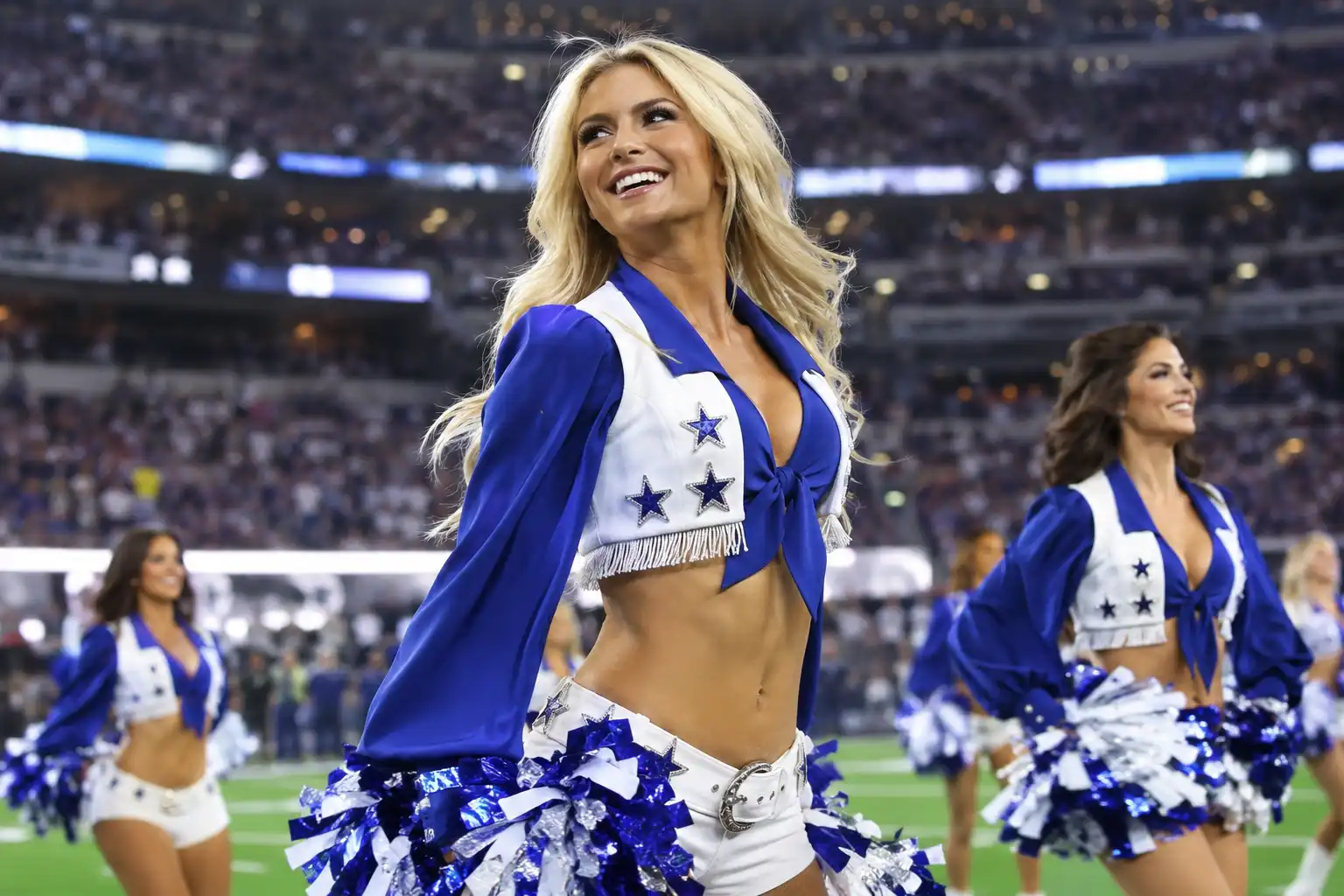
The DCC pay rise became one of the biggest talking points around the Dallas Cowboys Cheerleaders after members revealed that they had secured what was described as a 400% increase in compensation.
The change was announced publicly in the finale of Season 2 of Netflix’s America’s Sweethearts: Dallas Cowboys Cheerleaders in June 2025 and applied to the 2025–26 squad.
Four-year veteran Megan McElaney described the increase simply as “life-changing”, while former veteran Jada McLean said there was a sense of relief because they were “finally, we were done fighting.”
By June 2026, when Season 3 of America’s Sweethearts arrived, reporting placed the new compensation at approximately $75 per hour and around $2,500 per game or performance. However, the Dallas Cowboys have not publicly released the cheerleaders’ individual contracts or a complete official rate card, so those figures should be treated as reported current rates rather than publicly confirmed contractual minimums.
What Is the DCC Pay Rise?
The DCC pay rise refers to the major compensation increase negotiated by Dallas Cowboys Cheerleaders during and after the 2024–25 season.
Members said the eventual deal represented a 400% increase, following months of internal discussions with the Cowboys organisation.
The negotiations became an important storyline in Season 2 of America’s Sweethearts. Cheerleaders discussed their frustration with existing contracts, sought advice from people with legal experience and met with the Cowboys’ human resources and legal teams.
At one stage, squad members even discussed the possibility of missing practice or staging a walkout. The action never happened because members were concerned about disappointing supporters who had backed them following the first Netflix season.
The pay campaign eventually resulted in a substantially improved package for the 2025–26 season.
How Much Do Dallas Cowboys Cheerleaders Make Now?
The clearest picture comes from combining former cheerleaders’ disclosures with reporting published after the pay rise.
| Compensation | Before The Major Raise | 2025–26 Reported Rate |
| Hourly rehearsal/pay rate | Around $15 per hour | Around $75 per hour |
| Game/performance fee | Around $400–$500 | Around $2,500 |
| Other appearance fees | Varied by seniority | Increased, exact structure not publicly released |
| Annual earnings | Varied significantly | Up to around $150,000 has been estimated for highly utilised veterans |
| Health insurance | Not included | Still reportedly not included |
| Employment classification | Part-time | Part-time |
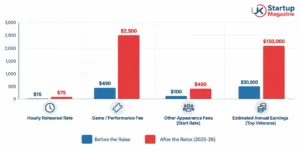
Former DCC member Kristin Westbrook, who was on the squad between 2019 and 2022, publicly said that she earned $15 per hour for practice and $400 per NFL game.
She also explained that other appearance fees increased with seniority, starting at approximately $100 for a rookie and increasing by $100 for each year on the squad.
Jada McLean later reported earning $15 per hour and $500 per game during the 2024–25 season, when she was a fifth-year veteran.
Current 2026 reporting puts the post-rise compensation at approximately $75 per hour and about $2,500 per game or performance.
These newer numbers also make mathematical sense in the context of a 400% increase: moving from $15 to $75 is a 400% increase over the original rate.
However, earnings should not be presented as a guaranteed annual salary. Total income can vary considerably according to seniority, rehearsals, games, public appearances, promotional work and other assignments.
For another example of how a headline wage increase can interact with premiums and employee benefits, Tesco’s 2025 pay rise shows why the overall compensation package can matter as much as the basic hourly figure.
What Wasn’t Disclosed About the New DCC Contract?
This is an important distinction that was missing from the earlier version of this article.
Neither Netflix nor the Dallas Cowboys publicly released the complete new employment contracts when the 400% raise was announced.
TIME reported in June 2025 that exact new pay rates were not disclosed in the series, and the Cowboys declined to confirm specific rates at that stage.
That means claims suggesting every cheerleader was immediately guaranteed a specific six-figure annual salary should be treated cautiously.
What can be established is:
- The 400% figure came directly from members of the squad.
- The Cowboys acknowledged that an agreement had been reached.
- Later 2026 reporting places the hourly figure around $75.
- Later reporting also places game or performance compensation around $2,500.
- Total annual income still depends on the amount and type of work performed.
- The full contract terms have not been made public.
Annual figures around $150,000 generally refer to estimates of what a veteran undertaking substantial additional work and appearances could potentially earn. They should not be described as a guaranteed DCC base salary.
When Did the DCC Pay Rise Take Effect?
The earlier timeline surrounding the DCC pay rise can also be clarified.
June 2024
Season 1 of America’s Sweethearts: Dallas Cowboys Cheerleaders was released.
The series exposed a much wider audience to the gap between the prestige and workload associated with being a DCC member and the compensation many members received.
Pay was discussed comparatively briefly during the first season, but public reaction helped make it a much bigger issue afterwards.
2024–25 Season
Members received contracts that did not contain the pay improvement some had expected.
Veterans including Jada McLean began organising more seriously around compensation.
McLean told TIME that cheerleaders consulted family members and DCC alumni with legal backgrounds before holding meetings with the Cowboys’ HR and legal departments.
June 18, 2025
Season 2 of America’s Sweethearts premiered.
Its finale revealed the successful negotiations and the reported 400% pay increase.
2025–26 Season
The improved compensation applied to the new squad.
June 16, 2026
Season 3 arrived on Netflix, following the 2025–26 DCC squad, meaning viewers were now watching the first full squad operating in the post-pay-rise period.
As of September 2026, the 2025 agreement remains the latest major across-the-board DCC compensation increase widely reported.
Why Did the Dallas Cowboys Cheerleaders Push for Higher Pay?
The dispute was about more than one hourly rate.
Dallas Cowboys Cheerleaders have historically had demanding rehearsal, performance and appearance schedules while many members simultaneously maintained other jobs.
TIME reported that DCC members can practise at least 20 hours per week, before games, appearances, training camp and other commitments are counted. At one point in the Netflix series, the squad faced 21 consecutive working days.
Other reporting has described the overall commitment during busy periods as reaching approximately 30 to 40 hours per week.
Yet the dancers continued to be treated as part-time employees.
That mismatch between employment classification, workload, physical demands and public visibility became central to the pay campaign.
How Did Netflix Change the DCC Pay Debate?
Netflix did not create the debate over NFL cheerleader compensation, but America’s Sweethearts gave it a much larger audience.
Season 1 showed cheerleaders working regular jobs before attending evening rehearsals and dealing with the significant physical demands of performing.
Charlotte Jones, Dallas Cowboys executive vice president and chief brand officer, also addressed the pay issue on camera.
Jones acknowledged that “they’re not paid a lot”, while arguing that cheerleaders were attracted to the organisation partly because of their passion for dance, elite performance opportunities and the experience of belonging to the squad.
After viewers reacted strongly to the compensation discussion, the issue became much more prominent.
Netflix says that Season 2 followed Jada and other veterans as discussions over pay developed, eventually leading to the 400% increase.
The difference between the two seasons was significant: pay was essentially a supporting issue in Season 1 but became one of the defining narratives of Season 2.
What Did Megan McElaney, Jada McLean and Kelli Finglass Say?
Named comments give the pay rise important context that simple salary tables cannot provide.
Megan McElaney
McElaney was one of the veterans involved in the effort and revealed the scale of the increase in the Season 2 finale.
She called the 400% raise “life-changing.”
Jada McLean
McLean helped lead the internal negotiations.
Following the agreement, she described feeling relief and said they were finally finished fighting over the issue.
McLean did not personally benefit from the new contract because she left the squad after her fifth season, but her role in the negotiations helped change compensation for subsequent members.
Kelli Finglass
At the 2024–25 end-of-season banquet, DCC director Kelli Finglass praised the members who had pushed for change.
She called the compensation issue “60-plus years long overdue.”
Finglass has also said the increased ability and visibility of modern DCC dancers gave management reason to reconsider compensation and other programme improvements.
What Is the History Behind NFL Cheerleader Pay Disputes?
The DCC pay rise did not happen in isolation.
It followed more than a decade in which professional cheerleaders across the NFL challenged wages, unpaid work, employment conditions and workplace treatment.
How Did the 2014 Raiderettes Lawsuit Change the Debate?
One of the most important cases began in January 2014.
Oakland Raiders cheerleader Lacy T., later publicly identified as Lacy Thibodeaux-Fields, filed a proposed class-action lawsuit alleging violations of California employment law.
Her contract provided approximately $1,250 for a season, equivalent to less than $5 per hour once the amount of required work was considered.
The obligations went far beyond game performances.
Reporting on the lawsuit described:
- Multiple rehearsals each week
- Long home-game shifts
- Charity and community appearances
- Photo shoots and fittings
- Unreimbursed beauty and work-related costs
- Fines for infractions such as forgetting required pom-poms
ESPN reported that Lacy’s baseline weight was 103 pounds, with only a four-pound allowance above it. Cheerleaders could be benched and lose game pay over weight-related requirements.
The case eventually contributed to a $1.25 million settlement covering dozens of former Raiderettes.
What Were the Buffalo Jills “Jiggle Tests”?
A separate 2014 legal challenge involved former Buffalo Bills cheerleaders known as the Buffalo Jills.
The lawsuit alleged that members were unpaid for practices, games and many required appearances.
Former cheerleader Maria Pinzone became one of the most prominent figures in the dispute.
Reporting on the case described strict appearance controls, including a so-called “jiggle test”, in which cheerleaders allegedly performed jumping jacks while staff assessed their bodies.
Pinzone reportedly earned only $105 during the 2012–13 season, further illustrating how low professional cheerleading compensation could be before the wave of legal challenges.
Why Was Erica Wilkins’ 2018 Cowboys Lawsuit So Important?
The most direct predecessor to the modern DCC pay rise came from former Dallas Cowboys Cheerleader Erica Wilkins.
Wilkins filed a federal lawsuit against the Cowboys in 2018 alleging unpaid wages and other Fair Labor Standards Act violations.
She had worked as a DCC member between 2014 and 2017.
According to reporting at the time, Wilkins earned a little over $16,500 in her final year, while the Cowboys’ male mascot, Rowdy, was reportedly earning approximately $25 per hour or $65,000 per year.
The contrast became one of the most frequently cited statistics in the debate over professional cheerleader compensation.
What Changed After the 2019 Settlement?
Wilkins’ case was settled in 2019.
The result was not merely an individual payment.
The Cowboys increased cheerleader pay from approximately:
| Compensation | Before 2019 Settlement | After Settlement |
| Hourly Pay | $8 | $12 |
| Game-Day Pay | $200 | $400 |
That means the move from $200 to $400 per game was connected to the settlement, rather than simply being a routine annual pay increase.
Pay later increased further. By 2024–25, Jada McLean reported earning about $15 per hour and $500 per game as a fifth-year veteran.
The major 2025 negotiations therefore represented the next substantial step after the changes triggered by Wilkins’ case.
What Happened With the $2.4 Million Cowboys Settlement?
Another important piece of DCC history involved workplace protections rather than wages.
ESPN reported in February 2022 that the Cowboys had paid $2.4 million to resolve allegations involving four cheerleaders and then-senior public relations executive Rich Dalrymple.
The allegations concerned an incident in which Dalrymple was accused of entering the cheerleaders’ dressing room and recording women while they were changing.
It is important to get the timeline right: the settlement itself dated back to 2016; it became public through ESPN’s reporting in 2022.
Dalrymple denied the allegations. The Cowboys said their internal investigation found no wrongdoing.
The episode remains relevant because debates about professional cheerleading have involved not only pay, but also workplace protections, privacy and the employment status of performers.
Are Dallas Cowboys Cheerleaders Full-Time Employees?
No.
The DCC continue to be described as part-time employees, despite the substantial time demands associated with the position.
That distinction is particularly important because the schedule can resemble full-time work during busy periods.
TIME documented at least 20 hours of rehearsal each week, on top of games, public appearances and other obligations. Other reporting has put the combined commitment during parts of the year at around 30 to 40 hours per week.
Members therefore frequently maintain outside employment.
The Netflix series has featured cheerleaders working in healthcare, retail, floristry and other occupations while simultaneously meeting DCC obligations.
Do Dallas Cowboys Cheerleaders Receive Health Insurance?
This remains one of the biggest limitations of the compensation package.
Jada McLean has said the Cowboys regard the cheerleaders as part-time employees and that their contracts therefore do not include employer-sponsored health insurance.
They have reportedly had access to team doctors and physical therapists, but that is different from having a conventional employer health-insurance policy.
The issue is notable because cheerleading is physically demanding and can involve injuries resulting from repetitive training, jumping, splits and other high-impact movements.
Former member Kristin Westbrook’s public pay disclosures also helped document how much squad members earned before the increase, while McLean’s comments provided greater clarity around the continuing lack of health coverage.
Current 2026 reporting indicates that the pay increase did not result in a corresponding change to health-insurance coverage.
What Does an Economist Say About the DCC Pay Rise?
The dispute also raises a broader economic question: does a large percentage increase automatically mean a worker has reached the market value of their labour?
Sports economist Dave Berri, who has written extensively about the economics of women’s sport, argued that the DCC increase could put pressure on other organisations to reassess compensation.
However, he cautioned that “massive increases in pay still don’t bring women to what they are worth.”
His argument is that percentage increases can sound enormous when the starting point is unusually low.
A move from $15 to $75 an hour is undeniably substantial, but evaluating the final compensation also requires considering workload, revenue generation, promotional value, employment benefits and the physical demands of the work.
Could the DCC Pay Rise Affect Other NFL Cheerleaders?
The DCC agreement does not automatically change compensation elsewhere in the NFL.
Cheerleading programmes operate under individual teams and compensation structures can differ significantly.
However, the Dallas dispute matters because the DCC are among the highest-profile professional cheerleading organisations in the United States.
Their negotiations demonstrated that:
- Collective organisation can affect compensation
- Public transparency can change employment discussions
- Media exposure can increase pressure on employers
- Historical lawsuits can lead to squad-wide policy changes
- Non-wage benefits remain important even after major salary increases
Kelli Finglass herself suggested that the changes could influence dance organisations beyond Dallas when she praised the veterans for changing the organisation and potentially other dance programmes.
Whether other NFL teams follow the same path will depend on their individual employment arrangements, contracts and negotiations.
Frequently Asked Questions
How Much Was the Dcc Pay Rise?
Dallas Cowboys Cheerleaders described the new agreement as a 400% pay increase. The improved compensation applied to the 2025–26 squad.
How Much Do Dallas Cowboys Cheerleaders Earn in 2026?
Current reporting places compensation at approximately $75 per hour and around $2,500 per game or performance. Individual contracts have not been publicly released, so earnings can vary.
Do Dallas Cowboys Cheerleaders Make $150,000 Per Year?
Some reports estimate that highly utilised veteran cheerleaders could potentially earn around $150,000, but this is not a guaranteed base salary for every squad member. Total income depends on hours, games, seniority and appearances.
Do Dallas Cowboys Cheerleaders receive health insurance?
Current reporting says no employer-sponsored health insurance is included because the cheerleaders remain classified as part-time employees, although they have access to team medical professionals.
What Did Dcc Cheerleaders Earn Before the Raise?
Former member Kristin Westbrook reported earning $15 per hour for practices and $400 per NFL game during her 2019–22 tenure. Jada McLean reported earning about $15 per hour and $500 per game during the 2024–25 season.
Why Did the Dallas Cowboys Cheerleaders Get a Pay Rise?
The increase followed years of scrutiny over cheerleader compensation, the earlier Erica Wilkins wage case, wider NFL cheerleader litigation and direct negotiations led by veteran DCC members after Netflix brought much greater attention to their workload and pay.