

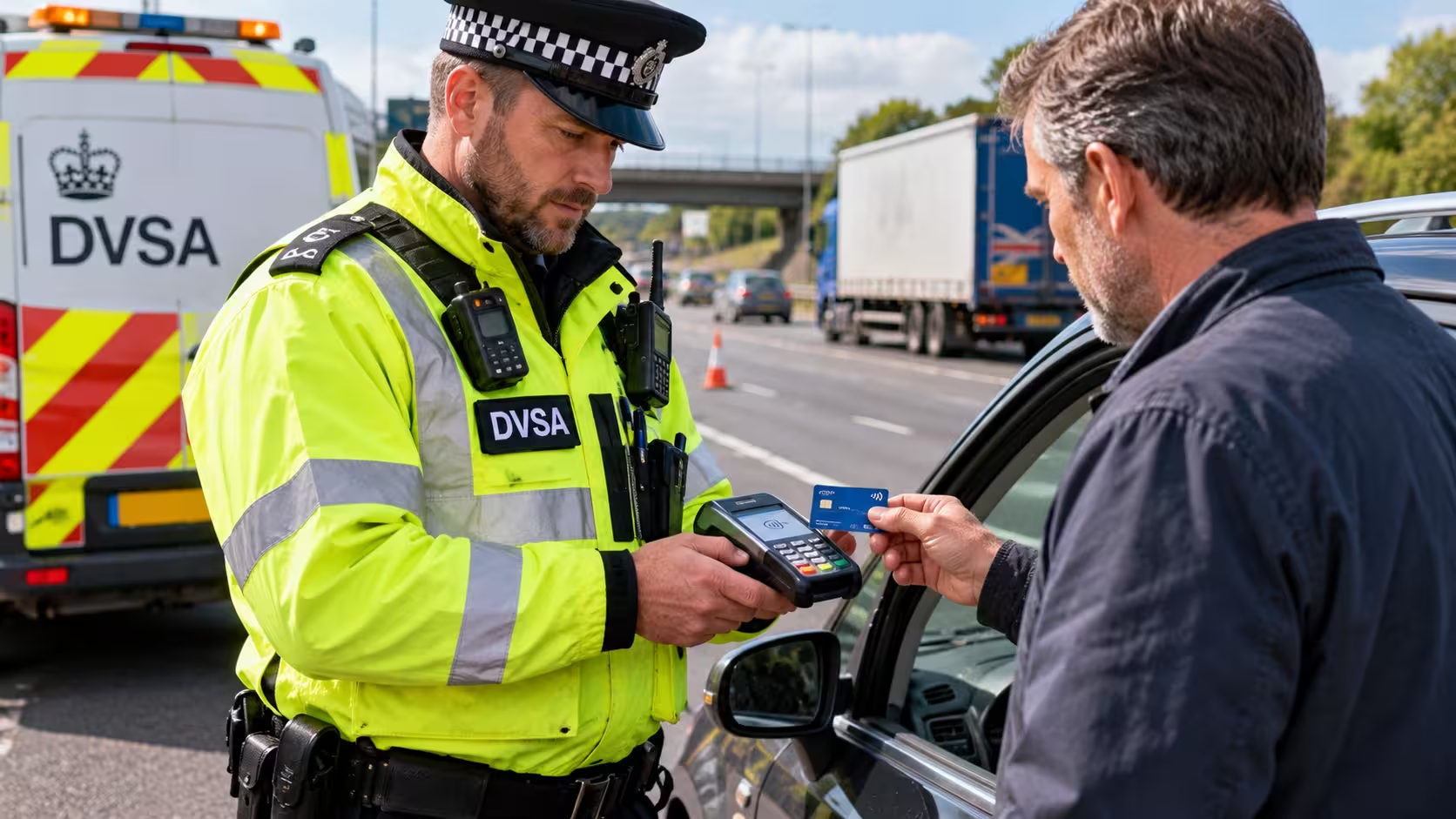
The DVSA roadside fines payment changes have made it easier for commercial drivers and transport operators to settle roadside penalties using modern digital payment methods. Since 28 May 2025, drivers have been able to use Apple Pay and Google Pay alongside existing debit and credit card options.
The Driver and Vehicle Standards Agency (DVSA) introduced these additional payment choices after changing its roadside fines payment provider. The update affects payments for fixed penalties, vehicle immobilisation fees and court deposits.
However, the change does not mean that every driver must immediately pay a roadside fine, nor does it introduce higher penalty amounts. Existing payment deadlines, enforcement procedures and rights to challenge penalties continue to apply.
For haulage companies, delivery businesses, fleet operators and self-employed commercial drivers, understanding these distinctions is essential.
A £200 penalty can become a £300 liability in England and Wales if it is not paid or appropriately challenged within the required period. Vehicle downtime, recovery costs and missed deliveries can create additional financial pressure.
We analysed the payment arrangements alongside enforcement procedures and business compliance requirements to explain what has changed, what remains the same and how operators can reduce unnecessary financial exposure.
What Are the Latest DVSA Roadside Fines Payment Changes?
The most important DVSA roadside fines payment change took effect on 28 May 2025, when the agency introduced a different payment service provider.
The update added Apple Pay and Google Pay as payment options, making transactions more convenient for drivers using smartphones.
The agency also confirmed that the standard card payment screen would look slightly different, although the overall payment process would remain familiar.
| Payment feature | Before 28 May 2025 | Following the change |
| Debit card payments | Available | Still available |
| Credit card payments | Available | Still available |
| Apple Pay | Not included in the previous arrangement | Added |
| Google Pay | Not included in the previous arrangement | Added |
| Payment provider | Previous provider | New provider |
| Online payment service | Available | Continues |
| Roadside fine amounts | Existing penalty structure | Unchanged by payment update |
| Payment deadlines | Existing legal deadlines | Unchanged |
| Right to challenge penalties | Available | Remains available |
The central point is that this was a payment-processing update rather than a new enforcement framework.
The DVSA’s original announcement stated that many drivers would notice little difference when using ordinary card payments.
Why Did the DVSA Introduce Digital Wallet Payments?
Digital wallets allow eligible users to complete transactions without manually entering card information each time.
This can be particularly convenient during roadside inspections, where a driver may need to contact a fleet manager or arrange payment while away from the office.
For transport businesses, the potential benefit is a simpler payment process rather than a reduction in the underlying fine.
In our assessment, businesses should view digital wallet availability as an administrative improvement. It does not remove the need for strong driver training, vehicle maintenance or compliance monitoring.
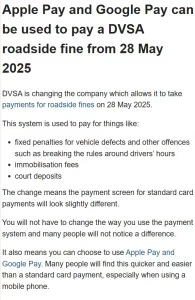
DVSA confirms Apple Pay and Google Pay were added to roadside fine payments from 28 May 2025.
Who Is Affected by the DVSA Roadside Fines Payment Changes?
The payment changes are particularly relevant to commercial road transport operations across England, Scotland and Wales.
DVSA officers can carry out roadside inspections of vans, heavy goods vehicles, buses and coaches. They may issue penalties when drivers or vehicles fail to meet the relevant legal requirements.
The organisations most directly affected include:
- Haulage companies: Businesses operating HGVs on domestic or international routes.
- Delivery operators: Companies using vans and commercial vehicles for goods distribution.
- Passenger transport businesses: Bus and coach operators subject to applicable safety and driving requirements.
- Self-employed commercial drivers: Individuals responsible for managing their own vehicles and business expenses.
- Fleet management companies: Organisations coordinating vehicle maintenance, driver compliance and operational records.
- International transport operators: Businesses bringing foreign-registered commercial vehicles into Great Britain.
Not every ordinary motorist receiving a road traffic penalty will use the DVSA roadside payment service.
The service is principally relevant to fines and related charges arising from DVSA commercial vehicle enforcement.
For growing transport businesses, responsibility does not end with the driver. Where breaches result from vehicle maintenance failures, unrealistic scheduling or weak internal controls, the operator may also face further scrutiny.
Our analysis suggests that the financial exposure increases when a business lacks a clear process for responding to an inspection, assigning payment responsibility and preserving supporting records.
How Can Drivers Pay a DVSA Roadside Fine?
The official payment service remains available through GOV.UK.
Drivers may use the online portal, telephone service or other permitted payment methods, depending on their circumstances.
Step 1: Receive the Fixed Penalty Notice
During an inspection, a DVSA examiner may identify an offence and issue the appropriate documentation.
The driver should review the notice carefully, including the alleged infringement, penalty amount and deadline.
Step 2: Obtain the Payment Details
The DVSA can provide a payment code and electronic notification through email or text message.
The notification identifies the amount due and the relevant payment instructions.
Drivers should ensure the contact information provided is correct, particularly when a fleet office or nominated payer is handling the transaction.
Step 3: Access the Official Payment Service
Visit the official GOV.UK roadside fine payment page.
Select the payment service and enter the required details.
The service supports payments associated with:
- Fixed penalties for vehicle defects and other offences.
- Drivers’ hours infringements.
- Vehicle immobilisation fees.
- Court deposits.
Step 4: Choose an Available Payment Method
Eligible drivers can use supported credit or debit cards, Apple Pay or Google Pay.
Drivers should check that their preferred option is displayed during the transaction.
Step 5: Keep the Payment Confirmation
Once payment is completed, retain the confirmation or receipt.
Commercial operators should record the transaction against the relevant driver, vehicle, journey and infringement.
This documentation is important for internal investigations and financial reconciliation.
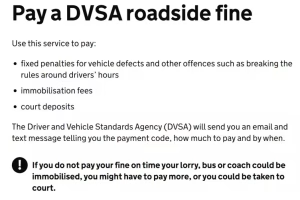
Official GOV.UK service for paying DVSA roadside fines, immobilisation fees and court deposits.
Can Drivers Still Pay DVSA Roadside Fines Using Cash or by Telephone?
Yes. The introduction of Apple Pay and Google Pay did not remove every traditional payment option.
The official GOV.UK payment instructions continue to identify cash payment to a DVSA examiner at the point a fine is issued.
The detailed enforcement guidance also explains that roadside cash deposits may be paid using pound sterling notes, subject to the applicable requirements.
However, drivers cannot simply visit a DVSA office to pay a fixed penalty in person.
| Payment method | Availability | Important information |
| Online debit or credit card | Available | Through the GOV.UK service |
| Apple Pay | Available | Where supported during checkout |
| Google Pay | Available | Where supported during checkout |
| Telephone | Available | During DVSA customer service hours |
| Cheque or postal order | UK drivers or operators | Must follow official postal instructions |
| Cash | At the roadside | Paid directly to the examiner when permitted |
| Cash at a DVSA office | Not available | Offices are not walk-in payment centres |
For telephone payments, drivers can contact the DVSA customer service centre on 0300 123 9000, Monday to Friday, 8am to 5pm.
Online payments are available 24 hours a day, seven days a week.
The distinction matters because businesses should not tell drivers that cash is entirely prohibited or that every penalty requires instant digital payment.
What Offences Can Result in DVSA Roadside Fines?
DVSA enforcement covers a range of commercial vehicle safety and operational offences.
The amount of a penalty depends on the infringement, its seriousness and the relevant enforcement provisions.
Common examples include:
Drivers’ Hours and Tachograph Offences
Drivers may receive penalties for breaching applicable driving time, rest period or record-keeping requirements.
These breaches are particularly important for commercial transport operators because scheduling decisions can contribute to non-compliance.
Businesses should regularly review tachograph records, journey schedules and driving time limits.
Operators involved in cross-border transport should also understand the DVSA HGV drivers’ hours rules changes, particularly when international journeys create additional compliance responsibilities.
Vehicle Defects and Roadworthiness
A DVSA inspection may identify defects involving tyres, brakes, lights, steering or other safety-critical components.
A defective vehicle may receive a prohibition in addition to a financial penalty.
Paying the penalty does not automatically mean the vehicle can return to the road if an outstanding safety prohibition remains.
Overloading and Unsafe Loads
Businesses may face enforcement action when commercial vehicles exceed permitted weight limits or carry loads that are not adequately secured.
Overloading can also increase vehicle wear, affect braking performance and create additional safety risks.
Documentation and Operating Requirements
Enforcement may also involve failures relating to applicable licences, inspection records and other commercial vehicle obligations.
Not every documentation issue automatically produces the same penalty. The legal offence and circumstances determine the enforcement response.
| Offence category | Possible enforcement consequences | Business risk |
| Drivers’ hours breach | Fixed penalty or further action | Driver scheduling disruption |
| Defective tyres or brakes | Fine, points where applicable, prohibition | Vehicle downtime |
| Vehicle overloading | Graduated fixed penalty | Delivery delays |
| Unsafe loading | Penalty or prohibition | Cargo and safety exposure |
| Tachograph infringement | Fixed penalty or prosecution | Compliance investigation |
| Serious or repeated breaches | Court proceedings or operator scrutiny | Higher legal and operating costs |
A useful preventative approach is to integrate vehicle safety procedures into everyday business operations rather than treating fines as isolated incidents.
Clear workplace health and safety responsibilities can support training, reporting and accountability across transport operations.
How Much Are DVSA Roadside Fines in 2026?
The DVSA roadside payment changes did not introduce a new fine scale.
Under the published commercial roadside enforcement framework, standard fixed penalties commonly range from £50 to £300 per offence.
Some offences may also involve driving licence penalty points.
| Fixed penalty amount | Possible application | Financial implication |
| £50 | Certain lower-level non-endorsable offences | £50 immediate liability |
| £100 | Relevant endorsable or non-endorsable offences | May include penalty points |
| £200 | More serious applicable fixed-penalty offences | Greater operating expense |
| £300 | Higher-tier applicable offences | Highest standard amount within this scale |
| Court-determined fine | Cases dealt with by prosecution | Amount depends on the offence and court decision |
These figures represent possible fixed-penalty levels, not a universal price list for every infringement.
A driver may receive more than one notice if several separate offences are identified.
For example, where three separate £200 penalties are lawfully imposed, the total amount would be £600.
Serious cases can also proceed to court, where the financial consequences may exceed the standard fixed-penalty scale.
Can DVSA Fines Include Penalty Points?
Yes. Some endorsable offences can result in both a financial penalty and points on the driver’s licence.
Official roadside guidance provides an example involving defective brakes, where the penalty is £100 and three driving licence points.
The exact consequences depend on the offence.
For employers, this creates an additional risk because a driver’s continuing entitlement to operate a commercial vehicle may be affected.
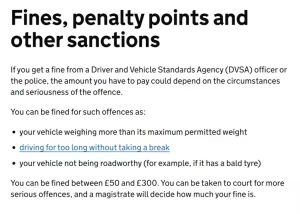
Published DVSA fixed penalties of £50 to £300 and the potential for driving licence penalty points.
Do UK Drivers Have to Pay DVSA Fines Immediately?
Not necessarily.
This is one of the most important distinctions for drivers and businesses.
A driver who has a satisfactory UK address will generally have 28 days from the issue of a fixed penalty notice to pay it.
A satisfactory address is one at which the driver can be reliably contacted. Merely providing a temporary hotel or agency address will not normally satisfy the requirement.
Drivers without a satisfactory UK address may instead be required to pay an immediate financial penalty deposit.
The important distinction is therefore the driver’s address and enforcement circumstances, rather than simply whether the vehicle is British or foreign-registered.
| Driver circumstances | General payment arrangement |
| Driver with satisfactory UK address | Normally 28 days for a fixed penalty |
| Driver without satisfactory UK address | Immediate financial penalty deposit may be required |
| Driver requesting court hearing | Must follow the applicable procedure and deadline |
| Vehicle subject to unpaid deposit prohibition | May remain immobilised until requirements are satisfied |
| Vehicle with serious safety defects | Cannot necessarily continue even after payment |
A fleet business should identify these differences before creating a universal roadside payment policy.
Requiring every employee to pay immediately could create unnecessary pressure, especially where an infringement is disputed.
However, businesses should not delay mandatory deposits, because failure to pay can prevent a vehicle from continuing its journey.
What Are DVSA Financial Penalty Deposits?
A financial penalty deposit is different from an ordinary fixed penalty paid within the standard period.
DVSA can require a deposit from a person who does not have a satisfactory UK address.
The deposit is intended to secure payment of the relevant penalty or potential court fine.
Where the case is proceeding to court, the published framework provides the following deposit amounts:
| Number of offences | Financial deposit |
| One offence | £500 |
| Two offences | £1,000 |
| Three or more offences | £1,500 |
| Maximum deposit for a single occasion | £1,500 |
For fixed penalties, the deposit generally reflects the total relevant penalties, subject to the applicable maximum.
The deposit is not necessarily an additional final fine.
Where a court case follows, the money can be applied towards the fine, and any amount that must be returned will be refunded under the applicable rules.
For businesses, the distinction is important for accounting purposes.
A deposit should be tracked separately from a confirmed penalty expense until its final treatment is established.
Our assessment is that international transport operators should maintain an accessible payment process and a central record of deposits.
Otherwise, a manageable enforcement issue can become a much larger operational problem involving immobilisation, recovery and missed delivery commitments.
What Happens If a DVSA Roadside Fine Is Not Paid on Time?
The consequences depend on the type of notice and the jurisdiction.
In England and Wales, where an ordinary fixed penalty is not paid within 28 days and no court hearing has been requested, the amount is increased by 50% when registered as an unpaid court fine.
For example:
| Original penalty | 50% increase | Amount after increase |
| £50 | £25 | £75 |
| £100 | £50 | £150 |
| £200 | £100 | £300 |
| £300 | £150 | £450 |
These calculations illustrate the financial effect of failing to act within the required period.
The rules in Scotland differ. Failure to accept and pay a conditional offer can result in the matter being referred to the procurator fiscal for consideration of court proceedings.
Businesses should therefore avoid assuming that every location uses an identical late-payment process.
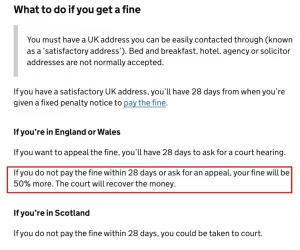
DVSA explains the 28-day fixed penalty deadline and 50% increase for unpaid penalties in England and Wales.
Can a Vehicle Be Immobilised?
Yes. Where a required financial deposit is not paid, DVSA may prevent the vehicle from continuing and immobilise it.
Outstanding vehicle safety prohibitions may also prevent further driving.
Even after the relevant payment is completed, the vehicle may not be released until other legal and safety requirements have been satisfied.
This is why financial preparation and mechanical compliance must be managed together.
How Do DVSA Roadside Fines Affect Small Business Finances?
For small haulage companies, the direct penalty may represent only part of the commercial cost.
A roadside incident can also disrupt scheduled deliveries, driver availability and customer commitments.
Our financial analysis separates three categories of exposure.
Direct Enforcement Costs
These include fixed penalties, deposits where required, immobilisation fees and other lawfully imposed enforcement charges.
Operational Disruption
Vehicle delays may generate additional driver costs, replacement transport expenses and lost productive hours.
Commercial and Compliance Consequences
Repeated or serious infringements can damage business relationships and attract closer regulatory scrutiny.
Consider a hypothetical delivery business that receives a £200 fixed penalty.
| Cost element | Illustrative amount |
| Original penalty | £200 |
| Penalty after a 50% increase, if applicable | £300 |
| Two hours of operating downtime at £55 per hour | £110 |
| Delivery rescheduling cost | £80 |
| Combined illustrated exposure | £490 |
This scenario assumes the late-payment increase applies and that the business incurs the additional operating expenses shown.
The £490 combined cost is 145% greater than the original £200 penalty.
These figures are a financial planning illustration, not an estimate of typical DVSA cases or a claim about average business losses.
The example shows why avoiding operational disruption may be more valuable than simply making a fine easier to pay.
In a business operating on tight delivery margins, a single disrupted journey can absorb profit that would otherwise support maintenance or growth.
This matters particularly for startups with limited working capital.
Can Businesses Claim DVSA Roadside Fines as Tax-Deductible Expenses?
Generally, penalties imposed for breaches of the law are not allowable deductions when calculating taxable trading profits.
This creates an important difference between ordinary business running costs and enforcement penalties.
For example, legitimate vehicle servicing, insurance and certain travel expenses may qualify for tax relief, subject to the applicable rules.
A fine for breaching transport legislation is different.
However, where an employer pays or reimburses a fine that is legally the employee’s personal liability, the employment tax and business deduction consequences can differ.
Businesses should consider who was legally liable for the penalty and how the payment was made rather than assuming every employer-funded fine receives the same tax treatment.
A practical accounting approach is to:
- Record fixed penalties separately from normal fleet operating expenditure.
- Track financial deposits until their final outcome is established.
- Reconcile payment receipts against the relevant notice.
- Identify any employee reimbursement implications.
- Ask an accountant to confirm the appropriate tax treatment.
Vehicle-related financial planning should also distinguish enforcement penalties from ordinary taxation.
Changes to car tax and vehicle operating costs may influence fleet budgets, but they are separate from the DVSA roadside payment update.
Can Drivers Challenge a DVSA Roadside Fine?
Yes. Drivers retain the right to challenge alleged offences through the applicable legal procedures.
The introduction of digital wallet payments did not remove this protection.
In England and Wales, a driver who wants the matter considered by a court can normally request a hearing within 28 days of the fixed penalty notice being issued.
DVSA also operates a complaints process for people who believe a penalty was issued incorrectly.
Under the published guidance, a complaint should generally be made within 10 days.
A complaint and a court hearing request are not the same procedure. Drivers must check how the applicable deadlines operate in their particular case.
What Evidence Should Drivers Keep?
Relevant evidence may include:
- A copy of the fixed penalty notice.
- Vehicle inspection and maintenance records.
- Tachograph information or driving records.
- Photographs of relevant vehicle conditions.
- Journey documentation.
- Written communications with DVSA.
- Payment receipts or deposit confirmations.
A driver who intends to contest a fixed penalty should follow the notice instructions rather than assuming that paying the penalty is the correct first step.
Where a mandatory financial deposit has been required, paying the deposit does not necessarily remove the right to contest the underlying allegation.
For significant penalties or potential licence consequences, professional legal advice may be appropriate.
What Should Fleet Operators Do Following the DVSA Payment Changes?
Although the 2025 payment update was relatively narrow, it provides an opportunity for transport businesses to improve their internal compliance procedures.
Businesses should establish clear responsibilities before a roadside incident occurs.
1. Create a Roadside Incident Procedure
Drivers should know whom to contact when they receive a notice, encounter a payment problem or are instructed not to move the vehicle.
An authorised fleet or compliance manager should be able to respond without unnecessary delay.
2. Establish Payment Authorisation
Businesses should determine whether drivers are permitted to use company payment methods or must obtain approval before paying.
Where a fine may be challenged, the procedure should distinguish between a fixed penalty and a required deposit.
3. Monitor Vehicle Maintenance
Maintenance should be preventative rather than reactive.
Daily walkaround checks, defect reporting and scheduled inspections can reduce the risk of vehicle-related offences.
4. Review Driving Hours Compliance
Businesses should monitor tachograph information and driving schedules for relevant breaches.
Commercial pressure to complete more deliveries should not override legal rest requirements.
5. Preserve Enforcement Records
Each incident should be recorded with its date, vehicle, driver, alleged offence, payment status and resolution.
This allows management to identify recurring problems rather than viewing each penalty in isolation.
6. Monitor Operator Compliance
DVSA uses an Operator Compliance Risk Score, or OCRS, to help assess the likelihood that operators may be non-compliant.
It is an enforcement risk indicator, not a public customer satisfaction rating.
Relevant infringements can contribute to an operator’s compliance history, and serious or repeated failures may lead to consideration by the Traffic Commissioner.
When the original online payment service was introduced in 2019, Gordon MacDonald, then DVSA Head of Enforcement Policy, said:
“DVSA’s priority is protecting everyone from unsafe drivers and vehicles.”
That statement helps explain why payment technology should be regarded as a supporting tool. The underlying objective of enforcement remains road safety and legal compliance.
How Can Businesses Measure Their DVSA Compliance Readiness?
A percentage-based internal readiness score can help small businesses assess whether important controls are in place.
For example, a fleet manager could create a checklist of 20 operational controls covering vehicle inspections, driver training, tachograph reviews, payment authorisation and incident documentation.
The score can be calculated as:
Compliance readiness = (Controls completed ÷ Total controls assessed) × 100
| Completed controls | Internal readiness score | Suggested management response |
| 20 out of 20 | 100% | Continue monitoring and updating procedures |
| 18 out of 20 | 90% | Address the remaining weaknesses |
| 15 out of 20 | 75% | Prioritise corrective action |
| 10 out of 20 | 50% | Conduct a more comprehensive review |
These percentages are illustrative internal management scores, not DVSA ratings, regulatory thresholds or results from an operator survey.
A high score also does not guarantee legal compliance. It simply helps management identify missing controls.
Our recommendation is to review both the existence and effectiveness of each procedure.
For example, having a daily inspection checklist is useful only when drivers complete it properly and defects are acted upon.
How Can Drivers Avoid Fake DVSA Fine Payment Messages?
Digital payment convenience also makes verification important.
DVSA has previously warned motorists about fraudulent text messages claiming that recipients owe parking penalties.
The distinction is important because DVSA does not issue or administer ordinary parking fines.
A suspicious message demanding payment for a DVSA parking fine should therefore be treated as a warning sign.
Drivers and businesses should:
- Check whether a genuine roadside enforcement encounter occurred.
- Verify the notice and payment reference independently.
- Access GOV.UK directly rather than relying on an unexpected message link.
- Avoid entering bank details on unfamiliar websites.
- Contact DVSA using its officially published telephone number when uncertain.
- Report suspicious messages through the appropriate fraud-reporting channels.
Fleet operators should ensure that payment instructions are communicated securely to authorised staff.
Are DVSA Roadside Fine Rules Different Across England, Scotland and Wales?
The payment service is available across Great Britain, but some enforcement and court procedures differ.
In England and Wales, an unpaid fixed penalty can be registered with the court and increased by 50% when the required action has not been taken.
In Scotland, unpaid conditional offers can be referred to the procurator fiscal, who decides whether further proceedings should follow.
The distinction also affects how drivers should approach appeals and court proceedings.
| Issue | England and Wales | Scotland |
| Digital roadside payments | Available | Available |
| Standard fixed penalty payment period | Generally 28 days for drivers with satisfactory UK address | Generally 28 days for applicable conditional offers |
| Court challenge | Driver can request hearing within applicable period | Different conditional-offer and prosecution process |
| Failure to pay | Court registration and 50% increase may apply | Referral to procurator fiscal may follow |
| Financial deposits | Applicable where legal conditions are met | Applicable arrangements subject to Scottish procedures |
Commercial businesses operating nationwide should ensure staff do not rely on an England-specific process when handling a Scottish notice.
The actual notice should always be treated as the starting point for the available response options.
What Is the Long-Term Business Impact of the DVSA Payment Changes?
The main advantage of the DVSA roadside fines payment changes is convenience.
Drivers now have more ways to complete eligible digital transactions, while operators can continue using the established online payment arrangements.
However, the wider financial benefit depends on how effectively businesses manage their compliance obligations.
A more convenient payment system does not reduce the probability of a fine unless it is accompanied by better training, vehicle maintenance and operating procedures.
For growing transport companies, there are three priorities.
First, reduce the likelihood of infringements through preventative management.
Second, minimise unnecessary disruption when a roadside inspection occurs.
Third, maintain financial records that distinguish genuine business costs, penalties and refundable deposits.
In our assessment, these measures offer greater long-term value than focusing exclusively on the choice between a payment card and digital wallet.
The ability to settle a penalty quickly is useful. Avoiding the infringement altogether remains the stronger financial outcome.
Conclusion
The DVSA roadside fines payment changes introduced on 28 May 2025 added Apple Pay and Google Pay to the existing payment system.
The change made eligible payments more convenient without introducing a new fixed-penalty scale or removing the established right to challenge an alleged offence.
Commercial drivers with a satisfactory UK address generally retain a 28-day payment period for ordinary fixed penalties. Those without a satisfactory address may need to provide an immediate financial deposit.
For businesses, the financial consequences extend beyond the original penalty.
An unpaid fine may increase by 50% in England and Wales, while vehicle immobilisation, delayed deliveries and additional operating expenses can increase the total commercial impact.
The most effective response is to combine clear payment procedures with regular vehicle inspections, driver training, accurate record-keeping and preventative compliance management.
Ultimately, the DVSA’s digital payment improvements should make enforcement transactions more convenient, but legal compliance remains the best way to protect fleet profitability and operational continuity.
Frequently Asked Questions
When Did the DVSA Roadside Fines Payment Changes Start?
The updated payment arrangements took effect on 28 May 2025, adding Apple Pay and Google Pay following a change of payment provider.
Can I Pay a DVSA Fine Using Apple Pay or Google Pay?
Yes. Both digital wallet methods are available for eligible payments through the updated system.
Can I Still Pay a DVSA Roadside Fine With Cash?
Yes. GOV.UK confirms that cash can be paid directly to a DVSA examiner when the fine is issued.
How Long Do I Have to Pay a DVSA Roadside Fine?
Drivers with a satisfactory UK address generally have 28 days to pay an ordinary fixed penalty. Immediate deposits may be required in other circumstances.
What Is the Maximum DVSA Fixed Penalty?
The published standard fixed-penalty scale includes amounts up to £300 per offence. Multiple offences and court proceedings can result in higher total liabilities.
Can DVSA Immobilise My Vehicle for Non-Payment?
Yes. Failure to pay a mandatory financial deposit can result in the vehicle being prohibited from moving or immobilised.
Can a Business Pay a DVSA Fine for Its Driver?
Yes, payment can be arranged through a nominated company payer. Businesses should separately assess legal liability and potential tax implications.
Can DVSA Fines Be Appealed?
Yes. Drivers can challenge eligible penalties through the applicable court procedure or raise a complaint with DVSA, subject to the relevant deadlines.
Are DVSA Roadside Fines Tax-Deductible?
Penalties for breaching the law are generally not deductible against trading profits. Different rules may apply where an employer pays an employee’s personal liability.
Did DVSA Increase Roadside Fine Amounts in 2026?
The 28 May 2025 payment-system change did not increase fixed-penalty amounts. It introduced additional payment methods rather than new penalty levels.