

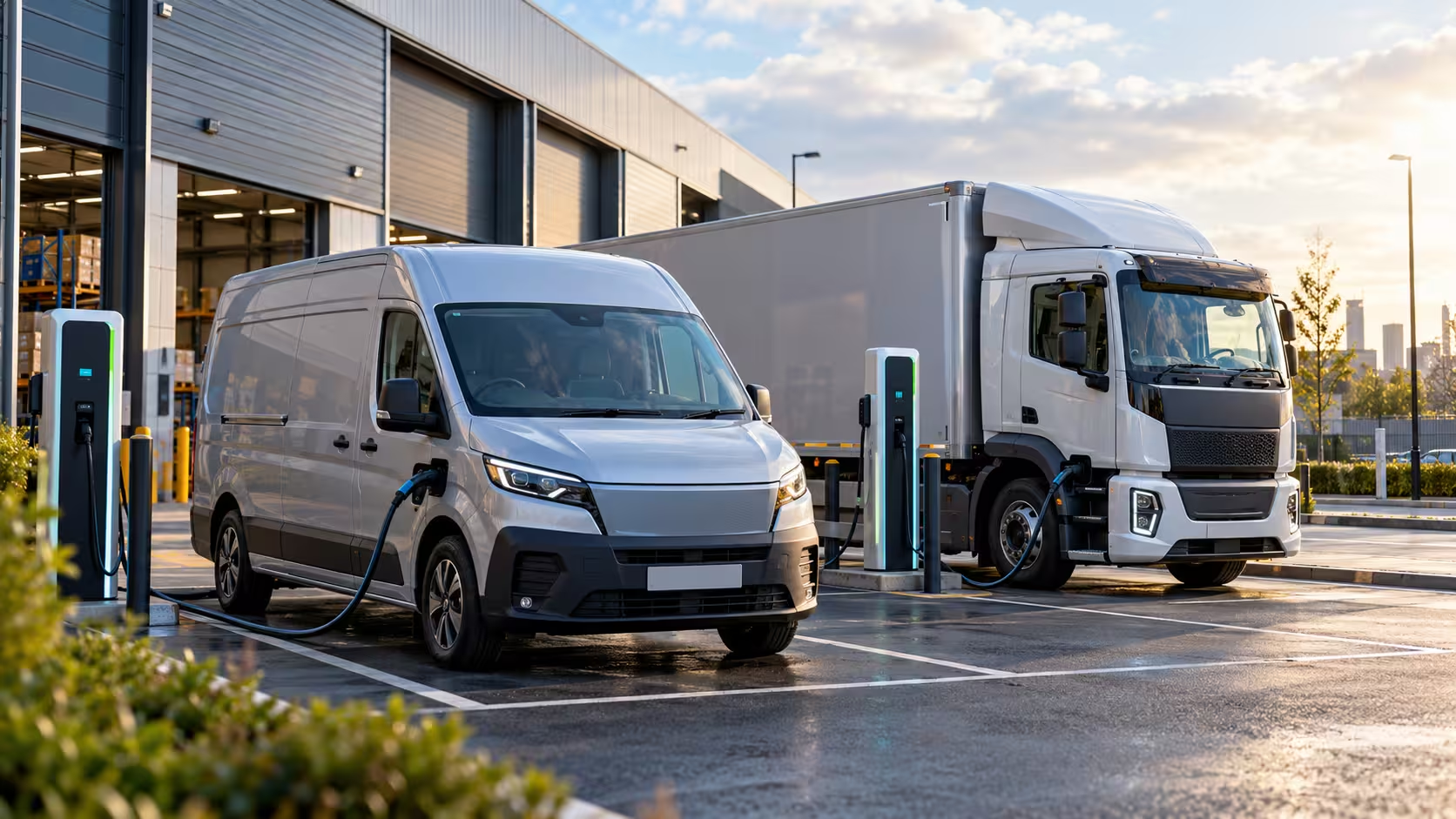
The UK government’s decision to extend electric van and truck discounts has become more significant for businesses following major changes to commercial vehicle grants in 2026.
What began as an extension of the Plug-in Van and Truck Grant in August 2025 has developed into a longer-term funding programme to help British businesses replace diesel vehicles with zero-emission alternatives.
Under the current arrangements, qualifying businesses can receive discounts of up to £5,000 on electric vans and up to £81,000 on eligible heavy electric trucks. Separate funding also supports commercial charging infrastructure.
For startups, tradespeople, delivery operators and established logistics businesses, these grants could substantially reduce vehicle acquisition costs.
However, the financial benefits depend on vehicle eligibility, daily mileage, charging access and operating requirements.
We analysed the updated government guidance, commercial vehicle market figures and published industry assessments to understand what the extension means for UK businesses in 2026 and beyond.
What Are the Latest Government Electric Van and Truck Discounts in 2026?
The government originally announced on 18 August 2025 that electric van and truck purchase grants would continue until at least 2027.
At that time, the maximum discounts were £2,500 for small vans, £5,000 for large vans, £16,000 for smaller trucks and £25,000 for larger trucks.
The position changed substantially in 2026.
On 25 March 2026, the Department for Transport announced a wider commercial vehicle support package. The revised Zero Emission Van Grant and Zero Emission Truck Grant arrangements took effect from 1 April 2026.
The funding framework now extends to 31 March 2030, subject to available budgets and changes to the schemes.
Current Electric Van and Truck Grant Rates
| Vehicle category | Maximum grant | Percentage limit |
| Small electric van (under 2.5 tonnes) | £2,500 | Up to 35% |
| Large electric van (2.5–4.25 tonnes) | £5,000 | Up to 35% |
| Electric truck (4.25–12 tonnes) | £15,000 | Up to 20% |
| Electric truck (12–18 tonnes) | £37,000 | Up to 40% |
| Electric truck (18–26 tonnes) | £52,000 | Up to 40% |
| Electric truck (over 26 tonnes) | £81,000 | Up to 40% |
The maximum truck discounts shown above apply in Great Britain. Different percentage restrictions apply to larger businesses in Northern Ireland.
The discount is the lower of the relevant percentage and monetary cap. Therefore, not every qualifying vehicle receives the full advertised maximum.
Our assessment: The revised funding creates a more meaningful purchasing incentive for medium and heavy commercial vehicles. Previously, the highest published truck grant in August 2025 was £25,000. The current maximum of £81,000 is 224% higher, although it applies under a different grant structure.
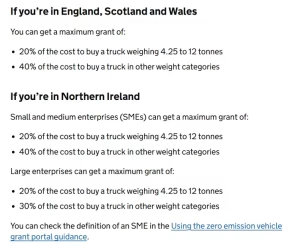
Current government electric truck grant categories and maximum discounts in 2026.
Why Has the Government Extended Electric Van and Truck Discounts?
The extension addresses two important challenges facing commercial transport operators: the higher purchase price of electric vehicles and the investment required to operate them.
Electric commercial vehicles can provide lower energy and maintenance costs, but their initial price can be considerably higher than comparable diesel models.
This creates financial pressure for smaller businesses that rely on vans or trucks to generate revenue.
A plumbing company purchasing its first electric van, for example, must consider more than the manufacturer’s advertised price. It must also budget for insurance, charging equipment, electricity, financing and any loss of carrying capacity.
The government’s revised grant programme attempts to reduce these barriers while supporting the transition towards zero-emission commercial transport.
The March 2026 funding announcement included £877 million for zero-emission van and truck purchase grants and approximately £171 million for the Depot Charging Scheme.
These funds are intended to support the commercial vehicle transition through to 2030, although funding allocations and individual grant conditions can change.
In our analysis, the strongest aspect of this approach is the combination of vehicle and infrastructure support. Discounting a truck without addressing where it can charge would solve only part of an operator’s problem.
Which Electric Vans Qualify for Government Discounts?
Not every electric van automatically qualifies for the government grant.
Vehicles must satisfy the relevant technical requirements and appear on the government’s approved list.
The basic criteria include zero tailpipe CO₂ emissions, a minimum zero-emission driving range of 60 miles and compliance with the specified vehicle weight limits.
Several familiar electric commercial vehicles currently appear on the approved lists.
| Electric van | Grant category | Maximum available |
| Citroën ë-Berlingo | Small van | £2,500 |
| Renault Kangoo E-Tech, qualifying variants | Small van | £2,500 |
| Nissan Townstar, qualifying variants | Small van | £2,500 |
| Ford E-Transit Courier | Small van | £2,500 |
| Ford E-Transit Custom, qualifying variants | Large van | £5,000 |
| Mercedes-Benz eSprinter | Large van | £5,000 |
| Volkswagen ID. Buzz Cargo | Large van | £5,000 |
| Kia PV5 Cargo | Large van | £5,000 |
| Maxus eDeliver 9 | Large van | £5,000 |
These are maximum grant amounts, not guaranteed discounts for every specification.
Businesses should confirm the exact model, variant and registration eligibility before placing an order.
The full list can be checked through the government’s eligible electric van models and grant limits.
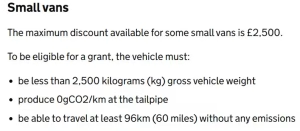
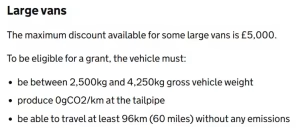
Government-approved electric van models eligible for discounts of up to £5,000.
How Much Could Businesses Actually Save When Buying Electric Vehicles?
The maximum grant figure is important, but businesses should calculate the percentage reduction against their actual vehicle quotation.
For example, consider three hypothetical purchases.
| Vehicle | Illustrative price | Grant applied | Price after grant | Price reduction |
| Small electric van | £32,000 | £2,500 | £29,500 | 7.8% |
| Large electric van | £48,000 | £5,000 | £43,000 | 10.4% |
| Heavy electric truck | £240,000 | £81,000 | £159,000 | 33.8% |
These examples assume that the vehicle qualifies for the maximum grant. They use consistent illustrative prices solely to demonstrate the calculation; they are not verified dealer quotations.
Actual invoice treatment, VAT, finance costs and other manufacturer discounts must be checked separately.
An £81,000 discount on a heavy electric truck could make a major difference to the amount a haulage business needs to finance.
Nevertheless, even a heavily discounted electric truck can remain more expensive than its diesel equivalent.
For that reason, we would not judge affordability based on the grant alone.
A business should compare the complete cost of acquiring and operating each vehicle over its expected working life.
How Can Businesses Apply for Electric Van and Truck Grants?
One of the most useful features of the scheme is that qualifying purchasers normally do not need to submit an individual government grant application.
The discount is applied through the approved vehicle manufacturer or dealership.
The buyer receives the deduction from the qualifying purchase price, while the approved supplier handles the government claim.
A business should first select an eligible vehicle and confirm that the specific variant is approved.
Next, it should request a written quotation showing the vehicle price, government grant and final amount payable.
For financed purchases, the business should ask whether the grant has already been reflected in the quoted monthly payments.
This distinction is important because a low headline price can be misleading when the finance quotation includes additional charges.
The current scheme generally applies to new eligible vans and trucks at their first registration. A business purchasing a second-hand electric vehicle should not assume that the same grant is available.
For startups considering vehicle finance alongside other borrowing, understanding business debt and its repayment obligations is important before entering a long-term finance agreement.
Are Electric Vans Cheaper to Run Than Diesel Vans?
Electric vans can be cheaper to power than diesel vehicles, particularly where businesses have access to reasonably priced overnight or depot charging.
However, the savings depend heavily on the electricity tariff, vehicle efficiency and annual mileage.
We modelled the following example for a business van travelling 15,000 miles annually.
| Cost assumption | Diesel van | Electric van |
| Annual mileage | 15,000 miles | 15,000 miles |
| Efficiency | 30 mpg | 0.35 kWh/mile |
| Energy price | £1.50/litre | £0.25/kWh |
| Estimated annual energy cost | £3,410 | £1,313 |
| Estimated annual energy savings | — | £2,097 |
| Energy cost reduction | — | 61.5% |
This is an illustrative calculation, not an independently measured fleet result. It excludes charging losses, maintenance, taxation, insurance, depreciation and finance charges.
Nevertheless, it demonstrates why electricity costs are central to the business case.
At the assumed electricity price, the electric van’s annual energy spend is approximately 61.5% below the diesel equivalent.
If the same electric van regularly uses public rapid charging at £0.70/kWh, its estimated annual electricity cost would rise to £3,675.
That would exceed the modelled diesel fuel cost.
This comparison highlights an important issue frequently overlooked in simple EV savings claims: electric vehicles are not automatically cheaper to operate on every route or charging arrangement.
The government has previously cited potential annual fuel savings exceeding £2,800, but this should be understood as a scenario-dependent estimate rather than a guaranteed saving for every business.
What Other Government Support Is Available for EV Charging?
Vehicle purchase discounts are only one part of the support available.
Businesses may also qualify for separate assistance with charging infrastructure.
Depot Charging Scheme
The Depot Charging Scheme supports eligible commercial fleet operators installing charging equipment at depots.
The first 2026 application window offered funding covering up to 70% of eligible charging equipment and associated civil works, subject to a maximum of £1 million across an applicant’s sites.
That window closed on 30 June 2026.
Government grant guidance subsequently indicated that a second application window was expected between 28 October 2026 and 29 January 2027, with its terms and grant rates still requiring confirmation.
Businesses should verify the live application arrangements rather than assume the first-window funding percentage will automatically apply to later rounds.
Workplace Charging Scheme
The Workplace Charging Scheme also changed in April 2026.
Eligible organisations can now receive up to £500 per charging socket, subject to the scheme’s overall contribution limits.
The scheme supports a maximum of 40 sockets across an applicant’s sites and is available until 31 March 2027 under the current arrangements.
For companies operating commercial fleets, it is worth understanding how EV charging infrastructure for commercial fleets can be designed around vehicle schedules and electricity availability.
Our assessment is that charging capacity should be evaluated before a major vehicle order is signed. An operator that cannot reliably recharge its vehicles between shifts risks losing productivity regardless of the purchase discount.
What Do Industry Experts Say About the Electric Vehicle Grant Extension?
Published industry commentary highlights the value of continued funding while identifying the practical barriers facing transport operators.
Mike Hawes, Chief Executive of the Society of Motor Manufacturers and Traders (SMMT), welcomed the longer-term commercial vehicle funding announcement in March 2026.
His assessment emphasised that grant support must be accompanied by sufficient charging infrastructure, suitable electricity grid connections and regulations that reflect the different requirements of commercial operators.
SMMT
This is significant because electric commercial vehicles do not operate under the same conditions as private cars.
A courier completing local deliveries may have several opportunities to charge a van. A heavy goods vehicle travelling long distances with a demanding schedule has far less flexibility.
The commercial vehicle transition therefore requires different approaches across different industries.
Lee Holmes, Transport and Logistics Director at Wren Kitchens and Bedrooms, has also publicly discussed the business benefits of government support.
In March 2026, he explained how investment had helped the company introduce 44-tonne electric trucks and rapid charging facilities, reducing its reliance on conventional fuels.
His comments illustrate how some established operators are approaching the transition through vehicle and infrastructure investment together.
GOV.UK
From our review of these published comments, the central message is consistent: grants can improve affordability, but successful electrification requires dependable charging infrastructure and operational planning.
How Popular Are Electric Vans in the UK in 2026?
Electric van adoption continues to grow, although the market remains some distance from the government’s intended zero-emission transition trajectory.
SMMT figures published on 5 October 2026 recorded 4,832 new battery-electric light commercial vehicle registrations during September.
This represented a 13.4% increase compared with September 2025.
Electric light commercial vehicles accounted for 9.6% of registrations in September, while their year-to-date share reached 10.8%.
The industry contrasted that figure with the 24% zero-emission van mandate target for 2026, although registration market share and manufacturer compliance calculations are not identical measures.
SMMT
Battery-electric LCV share, January–September 2026, compared with mandate target
Actual year-to-date share
10.8%
2026 mandate target
24%
The 10.8% share is equivalent to 45% of the 24% target; this is a comparison of market indicators, not a manufacturer compliance calculation. Source: SMMT, October 2026.
The figures suggest that manufacturer investment and government support are encouraging adoption, but affordability and infrastructure remain substantial barriers.
For smaller businesses, the expansion of approved electric van models should improve vehicle choice over time.
The wider use of electric delivery vehicles can already be seen in examples of sustainable logistics and electric fleet operations.
Which Businesses Benefit Most From Electric Van and Truck Grants?
Not every business will benefit equally from replacing diesel vehicles.
We assessed four common commercial applications using route predictability, charging accessibility, payload requirements and likely fleet utilisation.
The following percentages are our editorial suitability assessments, not customer review ratings or results from a fleet operator survey.
| Business type | Editorial suitability score | Reason |
| Local delivery and courier operations | 90% | Predictable routes and regular depot returns |
| Tradespeople and service businesses | 85% | Often suitable for regional journeys and overnight charging |
| Urban distribution fleets | 80% | Frequent stop-start operation and established delivery zones |
| Long-distance heavy haulage | 55% | Greater dependence on charging availability, payload and scheduling |
These scores indicate relative operational suitability under favourable charging conditions, rather than a mathematically validated probability of savings.
Local Delivery Businesses
Local delivery operators are among the strongest candidates for electric vans.
Their routes may be planned around specific geographical areas, making it easier to estimate daily energy consumption and arrange overnight charging.
Tradespeople and Service Businesses
Electric vans can be particularly practical for electricians, plumbers, maintenance companies and similar businesses.
They may offer lower day-to-day energy costs while supporting journeys between nearby customer locations.
However, businesses carrying heavy tools or towing equipment must confirm that the selected vehicle can meet their payload and operational requirements.
Vehicle Rental Businesses
Commercial rental operators could also consider incorporating electric vans into their fleets.
For businesses planning a vehicle rental operation in the UK, an electric offering may attract customers seeking lower-emission transport.
However, rental businesses must also account for vehicle depreciation, customer charging arrangements and residual value risk.
Long-Distance Haulage
Electric trucks present greater planning challenges for operators covering long distances.
These businesses need to consider real-world driving range, freight weight, charging speeds, driver schedules and the availability of suitable high-capacity chargers.
The larger truck grants can reduce capital expenditure substantially, but they do not eliminate these requirements.
What Are the Biggest Challenges When Switching to Electric Commercial Vehicles?
Even with government discounts, several financial and operational challenges remain.
The first is the higher initial cost of some electric vehicles. A grant can reduce the gap between diesel and electric alternatives without necessarily removing it.
The second is charging infrastructure. Installing chargers at a commercial depot may require electrical upgrades, landlord permission and significant capital investment.
The third concern is operational flexibility.
Electric vans operating fixed urban routes may be relatively straightforward to integrate, while longer commercial journeys require careful assessment of charging availability and downtime.
Battery performance can also vary with temperature, vehicle loading, driving style and accessory use.
Businesses should therefore base purchasing decisions on realistic working conditions rather than maximum advertised driving range.
Finally, financing costs and depreciation must be included in any commercial comparison.
A business that saves £2,000 annually on energy could still face a higher total ownership cost if its vehicle financing, insurance and depreciation costs are substantially greater.
Should Small Businesses Buy Electric Vans in 2026 or Wait?
The decision depends on whether an electric vehicle already meets the business’s requirements.
Waiting for future grants may not always be sensible, particularly because current funding rates are subject to government review and available budgets.
However, purchasing immediately simply because a discount exists can also be a costly mistake.
We would approach the decision by comparing the following factors.
| Decision factor | Consider buying now | Consider delaying |
| Charging access | Reliable home or depot charging | No dependable charging solution |
| Daily routes | Regular, predictable mileage | Frequent unpredictable long trips |
| Vehicle availability | Approved model meets requirements | Suitable vehicle not yet available |
| Business finances | Affordable purchase or finance terms | Financing creates cash-flow pressure |
| Replacement timing | Current vehicle nearing replacement | Existing vehicle still economical |
A startup that already needs to replace a diesel van may benefit from purchasing an approved electric alternative now.
By contrast, a business with a relatively new diesel vehicle and no charging facilities may achieve better financial results by delaying the transition until its operational arrangements improve.
The grant should support a commercially justified purchase, not create the justification for one.
How Will the Government’s Electric Vehicle Strategy Develop Towards 2030?
The government’s revised funding programme provides a longer planning horizon for businesses considering fleet electrification.
The £877 million purchase-grant allocation covers the Zero Emission Van Grant and Zero Emission Truck Grant framework to the end of March 2030.
Additional infrastructure funding is intended to help operators prepare depots and charging facilities.
However, a scheme operating until 2030 does not mean that the same individual grant amounts are guaranteed for every year.
The Office for Zero Emission Vehicles can review grant values, technical criteria and approved vehicle lists.
Businesses should therefore check the current rules before committing to future vehicle purchases.
The introduction of more electric commercial vehicle models, greater charging capacity and improvements in fleet technology may help increase adoption over the coming years.
However, the pace of change will also depend on vehicle affordability, electricity prices, infrastructure availability and the ability of operators to maintain their existing service standards.
Final Thoughts: Are Government Electric Van and Truck Discounts Worth It?
The government’s decision to extend electric van and truck discounts is an important development for UK businesses planning to modernise their commercial fleets.
The changes introduced in April 2026 have made the support more substantial for certain truck categories, with maximum discounts reaching £81,000.
Electric van grants of up to £5,000 remain particularly relevant to smaller businesses, tradespeople and delivery operators.
The wider funding programme also acknowledges that affordable vehicles alone are insufficient. Reliable charging infrastructure and realistic operating costs are equally important.
Our analysis indicates that businesses with predictable routes, regular charging access and high vehicle utilisation are likely to have the strongest commercial case for electrification.
For operators without these advantages, careful cost modelling remains essential.
Ultimately, the best decision is not simply to buy the vehicle with the largest government discount. It is to choose the vehicle that delivers reliable service at the most sustainable total cost for the business.
Frequently Asked Questions
Is the electric van and truck grant still available in 2026?
Yes. The current Zero Emission Van Grant and Zero Emission Truck Grant schemes operate under a funding framework extending to March 2030, subject to budgets and future changes.
What is the maximum electric van discount?
Eligible small electric vans can receive up to £2,500, while eligible large electric vans can receive up to £5,000, subject to the 35% discount limit.
Can a business receive £81,000 towards an electric truck?
Yes, qualifying electric trucks weighing over 26 tonnes can receive up to £81,000, subject to the relevant percentage and eligibility rules.
Do businesses need to apply directly for the vehicle grant?
Normally, no. The approved dealership or manufacturer applies the grant as a discount at the point of purchase.
Does the grant apply to second-hand electric vans?
No. The scheme generally supports eligible new vehicles at first registration, not used vans.
Are electric van grants available in Scotland and Northern Ireland?
Yes. The schemes operate across the UK, although Northern Ireland has additional conditions, particularly for larger enterprises purchasing electric trucks.
Can businesses get separate grants for installing EV chargers?
Yes. Eligible businesses may qualify for the Workplace Charging Scheme or the Depot Charging Scheme, subject to their respective eligibility rules and application windows.
Are electric vans cheaper to operate than diesel vans?
They can be, particularly when using lower-cost charging. However, total savings depend on mileage, energy tariffs, vehicle efficiency, maintenance and financing.