


Health and safety in the workplace is primarily the employer’s responsibility. Employers must identify workplace risks, introduce appropriate controls, provide suitable training and equipment, maintain safe premises, consult workers and protect both physical and mental health.
In Great Britain, these duties are mainly governed by the Health and Safety at Work etc. Act 1974 and supporting regulations. Employers must take reasonably practicable steps to prevent employees and other people affected by their activities from being exposed to avoidable risks.
Recent figures show why these responsibilities remain important. HSE estimates that 1.9 million workers suffered from work-related ill health in 2024/25, while around 40.1 million working days were lost because of work-related illness and non-fatal workplace injuries. Separate provisional figures show 126 workers were killed in work-related incidents in Great Britain during 2025/26.
What Does Health and Safety in the Workplace Mean for Employers?
Health and safety in the workplace means managing work so that employees and other people are not exposed to unnecessary risks of injury or ill health.
An employer does not have to guarantee that every workplace will be completely risk-free. Instead, the law generally requires employers to do what is reasonably practicable to protect people.
This involves considering the seriousness and likelihood of a risk and taking proportionate measures to control it.
Health and safety is therefore much wider than preventing obvious accidents.
Depending on the workplace, employers may need to manage risks involving machinery, vehicles, manual handling, chemicals, slips and falls, working at height, noise, display screen equipment, extreme temperatures and workplace stress.
The precise controls needed will depend on the type and size of the organisation and the hazards created by its activities.
Why Are Employers Responsible for Health and Safety at Work?

Employers generally have greater control over how work is organised, what equipment is purchased, where people work and what procedures employees must follow. This places them in the strongest position to identify and manage workplace risks.
The duty does not extend only to employees. Under Section 3 of the Health and Safety at Work etc. Act 1974, employers must also conduct their activities so that people who are not employees are not exposed to risks to their health or safety, so far as is reasonably practicable.
This could include customers, contractors, visitors or members of the public.
Good health and safety management also makes commercial sense. Workplace accidents and illness can cause absence, staff turnover, operational disruption, compensation claims and reputational damage.
HSE reported that injuries and new cases of work-related ill health arising from current working conditions carried an estimated annual cost of £22.9 billion in 2023/24.
Sarah Albon, HSE Chief Executive:
“Workplace health challenges persist, particularly around mental health.”
Which Laws Cover Employers’ Health and Safety Responsibilities?
The Health and Safety at Work etc. Act 1974 remains the central piece of workplace health and safety legislation across England, Scotland and Wales. Its age does not make it outdated. It continues to form the basis of employers’ general health and safety duties.
A range of additional regulations deal with particular aspects of workplace safety.
| Legislation | Main Employer Responsibility |
| Health and Safety at Work etc. Act 1974 | Protect employees and others from workplace health and safety risks |
| Management of Health and Safety at Work Regulations 1999 | Assess risks and establish arrangements to control them |
| Reporting of Injuries, Diseases and Dangerous Occurrences Regulations 2013 | Report specified serious workplace incidents and occupational diseases |
| Workplace (Health, Safety and Welfare) Regulations 1992 | Provide suitable workplace conditions and welfare facilities |
| Health and Safety (First-Aid) Regulations 1981 | Provide adequate and appropriate first-aid arrangements |
| Personal Protective Equipment at Work Regulations | Ensure suitable PPE is provided where necessary |
| COSHH Regulations 2002 | Assess and control risks from hazardous substances |
Different or additional regulations may apply to higher-risk activities such as construction, asbestos work, lifting operations and work at height.
Northern Ireland has a separate legal framework.
Employer duties there are primarily based on the Health and Safety at Work (Northern Ireland) Order 1978 and the Management of Health and Safety at Work Regulations (Northern Ireland) 2000, with HSENI acting as the relevant regulator.
What Are the Main Health and Safety Responsibilities of Employers?
Although requirements vary between workplaces, most employers have several core responsibilities.
| Employer Responsibility | What It Means in Practice |
| Risk Assessment | Identify hazards, evaluate risks and introduce appropriate controls |
| Health and Safety Policy | Explain how health and safety will be managed within the organisation |
| Safe Workplace | Maintain premises, access routes and working conditions |
| Safe Equipment | Keep machinery and work equipment suitable and properly maintained |
| Training and Supervision | Give employees the knowledge and support needed to work safely |
| PPE | Provide suitable protective equipment where risks cannot otherwise be adequately controlled |
| Welfare Facilities | Provide toilets, washing facilities, drinking water and suitable rest arrangements |
| First Aid | Provide adequate equipment, facilities and personnel based on workplace needs |
| Employee Consultation | Involve workers or their representatives in relevant health and safety matters |
| Incident Management | Record incidents and report those covered by RIDDOR |
| Mental Health Risks | Assess and control work-related stress and other relevant psychological risks |
| Monitoring | Review controls and improve them where circumstances change |
These responsibilities should form part of normal business management rather than being treated as a one-off compliance exercise.
How Should Employers Carry Out Workplace Risk Assessments?

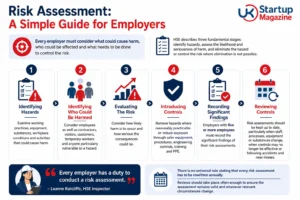
Every employer must consider what could cause harm, who could be affected and what needs to be done to control the risk.
HSE describes three fundamental stages: identify hazards, assess the likelihood and seriousness of harm, and eliminate the hazard or control the risk where elimination is not possible.
A practical risk assessment usually involves:
- Identifying Hazards: Examine working practices, equipment, substances, workplace conditions and activities that could cause harm.
- Identifying Who Could Be Harmed: Consider employees as well as contractors, visitors, customers, temporary workers and anyone particularly vulnerable to a hazard.
- Evaluating The Risk: Consider how likely harm is to occur and how serious the consequences could be.
- Introducing Controls: Remove hazards where reasonably practicable or reduce exposure through safer equipment, procedures, engineering controls, training and PPE.
- Recording Significant Findings: Employers with five or more employees must record the significant findings of their risk assessments.
- Reviewing Controls: Risk assessments should be kept up to date, particularly when staff, processes, equipment or substances change, when controls may no longer be effective or following accidents and near misses.
There is no universal rule stating that every risk assessment has to be rewritten annually. Reviews should instead take place often enough to ensure the assessment remains valid and whenever relevant circumstances change.
Leanne Ratcliffe, HSE Inspector:
“Every employer has a duty to conduct a risk assessment.”
Does Every Employer Need a Written Health and Safety Policy?
Every business must have arrangements for managing health and safety, but whether the policy has to be written depends on the number of employees.
If an organisation employs five or more people, its health and safety policy must be written down. Businesses with fewer than five employees do not have to put the policy in writing, although HSE says doing so can still be useful.
A well-structured policy normally has three main parts.
Statement of Intent
This explains the organisation’s overall approach and commitment to managing health and safety.
Responsibilities
This identifies who is responsible for particular health and safety tasks within the business.
Arrangements
This explains the practical systems used to achieve the policy, including risk assessments, training, emergency arrangements, workplace inspections and safety procedures.
Employers should share the policy and any changes with employees. It should also be reviewed when business activities, responsibilities or risks materially change.
What Training and Supervision Must Employers Provide?

Employees need enough information, instruction, training and supervision to perform their jobs without exposing themselves or others to avoidable risks.
The amount of training needed will depend on the job.
A low-risk office worker may require basic induction, emergency procedures and workstation guidance, while an employee operating industrial machinery may need detailed competency-based training and close supervision.
Training may be particularly important when:
- An employee starts a new job
- New equipment or technology is introduced
- Working procedures change
- Employees take on unfamiliar duties
- Existing knowledge needs refreshing
- An incident identifies a weakness in current practices
Training alone is not enough where physical safeguards or safer working methods are reasonably practicable. Employers should first try to eliminate or control hazards and then use instruction and training to support those controls.
Adequate supervision is also important. Employers should check that workers understand procedures and are actually following them.
What Equipment, PPE and Workplace Facilities Must Employers Provide?
Employers must ensure that work equipment and the working environment are suitable and safe for their intended use.
Workplaces should have appropriate ventilation, lighting, space, cleanliness and reasonable temperatures. Employers must also maintain premises and equipment and keep floors and traffic routes free from avoidable obstructions.
Workers must generally have access to suitable welfare facilities such as toilets, washing facilities, drinking water and somewhere appropriate to rest and eat meals.
Where risks cannot be adequately controlled through other measures, employers may also need to provide suitable PPE. HSE guidance confirms that necessary protective clothing or equipment should be provided free of charge.
Laura Artosi, HSE Inspector:
“Employers have a duty to create a safe and healthy work environment for their employees.”
What First-Aid Responsibilities Do Employers Have?
Employers must make adequate and appropriate first-aid provision so that employees can receive immediate attention if they become injured or ill at work.
Under the Health and Safety (First-Aid) Regulations 1981, employers should carry out a first-aid needs assessment covering factors such as workplace hazards, workforce size and working arrangements.
The minimum provision will commonly include a suitably stocked and accessible first-aid kit. Depending on the workplace, trained first-aiders, additional equipment or a dedicated first-aid room may also be required.
Importantly, there is no single number of first-aiders that is suitable for every organisation. Provision should reflect the risks and circumstances of the individual workplace.
Are Employers Responsible for Mental Health and Work-Related Stress?
Yes. Health and safety responsibilities extend beyond physical accidents.
Employers have a legal duty to assess and manage risks from work-related stress in the same way they consider other workplace health and safety risks.
HSE specifically states that employers should assess the potential impact of stress on both mental and physical health.
This has become particularly important because HSE recorded 964,000 workers experiencing work-related stress, depression or anxiety in 2024/25, accounting for more than half of workers reporting work-related ill health.
Employers should therefore look at factors such as excessive demands, lack of control, inadequate support, poor workplace relationships, badly managed organisational change and unclear roles.
Mental health support can be useful, but it should not replace action on problems created by the work itself. Preventing or reducing harmful workplace pressures is generally more effective than relying only on wellbeing programmes after problems have developed.
What Workplace Incidents Must Employers Report Under RIDDOR?
One common misunderstanding is that every workplace accident or near miss must be reported to HSE. That is not correct.
RIDDOR covers defined categories of work-related incidents. Reportable events include certain deaths, specified worker injuries, qualifying injuries to non-workers, over-seven-day incapacitation, specified occupational diseases and certain dangerous occurrences.
For many serious incidents, the responsible person must notify the enforcing authority without delay, with the report generally required within 10 days.
An accident resulting in a worker being unable to carry out normal duties for more than seven consecutive days must normally be reported within 15 days of the accident.
Employers must also retain records of reportable injuries, diseases and dangerous occurrences.
Internal recording can go beyond RIDDOR. Recording smaller accidents and near misses can help businesses identify patterns and weaknesses before more serious harm occurs.
Do Employers Have to Consult Employees About Health and Safety?
Yes. Employee consultation is an important part of health and safety management.
Employers should consult workers or their representatives about matters affecting their health and safety. HSE identifies employee consultation as one of the legal responsibilities organisations need to address.
Consultation can help employers identify hazards that managers may not notice. Employees working directly with equipment, customers, vehicles or production processes often understand practical risks particularly well.
Effective consultation should allow workers to raise concerns without fear of being ignored or penalised. Safety meetings, representatives, committees, staff surveys and direct discussions can all form part of this process depending on the workplace.
What Health and Safety Responsibilities Do Employees Have?
Employers carry the main responsibility for managing workplace health and safety, but employees also have legal duties.
| Employers | Employees |
| Assess and control workplace risks | Take reasonable care of themselves and others |
| Provide appropriate training | Follow training and instructions |
| Maintain safe equipment | Use equipment correctly |
| Provide required PPE | Wear and use PPE properly |
| Establish safe working procedures | Follow established procedures |
| Consult workers | Participate in consultation where appropriate |
| Investigate and manage incidents | Report hazards, accidents and problems |
| Monitor workplace safety | Cooperate with reasonable safety measures |
An employer cannot simply transfer its legal duties to employees. Equally, employees are expected to cooperate with reasonable health and safety measures and avoid behaviour that could put themselves or others at risk.
Clear responsibilities on both sides help create a workplace where safety becomes part of everyday decision-making.
What Happens If Employers Fail to Meet Their Health and Safety Responsibilities?
Failure to comply with workplace health and safety law can lead to regulatory action, prosecution and substantial financial penalties.
HSE and other enforcing authorities can investigate workplaces and, depending on the circumstances, issue enforcement notices.
A prohibition notice can stop an activity where there is a risk of serious personal injury, while an improvement notice can require specified deficiencies to be corrected.
Serious breaches may result in criminal prosecution. HSE confirms that sanctions for health and safety failures can include fines, imprisonment and, in appropriate circumstances, disqualification.
Individual directors or managers may also face prosecution where an offence occurs with their consent, connivance or because of their neglect.
Enforcement is not only a theoretical risk. HSE continues to prosecute businesses where inadequate risk assessments, guarding, supervision or safe systems of work contribute to serious injuries.
Financial penalties are only one consequence. Serious incidents can also cause lost working time, insurance costs, employee dissatisfaction, recruitment difficulties and lasting reputational damage.
How Can Employers Improve Workplace Health and Safety in 2026?
Effective health and safety management should be continuous rather than something completed once and forgotten.
Employers can strengthen their approach by:
- Reviewing risk assessments whenever work, staff, equipment or hazards change
- Checking that written policies reflect how the business actually operates
- Giving employees appropriate training and supervision
- Acting quickly when workers report hazards or unsafe practices
- Investigating accidents and near misses to identify underlying causes
- Monitoring physical and psychological workplace risks
- Maintaining equipment and checking safety controls regularly
- Reviewing first-aid, emergency and welfare arrangements
- Consulting employees before introducing significant workplace changes
- Keeping accurate records of training, inspections and relevant incidents
The objective should not be to create the largest possible collection of safety paperwork.
Documentation matters, but practical risk control matters more. HSE specifically warns employers not to rely purely on paperwork and says the priority should be controlling risks in practice.
What Should Employers Remember About Health and Safety in the Workplace?
Health and safety in the workplace is an ongoing employer responsibility rather than a one-time compliance task.
Employers should understand their risks, introduce proportionate controls, maintain safe premises and equipment, provide suitable training and supervision, consult workers and respond when circumstances change.
Physical safety and occupational health, including work-related stress, should both form part of this process.
The Health and Safety at Work etc. Act 1974 remains the central framework in Great Britain, supported by regulations covering areas such as risk assessment, first aid, workplace facilities and incident reporting.
Businesses that integrate these responsibilities into everyday management are better placed to protect employees, comply with the law and reduce the financial and operational consequences of workplace accidents and ill health.
Frequently Asked Questions
What Are the Main Health and Safety Responsibilities of an Employer?
Employers must assess and control workplace risks, provide a safe working environment, maintain suitable equipment and provide appropriate information, training, supervision, welfare facilities and emergency arrangements.
Do All Employers Need a Health and Safety Policy?
Yes, businesses need arrangements for managing health and safety. If the business has five or more employees, the health and safety policy must be written down.
Does a Business With Fewer Than Five Employees Need a Risk Assessment?
Yes. The duty to assess workplace risks still applies. Businesses with fewer than five employees generally do not have to record the significant findings in writing, although keeping a record can be useful.
How Often Should Workplace Risk Assessments Be Reviewed?
There is no general rule requiring every risk assessment to be rewritten annually. Employers should review controls when circumstances change, when controls may no longer work effectively or when incidents or worker feedback indicate a new problem.
Is an Employer Responsible for Work-Related Stress?
Yes. Employers must assess and manage risks to workers from work-related stress just as they manage other relevant health and safety risks.
Does Every Workplace Accident Have to Be Reported to HSE?
No. RIDDOR only requires specified categories of work-related accidents, injuries, occupational diseases and dangerous occurrences to be formally reported.
Can an Employer Be Prosecuted for Health and Safety Failures?
Yes. Serious breaches can lead to enforcement action and criminal prosecution, with possible fines and, for individuals in appropriate cases, imprisonment. Directors and managers can also face personal liability in certain circumstances.