
The milkshake tax has become an important issue for UK drinks manufacturers, food startups, importers and retailers because the government is changing how sugary milk-based drinks are treated under the country’s existing soft drinks levy.
For businesses, the immediate concern is not simply whether milkshakes will become more expensive. Product recipes, sugar levels, packaging arrangements, supplier contracts and future pricing strategies could all need attention before the new rules arrive.
The government has now confirmed the main policy, while draft legislation published in July 2026 provides businesses with more detail ahead of implementation. That makes 2026 and 2027 important preparation years, particularly for brands selling bottled milkshakes, flavoured milks and ready-to-drink coffees.
What Is the Milkshake Tax?
The term milkshake tax can be slightly misleading because the government is not introducing a completely separate tax exclusively for milkshakes.
Instead, it is expanding the existing Soft Drinks Industry Levy, commonly called the UK sugar tax, which has applied to qualifying sugary soft drinks since April 2018.
Milk-based drinks have historically received an exemption when they contain enough milk. Under the current rules, a drink can generally qualify as a milk-based drink for this purpose when it contains at least 75ml of milk for every 100ml of prepared drink.
That exemption means many bottled milkshakes and flavoured milk drinks have not been taxed in the same way as sugary fizzy drinks.
The government has decided to remove this exemption for milk-based drinks containing added sugar. Certain milk substitutes containing added sugar will also be brought within the levy.
Importantly, the levy is primarily a charge on qualifying drinks produced, packaged or imported commercially. It is not a separate tax that consumers will see automatically added to every milkshake purchase at the till.
When Does the Milkshake Tax Start in the UK?
The new treatment of milk-based and milk-substitute drinks is scheduled to begin on 1 January 2028.
This date is important because earlier discussion surrounding the policy may leave consumers or businesses believing the milkshake tax has already started.
As of 2026, qualifying milk-based drinks can still benefit from the existing exemption. The government’s 2028 reforms will change that position.
| Stage | Milkshake Tax Development |
| April 2018 | Soft Drinks Industry Levy introduced |
| April 2025 | Government consultation proposed strengthening the levy |
| November 2025 | Government confirmed milk-based drink exemption would be removed |
| 13 July 2026 | Draft legislation and technical consultation published |
| 6 September 2026 | Current technical consultation scheduled to close |
| 1 January 2028 | New rules scheduled to take effect |
HMRC’s July 2026 policy paper confirms that legislation is intended to be introduced through the Finance Bill 2026-27. The associated technical consultation remains open until 6 September 2026.
Businesses therefore have advance notice rather than facing an immediate change in 2026.
Which Milkshakes and Drinks Will Be Affected?
The biggest distinction is between pre-packaged commercial drinks and drinks freshly prepared for customers.
The new rules are intended to bring pre-packaged milk-based products with added sugar into the Soft Drinks Industry Levy.
Government examples include bottled milkshakes, flavoured milk, sweetened yoghurt drinks, chocolate milk and certain ready-to-drink coffees.
Drinks Likely to Come Within the Levy
Products potentially affected include:
- Bottled milkshakes with added sugar
- Pre-packaged chocolate milk
- Sweetened flavoured milk
- Packaged yoghurt-based drinks
- Certain ready-to-drink coffees containing milk and added sugar
- Sweetened milk-alternative drinks
- Other qualifying packaged milk beverages exceeding the relevant sugar threshold
Whether an individual product actually attracts the levy will depend on its ingredients and taxable sugar level.
Drinks That Will Remain Outside the Milkshake Tax
Not every drink containing milk will suddenly become taxable.
| Product | Expected Position From 2028 |
| Pre-packaged sugary milkshake | Potentially liable |
| Sweetened bottled chocolate milk | Potentially liable |
| Sweetened ready-to-drink milky coffee | Potentially liable |
| Fresh milkshake prepared in a café | Outside SDIL |
| Plain cow’s milk | Outside SDIL |
| Milk drink without added sugar | Outside SDIL |
| Qualifying milk substitute without added sugar | Outside SDIL |
The distinction should be particularly reassuring for independent milkshake bars, cafés and restaurants.
The government has specifically confirmed that open-cup beverages, including drinks prepared and served in cafés, will remain unaffected by the SDIL changes.
A café selling a freshly blended milkshake is therefore in a different position from a company producing thousands of bottles of a pre-packaged milkshake for supermarkets.
How Will the New Sugar Threshold Work?
Another important part of the reform is a reduction in the minimum sugar threshold for the wider Soft Drinks Industry Levy.
Currently, qualifying soft drinks become liable when they contain at least 5g of total sugar per 100ml.
From 1 January 2028, the lower threshold will fall to 4.5g per 100ml.
There is, however, an important complication for dairy milk.
What Is the Lactose Allowance?
Milk naturally contains lactose, which is a form of sugar. Taxing naturally occurring lactose in exactly the same way as sugar deliberately added to a milkshake would undermine the intended focus of the policy.
The government is therefore introducing a lactose allowance.
For milk-based drinks, the levy calculation will take account of total sugars while excluding qualifying sugars attributable to naturally occurring lactose in milk or milk products.
This makes the ingredients and nutritional composition of a product particularly important.
A manufacturer should not assume that the total sugar number displayed on a nutritional label automatically represents the amount that will be considered for levy purposes.
Plant-based alternatives will be treated differently. The existing blanket exemption for qualifying milk substitutes is being removed, although milk-substitute drinks without added sugar will remain outside the levy.
How Much Will the Milkshake Tax Cost?
There is no single fixed amount that can currently be described as the 2028 milkshake tax per bottle.
The levy operates through rates charged according to the volume and sugar band of qualifying drinks rather than through a flat charge added to each individual milkshake.
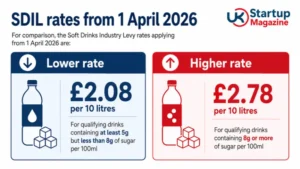
For comparison, the SDIL rates applying from 1 April 2026 are:
- £2.08 per 10 litres for qualifying drinks containing at least 5g but less than 8g of sugar per 100ml
- £2.78 per 10 litres for qualifying drinks containing 8g or more of sugar per 100ml
These are the current 2026 rates, not guaranteed 2028 rates.
The levy is now subject to annual uprating, meaning businesses should not build their 2028 forecasts around today’s rates.
This also means headlines claiming that every milkshake will automatically become a certain number of pence more expensive should be treated cautiously.
Manufacturers could respond in several ways. Some may reformulate their recipes to reduce sugar, others could absorb part of the levy, while some may pass additional costs through the supply chain.
Who Actually Pays the Milkshake Tax?
For startups, understanding who is legally responsible is more useful than simply knowing which drinks are covered.
The SDIL generally applies to businesses involved in producing, packaging or importing liable drinks rather than making ordinary consumers responsible for reporting or paying the levy directly.
A business may need to register with HMRC when it:
- Owns a brand and produces qualifying drinks
- Produces qualifying drinks under another company’s brand
- Bottles, cans or otherwise packages qualifying drinks for another business
- Imports qualifying packaged drinks into the UK
HMRC provides detailed guidance on which businesses need to register for the Soft Drinks Industry Levy.
Will Small Milkshake Startups Be Exempt?
The existing small-producer protection is expected to remain.
Under current rules, a producer can generally qualify as a small producer when it and connected businesses remain within the one million litre annual production threshold, subject to HMRC’s detailed tests.
The government has specifically said that the smallest producers will continue to be exempt when the levy is expanded.
This could protect many genuinely small drinks startups from directly paying SDIL.
Businesses approaching the threshold should nevertheless track production carefully rather than assuming that startup status alone provides an exemption.
What Does the Milkshake Tax Mean for UK Startups?
The 2028 date gives beverage businesses time to respond before the expanded levy begins.
For many brands, reformulation may be more commercially attractive than simply paying the levy.
That has been one of the main behavioural effects of the original sugar tax.
Government analysis states that average sugar content in soft drinks covered by SDIL fell by around 46% between 2015 and 2020 following extensive industry reformulation.
For a milkshake startup, preparation could involve:
- Reviewing Added Sugar in each recipe
- Separating Naturally Occurring Lactose from other sugars where relevant
- Testing Lower-Sugar recipes before reformulation deadlines
- Reviewing Packaging and production volumes
- Checking Whether Contract Manufacturers affect levy responsibilities
- Modelling Product Margins under different SDIL rates
- Reviewing Imported Drinks for potential liability
- Maintaining Accurate Production and ingredient records
The commercial opportunity should not be overlooked either.
Brands that can reduce added sugar while maintaining taste and texture may avoid or reduce levy exposure while appealing to customers looking for lower-sugar drinks.
Why Is the Government Expanding the Sugar Tax to Milkshakes?
The central policy objective is to encourage producers to reformulate high-sugar drinks rather than simply generate tax revenue.
Milk-based drinks were originally exempt partly because of concerns about the nutritional benefits of milk, particularly calcium intake among younger people.
The government later reconsidered whether this justified exempting heavily sweetened milk beverages.
Its review noted that milk-based drinks account for only around 3.5% of young people’s calcium intake, contributing to the decision to reconsider the exemption.
When confirming the policy in November 2025, the government estimated that the expanded levy and associated reformulation could remove around 17 million calories from daily national consumption.
The government’s own Budget costing assumes substantial reformulation. It estimates that around 65% of affected products could be reformulated to avoid the levy, based on experience following the original SDIL.
That figure helps explain why the milkshake tax is better understood as a reformulation incentive than simply a straightforward consumer tax.
Will Milkshakes Become More Expensive?
Some packaged milkshakes could become more expensive, but a nationwide fixed price rise is not part of the policy.
Businesses determine retail pricing themselves.
A producer whose product becomes liable could:
- Reformulate below the relevant threshold
- Reduce portion or bottle sizes
- Absorb some or all of the additional cost
- Renegotiate supplier costs
- Introduce lower-sugar alternatives
- Pass some of the cost to wholesalers or consumers
The government currently expects the direct effect of the reform on overall consumer price inflation to be negligible. It also estimates that, after expected reformulation, only an additional 4% of soft drink sales will ultimately pay SDIL because of these changes.
Freshly made café milkshakes are a different matter. Because open-cup drinks remain outside the levy, a customer buying a made-to-order shake should not assume its price will increase specifically because of the milkshake tax.
What Should Milkshake Businesses Do Before 2028?
UK Businesses do not need to treat the policy as an overnight tax change, but waiting until the end of 2027 could make compliance more difficult.
The first priority should be identifying exactly which products could enter the levy.
Businesses can then assess recipes, sugar composition, production volumes and manufacturing arrangements before deciding whether reformulation makes commercial sense.
Larger businesses should also determine whether they are likely to require HMRC registration and prepare systems capable of maintaining the necessary production and levy records.
There is still an active legislative process. HMRC’s 2026 technical consultation concerns draft legislation designed to implement the government’s already announced policy and is due to close on 6 September 2026.
Important: The main policy and planned 1 January 2028 commencement have been announced, but businesses making long-term tax calculations should continue checking final legislation and future SDIL rates before relying on exact cost projections.
Conclusion
The milkshake tax is not a blanket charge on every milkshake sold in Britain.
It is an expansion of the existing Soft Drinks Industry Levy that is scheduled to bring qualifying pre-packaged milk-based and milk-substitute drinks with added sugar into the system from 1 January 2028.
For UK startups, the biggest opportunity lies in preparing early.
Reviewing recipes, sugar levels, production volumes and packaging arrangements during 2026 and 2027 could give drinks businesses considerably more flexibility than simply absorbing additional costs once the new rules arrive.
Independent cafés serving freshly prepared open-cup milkshakes will remain outside the levy, while packaged drinks manufacturers and importers have much more reason to examine the new rules closely.
Frequently Asked Questions
Is the Milkshake Tax Already in Force in the UK?
No. Milk-based drinks still benefit from the relevant existing SDIL exemption in 2026, with the new rules scheduled to take effect on 1 January 2028.
Will McDonald’s and Café Milkshakes Be Taxed?
Freshly prepared open-cup milkshakes sold by cafés and similar outlets are outside the planned expansion of SDIL. Pre-packaged qualifying sugary milk drinks are treated differently and may become liable.
Does the Milkshake Tax Apply to Plain Milk?
No. Plain cow’s milk and milk-based drinks without added sugar will remain outside the levy.
Will Chocolate Milk Be Subject to the Milkshake Tax?
Pre-packaged chocolate milk containing added sugar may fall within the levy when the relevant sugar threshold is reached. The precise treatment will depend on the product’s composition and the lactose allowance.
Are Plant-Based Milkshakes Included?
Certain pre-packaged milk-substitute drinks containing added sugar will be brought into the expanded levy. Milk substitutes without added sugar are expected to remain outside its scope.
Will Small Drinks Companies Have to Pay the Milkshake Tax?
The government intends to retain the small-producer exemption, meaning many producers operating within the one million litre threshold will not pay the levy directly. Businesses still need to check HMRC’s detailed eligibility rules and connected-business requirements.
Why Is the Government Introducing a Milkshake Tax?
The government wants producers to reduce added sugar in packaged drinks and sees the Soft Drinks Industry Levy as an incentive for reformulation.
The existing levy has already been associated with substantial reductions in average sugar content across affected soft drinks.