

Updated: 30 October 2026
Octopus Energy Ofgem compensation became a major consumer rights issue after the UK energy regulator identified billing failures affecting 34,494 former prepayment meter customer accounts.
On 8 July 2025, Ofgem announced that Octopus Energy had agreed to provide £1.483 million in refunds, compensation and additional redress, with an average payment of approximately £43 per affected account.
The investigation found that Octopus had failed to issue final bills within the required six-week period to many prepayment customers who left the supplier between 2016 and October 2023.
For affected households, the problem was more significant than a missing document. Some customers were left without clear confirmation of their closing balances, outstanding credit or compensation rights.
We analysed the regulator’s detailed findings, Octopus Energy’s published response and the wider compensation rules applying in 2026. Our review focuses on the financial impact, the rights of former customers and the practical steps available to anyone who believes they missed a payment.
Importantly, the £43 average was not a guaranteed payment for every Octopus customer, and the 2025 ruling did not create a universal compensation scheme for all households.
What Happened in the Octopus Energy Ofgem Compensation Case?
The central problem was Octopus Energy’s failure to provide final bills to many departing prepayment customers within six weeks of their supply ending.
Prepayment customers normally purchase energy in advance, using a meter that records available credit. This differs from conventional credit billing, where households receive periodic bills for energy already consumed.
Although a prepayment meter can display an available balance, that information does not replace a formal closing statement.
Ofgem’s investigation established that the supplier had not met the relevant final billing requirements across thousands of accounts.
| Investigation detail | Confirmed finding |
| Energy supplier | Octopus Energy |
| Regulator | Ofgem |
| Announcement date | 8 July 2025 |
| Period examined | 2016 to October 2023 |
| Accounts affected | 34,494 |
| Main issue | Final bills not issued within six weeks |
| Total compensation and redress | £1,483,000 |
| Average amount per affected account | Approximately £43 |
| Main regulatory requirement | Standard Licence Condition 27.17 |
| Reported corrective action | Billing systems and processes updated |
The issue came to Ofgem’s attention following a similar problem reported by E.ON Next. The regulator subsequently examined compliance at other suppliers, including Octopus.
Our analysis shows why the investigation matters beyond its headline value. Failure to provide a final statement can prevent customers from identifying and recovering money that remains legally theirs.
Beth Martin, Ofgem’s director for consumer protection and competition, explained that customers need final bills to identify outstanding credit and reclaim it.
Her regulatory position is particularly relevant to prepayment households, where even relatively modest refunds may make a meaningful difference to a customer’s finances.
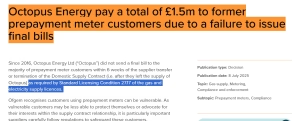
Ofgem confirms Octopus Energy’s £1.483 million compensation agreement following failures affecting more than 34,000 prepayment accounts.
How Was the £1.483 Million Octopus Energy Compensation Calculated?
One of the most important findings in our review is that the total compensation was divided into three distinct categories.
Ofgem’s detailed decision identifies refunds of unused customer credit, Guaranteed Standards of Performance payments and additional redress.
Breakdown of Octopus Energy Compensation
| Compensation category | Total amount | Share of total | Purpose |
| Outstanding credit refunds | £231,000 | 15.6% | Returning customer credit remaining on closed accounts |
| Guaranteed Standards payments | £1,040,000 | 70.1% | Compensation for breaches of applicable service standards |
| Additional redress | £212,000 | 14.3% | Recognising the impact of delayed refunds and payments |
| Total | £1,483,000 | 100% | Customer refunds and compensation package |
The percentage figures are calculated from the official compensation breakdown, rounded to one decimal place.
The largest component, representing approximately 70.1% of the total, related to Guaranteed Standards compensation.
This is an important distinction. The entire £1.483 million was not a regulatory fine paid to the government. It represented customer-focused redress, with arrangements for unclaimed funds to be transferred to the Energy Industry Voluntary Redress Fund.
Why Was the Average Compensation Approximately £43?
Dividing the overall £1.483 million package by 34,494 affected accounts produces an approximate average of £43.
However, an average is not an individual entitlement.
One customer might have been owed unused credit, another might have qualified for standard compensation, while another could have received additional redress because of the circumstances surrounding delayed payments.
For example, a former customer with outstanding meter credit and a qualifying final billing failure could potentially have had more than one component included in their settlement.
The precise amount depends on the individual’s records and applicable rules.
From a financial perspective, this is why customers should request an account-specific calculation rather than assume they are automatically owed £43.
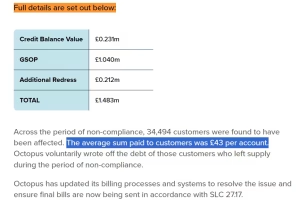
Official breakdown showing £231,000 in credit refunds, £1.040 million in Guaranteed Standards payments and £212,000 in additional redress.
Who Qualifies for Octopus Energy Ofgem Compensation?
The July 2025 compensation agreement primarily concerned former domestic prepayment meter customers whose accounts were affected by the historic final billing failures.
The principal eligibility factors were:
- The customer previously received electricity or gas from Octopus Energy through a prepayment arrangement.
- The customer left the supplier or closed the relevant account during the investigated period.
- A final bill was not issued within the required six-week period.
- The account fell within the population identified during the regulatory review.
Ofgem confirmed that Octopus attempted to contact affected customers using the details held on its records. Where customers could not be reached through ordinary contact information, a third-party tracing agency was used.
Does Every Former Octopus Customer Qualify?
No. Customers who used Octopus Energy but received their final statements correctly are not automatically included in the historic compensation agreement.
Similarly, being a current Octopus customer does not establish entitlement to this particular settlement.
| Customer circumstances | Potential entitlement |
| Former prepayment customer affected by the 2016–October 2023 failure | May qualify under the historic redress arrangement |
| Former customer who received an eligible late final bill | May have compensation rights depending on the breach date and payment history |
| Current customer with a new late final billing problem | Covered by applicable current billing rules if the conditions are met |
| Customer whose bill was correct and issued on time | Not automatically entitled to compensation |
| Customer experiencing a separate smart meter service failure | May qualify under different 2026 compensation rules |
| Customer affected by the separate 2025 overcharging investigation | Covered by that investigation’s own refund arrangements |
We would particularly encourage former tenants to check their records.
People moving out of rented properties can lose access to old email accounts, change postal addresses or assume that remaining prepayment credit transferred automatically.
The historic investigation demonstrates why keeping energy account information accessible after moving remains important.
Can You Still Claim Octopus Energy Ofgem Compensation in 2026?
Former customers who believe they were affected can still contact Octopus Energy to ask for an account review.
However, the original redress exercise was designed to contact affected customers proactively. Ofgem expected contactable customers to receive their payments by September 2025.
That historical expectation should not be mistaken for confirmation that every eligible person had received their money by October 2026.
The published decision does not establish a new open-ended application scheme or guarantee that every late enquiry will result in a payment.
How to Check Whether You Are Owed Money?
Step 1: Identify your former account.
Find your previous Octopus account number, former property address and approximate dates of supply.
Old correspondence, tenancy agreements and payment records may help.
Step 2: Confirm your meter type.
Check whether the property had a prepayment meter while Octopus supplied it. The original enforcement case concerned that group.
Step 3: Check your final bill.
Look for a closing statement issued within six weeks of leaving the supplier.
If you cannot find one, ask Octopus to confirm whether it was generated and when.
Step 4: Request a review of the redress record.
Ask whether your account was part of the 2025 Ofgem compensation exercise and whether a refund, cheque, account credit or another payment was issued.
Step 5: Request a breakdown.
If compensation was calculated, ask for the amounts attributed to unused credit, Guaranteed Standards compensation and any additional redress.
Step 6: Follow the complaints process if necessary.
If the supplier cannot resolve your concern, register a formal complaint and retain the correspondence.
Octopus Energy’s general customer service contact details are:
| Contact method | Details |
| Customer service email | hello@octopus.energy |
| Telephone | 0808 164 1088 |
| Website | octopus.energy |
| Ombudsman | Energy Ombudsman, once the relevant escalation conditions are met |
There is no need to use an unofficial compensation claims company simply to ask Octopus whether your account was affected.
What Happens If You Changed Address and Missed the Compensation?
This is a particularly relevant issue because the investigated accounts belonged to customers who had already left the supplier.
Ofgem confirmed that Octopus attempted to trace customers whose original contact information was no longer sufficient.
Where possible, payments were made directly to accounts. In other cases, cheques were sent.
The regulator also stated that money remaining unclaimed after reasonable contact attempts would be transferred to the Energy Industry Voluntary Redress Fund.
That fund supports projects intended to benefit energy consumers, particularly people in vulnerable circumstances.
If you have moved home or believe that a cheque was sent to an old address, request confirmation of the original payment method and whether the money was ever successfully received.
If you received an expired cheque, ask the supplier to review whether it can be reissued. Reissuance should not be assumed to be automatic.
For households managing rising utility costs, this historical compensation should also be distinguished from ongoing support. The DWP energy bill boost concerns energy-bill assistance rather than compensation for supplier billing failures.
What Did Octopus Energy Say About Ofgem’s Findings?
The supplier did not fully agree with Ofgem’s interpretation of the problem.
In a public statement dated 8 July 2025, Octopus Energy argued that conventional prepayment systems and incomplete moving-home information created substantial practical difficulties in producing final bills.
The company said that many prepayment customers did not notify it when moving and that obtaining accurate closing information was often difficult.
Its published statement included several percentages.
| Measure | Figure reported by Octopus |
| Prepayment customers who do not notify Octopus when moving | 60% |
| Prepayment customers for whom Octopus holds bank details | 10% |
| Refund cheques that go uncashed | 70% |
| Prepayment customers contacting Octopus about final bills | 2% |
| Estimated customers who would receive a final statement and refund under the process described | Approximately 16% |
These are company-reported figures, not independently verified results from a new customer survey conducted for this article.
The company also argued that its approach to prepayment pricing and debt write-offs had delivered substantial customer benefits.
Rachel Fletcher, Octopus Energy’s director of economics and regulation, stated:
“People want lower bills. We’d like to see Ofgem focusing its efforts on delivering that.”
This captures the supplier’s argument that affordability and practical consumer outcomes deserve greater regulatory attention.
However, Ofgem maintained that suppliers must take the required steps to produce final bills and return customer credit.
Our view is that these positions address different aspects of the same issue.
Lower tariffs can benefit households, but they do not replace a customer’s right to accurate closing records and refunds.
A customer should not have to choose between reasonably priced energy and compliant billing procedures.
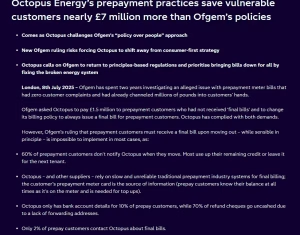
Octopus Energy’s published explanation of the practical challenges involved in issuing final bills to prepayment customers.
What Are the Ofgem Compensation Rules in 2026?
The original Octopus case involved historic failures, but the relevant consumer protections have since changed.
A key difference is the standard compensation amount.
From 2 January 2025, the applicable supplier Guaranteed Standards payment increased from £30 to £40.
The earlier £30 amount was relevant to the period investigated in the Octopus case.
Old and New Compensation Rates
| Compensation situation | Historical rate applicable to the investigated failures | Current standard payment |
| Qualifying failure to issue a final bill within six weeks | £30 | £40 |
| Failure to pay the required compensation on time | Additional £30 | Additional £40 |
| Potential total for both qualifying failures | £60 | £80 |
The first payment must normally be made within ten working days of the supplier failing the relevant standard.
If that compensation is not paid on time, a further payment becomes due under the applicable rules.
Exceptions and disputes about eligibility may affect individual cases.
A household experiencing a qualifying new failure in 2026 may therefore have different compensation rights from someone involved in the historic 2016–2023 investigation.
This distinction is essential when checking online compensation claims.
What New Smart Meter Compensation Rules Started in February 2026?
A further regulatory development took effect on 23 February 2026.
Ofgem introduced additional Guaranteed Standards covering certain smart meter installation and service problems.
These rules extend automatic compensation protections to specific situations.
| Smart meter issue | Relevant requirement | Compensation |
| Delay in arranging a first-time smart meter installation | Appointment not offered within six weeks of the request | £40 |
| Unsuccessful installation appointment | Failure caused by a problem within the supplier’s control | £40 |
| Reported smart meter problem | No resolution plan provided within five working days | £40 |
These standards are separate from the £1.483 million historic Octopus redress agreement.
They do not automatically establish compensation for every smart meter that stops sending readings, and the rules should not be interpreted as a guarantee that every reported fault must be fully repaired within five days.
The five-working-day standard concerns providing a resolution plan.
This matters for households using smart meters to monitor high electricity consumption, including those with gaming PCs, consoles and other connected equipment.
Accurate usage information can support household budgeting, but customers must distinguish a technical meter issue from a supplier’s failure to meet a compensable service standard.
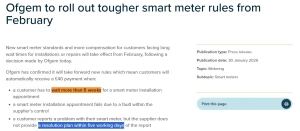
Ofgem’s new smart meter compensation rules, including £40 payments for specified installation delays, failed appointments and missing resolution plans.
Was Octopus Energy Involved in Another Ofgem Compensation Investigation?
Yes. Another important distinction is a separate Ofgem announcement on 9 May 2025.
That case concerned incorrect charges associated with restricted meter infrastructure, rather than missing final bills for departing prepayment customers.
The investigation covered ten energy suppliers whose customers had been charged incorrectly under the energy price cap rules.
For Octopus Energy, Ofgem recorded:
| Measure | May 2025 overcharging case |
| Octopus customer accounts affected | 20,862 |
| Refunds | £2,636,884 |
| Goodwill payments | £546,278 |
| Combined refunds and goodwill | £3,183,162 |
| Relevant period | January 2019 to September 2024 |
The two cases should not be combined into a single compensation calculation.
The May investigation concerned customers using particular metering arrangements and the application of the price cap.
The July investigation concerned the failure to provide final bills to departing prepayment customers.
Our analysis found this distinction particularly important because readers researching Octopus Energy compensation may encounter several headlines reporting different totals.
Understanding the underlying regulatory issue is necessary before deciding whether a particular announcement applies to an account.
For wider context on how regulated energy tariffs work, our examination of whether UK energy prices are going up or down explains how unit rates, standing charges and Ofgem’s price cap influence household bills.
Did Octopus Energy Fix the Billing Problems?
Ofgem’s July 2025 decision confirmed that Octopus had updated its billing processes and systems to address the identified non-compliance.
The supplier also agreed to customer refunds and compensation and voluntarily wrote off debt associated with customers who left during the affected period.
These measures are material because they address both the immediate financial consequences and the underlying operational process.
Nevertheless, confirmation that systems were updated does not independently establish that every future bill will always be correct.
Our assessment separates the documented corrective actions from the question of longer-term service performance.
Our Editorial Rating of the Compensation Response
Based on the publicly documented regulatory outcome, we assign an editorial response rating of 69%.
This is our qualitative assessment converted into a percentage using the criteria below. It is not a customer satisfaction survey, an Ofgem rating or a statistical measurement of current service quality.
| Assessment category | Editorial score | Main consideration |
| Historical regulatory compliance | 5/25 | Large number of accounts affected over an extended period |
| Corrective measures | 23/25 | Billing systems updated and remedial action confirmed |
| Financial redress commitments | 23/25 | £1.483 million package and voluntary debt write-offs |
| Customer communication and traceability | 18/25 | Contact and tracing efforts documented, but final individual receipt remains difficult to independently establish |
| Overall editorial assessment | 69/100 (69%) | Documented response to the historic enforcement case |
The most positive factor is that formal corrective action and financial redress were agreed.
The most serious concern remains the length of time during which the billing failures affected departing customers.
A company’s response to a regulatory investigation matters, but the original compliance failure must still form part of any balanced assessment.
Why Are Final Energy Bills Important for Household Finances?
Final bills provide an essential financial record when customers move home, switch supplier or terminate a contract.
They identify the account’s closing position and help determine whether a refund is due.
For a prepayment customer, remaining credit may be visible on the meter, but the formal settlement also clarifies responsibility for that balance.
A final bill can help prevent:
- Money remaining unidentified after an account closes.
- Confusion over whether a refund has already been issued.
- Disputes about energy charges associated with a former property.
- Delays in accessing credit that belongs to the departing customer.
- Errors when reconciling household expenses after moving.
These issues are especially relevant to renters, students, households relocating frequently and people who may not maintain access to previous supplier accounts.
From a budgeting perspective, the sensible approach is to treat unused energy credit as money to be reconciled, not as a small balance that can automatically be disregarded.
Customers should also distinguish contractual compensation from government assistance.
For example, the £150 energy bill confirmation and Warm Home Discount relate to qualifying household support, not Ofgem’s enforcement action against Octopus Energy.
How Can You Escalate an Octopus Energy Compensation Complaint?
If Octopus does not provide a satisfactory answer to a billing or compensation enquiry, the next step is to use the formal complaints procedure.
Customers should explain the issue, specify the remedy they want and preserve records of their communications.
A written complaint should identify:
- The former account number and supply address.
- The date the customer stopped receiving energy from Octopus.
- Whether the account used a prepayment meter.
- Whether a final bill was received.
- Any missing refund or compensation payment.
- The action requested from the supplier.
Under Ofgem’s published complaint guidance, unresolved cases can generally be referred to the Energy Ombudsman after eight weeks, or sooner where the supplier issues a deadlock letter.
The Ombudsman can consider the evidence and require an appropriate remedy within its powers.
The government announced reforms in June 2026 intended to shorten the standard escalation period from eight to six weeks.
However, the published Ofgem and Energy Ombudsman customer guidance still sets out the eight-week route. Customers should follow the rules actually in force when escalating rather than assume a proposed reduction already applies.
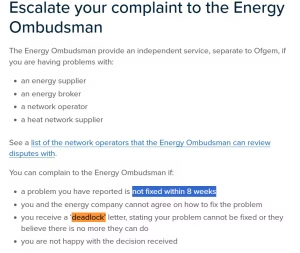
Ofgem’s official explanation of when customers can refer unresolved energy supplier complaints to the Energy Ombudsman.
How Can Customers Avoid Missing Future Energy Compensation?
Our review suggests that many compensation problems can become harder to resolve when customers lose access to historic account information.
A practical approach is to keep digital records of final bills, opening and closing meter readings, supply dates and any outstanding credit.
When switching energy supplier, customers should check that the old supplier has issued a final statement and that any refund has been processed.
When moving home, it is also important to notify the supplier of the departure date and provide a forwarding address or current contact details.
Customers should verify unexpected messages offering compensation.
Fraudulent emails and text messages can imitate legitimate businesses, particularly when widely publicised regulatory settlements create an opportunity for scammers.
If a message asks for banking details through an unfamiliar link, customers should contact their supplier independently using its verified website or telephone number.
No genuine compensation entitlement requires giving a third-party stranger access to an energy account password.
Conclusion: What Does Octopus Energy Ofgem Compensation Mean for Customers?
The Octopus Energy Ofgem compensation case highlights the financial consequences of failing to meet established consumer billing standards.
The regulator identified 34,494 affected prepayment accounts and secured a £1.483 million package covering unused credit refunds, standard compensation and additional redress.
Our analysis shows that the central lesson extends beyond the average £43 payment.
Consumers need reliable final bills, transparent closing balances and timely access to money owed to them, particularly when switching suppliers or moving property.
Octopus Energy responded by agreeing to compensation, updating its billing systems and writing off certain historic debts. Its public disagreement with Ofgem also highlighted practical difficulties associated with prepayment account information and moving-home processes.
Nevertheless, the requirement to protect customer balances remains fundamental.
For anyone researching Octopus Energy Ofgem compensation in 2026, the most useful next step is to establish which regulatory case applies, confirm the relevant account dates and request an individual payment review where appropriate.
The strongest consumer protection is not simply the availability of compensation after an error. It is a billing system that gives customers accurate information and returns money promptly in the first place.
Frequently Asked Questions About Octopus Energy Ofgem Compensation
How much compensation did Octopus Energy agree to pay?
Octopus Energy agreed to provide £1.483 million in compensation, credit refunds and additional redress following Ofgem’s July 2025 investigation.
How many customers were affected?
Ofgem identified 34,494 affected prepayment customer accounts.
Is every Octopus Energy customer entitled to £43?
No. The £43 figure represents an average across affected accounts, not a fixed entitlement for every current or former customer.
Can former customers ask about compensation in 2026?
Yes. Former customers can ask Octopus to review their historical account and confirm whether a payment was owed or issued. This does not guarantee a fresh payment under the original settlement.
What happens if Octopus fails to issue a final bill in 2026?
A qualifying failure to issue a final bill within six weeks can trigger £40 in standard compensation. A further £40 may become due if the required initial compensation is not paid on time.
Can smart meter customers receive £40 compensation?
Yes, for specified failures covered by the smart meter standards introduced on 23 February 2026. Eligibility depends on the nature of the service failure.
What if I already switched to another energy supplier?
Switching does not remove an entitlement arising from a qualifying failure by a previous supplier. Contact the supplier responsible for the original account.
Was the £1.483 million a fine?
The published figure was a customer redress and compensation package, rather than simply a fine payable to the Treasury.
Does Ofgem pay the money directly to customers?
The relevant energy supplier is responsible for customer payments under the compensation arrangement. Ofgem oversees compliance but is not the ordinary claims payment provider.
Does this compensation cover business energy accounts?
The July 2025 enforcement decision concerned domestic prepayment accounts. Business customers should not assume that the same settlement applies to their commercial supply contracts.