


Rachel Reeves pension changes have reshaped the way UK workers, pensioners, business owners and families need to approach retirement planning.
From new inheritance tax rules to restrictions on pension salary sacrifice and reforms to workplace pension investments, several important policies introduced during her time as Chancellor are now becoming law or approaching implementation.
However, there is an important distinction. Rachel Reeves left the Chancellor’s position in July 2026, and John Healey delivered the latest UK Budget on 28 October 2026.
Some of the newest pension announcements therefore belong to the current Chancellor, although they build on policies established during Reeves’ tenure.
We analysed the confirmed legislation, Treasury announcements, pension industry developments and the practical financial implications for different groups of savers.
Our assessment indicates that the most important changes concern how unused pension wealth is taxed after death, how salary sacrifice operates from 2029, and how the State Pension interacts with frozen Income Tax thresholds.
For someone approaching retirement, these developments could affect when they draw their pension, how they structure savings and what they eventually leave to their family.
What Are New Pension Changes in 2026 and 2027?
Rachel Reeves’ pension reforms were designed to improve retirement outcomes, increase investment in the UK economy and change certain tax advantages associated with pension savings.
Some reforms are already legislated, while others will take effect over the next several years.
| Pension change | Implementation | Main impact |
| Inheritance Tax on unused pensions | 6 April 2027 | Most unused pension funds become part of the taxable estate |
| Salary sacrifice National Insurance restrictions | 6 April 2029 | NIC exemption limited to the first £2,000 sacrificed annually |
| Pension Schemes Act 2026 | Royal Assent 29 April 2026 | Introduces a framework for consolidation, value-for-money assessments and retirement support |
| Mansion House Accord | Targets for 2030 | Encourages pension providers to increase private-market investment |
| State Pension age increase | 2026–2028 | Existing legislation gradually raises eligibility from 66 to 67 |
| New Pension Tax Allowance | 6 April 2027 | Reduces Income Tax for some lower-income pensioners |
| State Pension increase | April 2027 | Full new State Pension increases by 3.9% |
| Adjusted State Pension triple lock | Planned from April 2030 | Changes how pension increases relate to earnings over time |
Not all these policies were personally announced by Reeves. The table includes later developments because they are relevant to understanding the current retirement landscape.
The key distinction is between changes to pension taxation, changes to State Pension entitlement and reforms affecting how private pension schemes manage investments.
Will New Budget Changes Introduce Inheritance Tax on Pensions?
One of the most significant reforms is the decision to include most unused pension funds and pension death benefits within the Inheritance Tax calculation from 6 April 2027.
The policy was announced in the Autumn Budget 2024 and subsequently legislated through Finance Act 2026.
Previously, many unused defined contribution pension pots could pass to beneficiaries outside the deceased person’s estate for Inheritance Tax purposes.
From April 2027, that treatment will change.
The reform can affect workplace pensions, personal pensions, Self-Invested Personal Pensions (SIPPs) and certain pension death benefits.
However, this does not mean every inherited pension automatically attracts a 40% tax charge.
Whether Inheritance Tax becomes payable will depend on the entire estate, available tax-free allowances, exemptions and reliefs.
How Much Inheritance Tax Could Families Pay?
The standard Inheritance Tax rate is 40% on the taxable portion of an estate.
The usual nil-rate band is £325,000. An additional residence nil-rate band of up to £175,000 may also be available where the relevant conditions are satisfied.
Unused allowances may be transferable between spouses or civil partners.
Consider a simplified example involving a single individual with no additional exemptions or residence nil-rate band.
| Estate component | Value |
| Property and other investments | £400,000 |
| Unused pension savings | £200,000 |
| Total estate from April 2027 | £600,000 |
| Standard nil-rate band | £325,000 |
| Taxable estate | £275,000 |
| Illustrative Inheritance Tax at 40% | £110,000 |
Under the earlier treatment, assuming the pension was outside the estate, the equivalent tax on the £400,000 non-pension estate would have been £30,000.
The difference is £80,000.
This example demonstrates the potential exposure rather than predicting an individual’s tax bill. A qualifying residence, spouse exemption, debts, charitable gifts and other reliefs could materially change the result.
For business owners, the implications can be particularly important because wealth is often spread across company shares, investments, property and pension accounts.
We examined this issue further when assessing HMRC pension inheritance tax changes for startup founders. For entrepreneurs, the central challenge is understanding how pension wealth interacts with the rest of the estate.
Can Beneficiaries Face Both Inheritance Tax and Income Tax?
Potentially, yes.
The pension holder’s age at death remains important when determining whether beneficiaries pay Income Tax on inherited pension withdrawals.
Where a person dies before age 75, qualifying inherited pension benefits can often be accessed without Income Tax, subject to the applicable conditions and allowances.
Where death occurs at age 75 or later, inherited pension withdrawals are generally taxable as the beneficiary’s income.
From April 2027, relevant inherited pension funds may also contribute to an estate’s Inheritance Tax liability.
The rules contain mechanisms addressing the interaction between the two taxes, including provisions dealing with pension funds used to settle Inheritance Tax.
Families should therefore avoid assuming that the total liability is simply 40% Inheritance Tax plus the beneficiary’s full marginal Income Tax rate on the same amount.
What Should Families Do Before April 2027?
We consider reviewing the complete estate more useful than withdrawing money simply because a new tax rule is approaching.
Taking a large pension withdrawal could trigger Income Tax and leave the withdrawn cash inside the estate anyway.
Pension nominations, wills, available reliefs, beneficiaries’ tax positions and retirement spending requirements should be considered together.
The new rules also create additional responsibilities for personal representatives and pension administrators.
HMRC’s August 2026 technical update explains information-sharing processes, withholding notices and mechanisms through which pensions may contribute directly towards the associated tax liability.
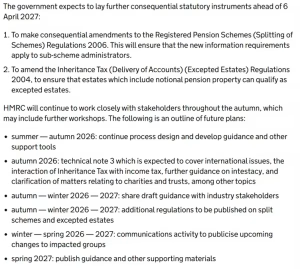
HMRC confirms that most unused pension funds and pension death benefits enter the Inheritance Tax calculation from 6 April 2027.
How Will Pension Salary Sacrifice Change Under Rachel Reeves’ Reforms?
Another substantial pension reform concerns salary sacrifice arrangements.
Salary sacrifice allows an employee to exchange part of their gross salary or bonus for an employer pension contribution.
Under the existing arrangements, this can generate National Insurance savings for both employees and employers.
From 6 April 2029, the National Insurance exemption for employee pension contributions made through salary sacrifice will generally be limited to the first £2,000 per tax year.
Amounts sacrificed above that threshold will attract employee and employer National Insurance contributions.
Importantly, this is not a £2,000 limit on pension contributions themselves.
Workers can continue contributing more than £2,000, subject to the usual pension tax rules. The reform restricts the National Insurance advantage rather than removing pension Income Tax relief.
How Much Could Employees Lose?
Consider an employee contributing £5,000 annually through salary sacrifice.
| Calculation | Amount |
| Annual salary-sacrificed pension contribution | £5,000 |
| Contributions retaining NIC exemption | £2,000 |
| Contributions subject to NICs under the reform | £3,000 |
| Illustrative employee NIC at 8% | £240 |
| Illustrative employer NIC at 15% | £450 |
These figures use illustrative National Insurance rates and assume the relevant earnings fall within the corresponding contribution bands. Actual liabilities in 2029 will depend on the rates, earnings thresholds and circumstances applying then.
Our analysis suggests that higher contributors and businesses offering generous salary exchange arrangements have the strongest reason to revisit their payroll calculations.
Government estimates indicate that approximately 7.7 million employees use pension salary sacrifice. Around 3.3 million, representing approximately 44%, contribute more than £2,000 through these arrangements.
That means an estimated 56% of existing users would not be directly affected by the new threshold, based on the government’s modelling.
The business implications are particularly relevant for technology firms, gaming studios, creative agencies and growing startups.
Employers offering pension salary sacrifice as part of a competitive remuneration package may need to examine additional payroll costs and decide whether to absorb them or change their benefits arrangements.
Our detailed examination of the HMRC salary sacrifice limit changes explains the distinction between restricting National Insurance savings and restricting pension contributions.
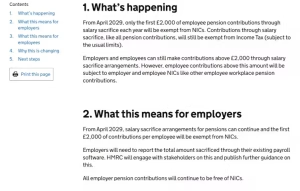
HM Treasury confirms the £2,000 annual National Insurance exemption threshold for pension salary sacrifice from April 2029.
How Will the State Pension Change in 2027?
The State Pension is another major consideration for people evaluating the wider impact of pension reform.
On 28 October 2026, the government confirmed that the basic and full new State Pensions would increase by 3.9% for the 2027–28 financial year.
The increase reflects average earnings growth under the existing triple-lock arrangement.
The resulting standard weekly rates are:
| State Pension | 2026–27 | 2027–28 | Annual increase |
| Full new State Pension | £241.30 | £250.70 | £488.80 |
| Full basic State Pension | £184.90 | £192.10 | £374.40 |
Annual figures are calculated using 52 weeks. Individual State Pension entitlements may differ because of National Insurance records and other historical factors.
The full new State Pension is therefore set to reach £13,036.40 annually from April 2027.
This is significant because it exceeds the standard £12,570 Personal Allowance.
Without additional tax provisions, someone receiving only the full new State Pension could become liable for a relatively small amount of Income Tax.
The government has introduced a specific measure to address that problem.
What Is the New Pension Tax Allowance Announced in the 2026 Budget?
The 28 October 2026 Budget provided further details of the Pension Tax Allowance, which will apply from 6 April 2027.
This measure is particularly important for lower-income pensioners.
It will reduce the Income Tax liability of eligible individuals who have reached State Pension age, including some whose income comes from private pensions, employment or other sources.
For the 2027–28 tax year, the full new State Pension will be worth £13,036.40 annually, compared with the Personal Allowance of £12,570.
The difference is £466.40.
At the basic 20% Income Tax rate, that creates a potential tax liability of £93.28.
The new Pension Tax Allowance can eliminate that liability for eligible pensioners.
Who Will Qualify?
| Total annual income in 2027–28 | Pension Tax Allowance treatment |
| Below £12,570 | Normally no Income Tax liability arising from this income |
| £12,570 to £13,036.40 | Full reduction available, limited to the actual tax liability |
| Above £13,036.40 but below approximately £13,319 | Gradually reduced tax allowance |
| £13,319 or more | No Pension Tax Allowance |
For income above the full annual new State Pension, the tax reduction falls by £1 for every additional £3 of income.
The allowance is expected to benefit approximately 500,000 pensioners in 2027–28, including around 290,000 who would otherwise have paid tax.
It will apply for the tax years 2027–28, 2028–29 and 2029–30. The government will consider arrangements beyond April 2030 separately.
HMRC will apply the reduction automatically where eligible, meaning pensioners should not normally need to submit a separate claim.
This addresses one of the most important problems in pension taxation: rising State Pension payments alongside frozen Income Tax thresholds.
However, the measure does not eliminate fiscal drag for pensioners with larger combined incomes.
For example, someone receiving £15,000 from State Pension and other taxable sources will exceed the eligibility range for the new allowance.
Former pensions minister Steve Webb described the temporary measure as potentially becoming a “long-term headache”, warning that reversing the tax reduction later could prove difficult.
From our financial perspective, the immediate protection for lower-income pensioners is valuable, but retirement planning still needs to consider every taxable income source rather than just the State Pension.
The wider issue is explored in our examination of the pensioner income tax increase, particularly how frozen thresholds affect people with additional retirement income.
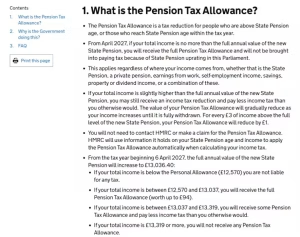
The new Pension Tax Allowance can remove an Income Tax liability of up to £93.28 for eligible pensioners in 2027–28.
Is Rachel Reeves Increasing the State Pension Age to 67?
The State Pension age is rising from 66 to 67 between 2026 and 2028, but it is incorrect to describe this as a new policy introduced by Rachel Reeves.
The increase was legislated under the Pensions Act 2014.
The timetable affects people born between 6 April 1960 and 5 March 1961 through a phased increase in eligibility age.
People born from 6 March 1961 through 5 April 1977 generally reach State Pension age at 67 under the current timetable.
The existing legislated increase to 68 is scheduled between 2044 and 2046, although the government continues to review the long-term timetable.
These changes matter because someone reaching retirement age during the transition may need to finance additional months before State Pension payments begin.
We consider that bridging period particularly important for self-employed workers and small-business owners who do not have a defined-benefit pension providing guaranteed retirement income.
A person relying heavily on the State Pension should calculate their actual eligibility date rather than assuming it begins automatically at their 66th birthday.
What Will Happen to the State Pension Triple Lock From 2030?
The triple lock currently guarantees that the full new and basic State Pensions increase by the highest of annual earnings growth, Consumer Prices Index inflation or 2.5%.
However, the government has announced an adjustment from April 2030.
Under the planned arrangement, the State Pension would increase by the highest of inflation, 2.5%, or the amount needed to maintain its value relative to average earnings at the level reached in April 2029.
This is not the same as removing all protection against earnings growth.
Instead, the government intends to stop the State Pension continually increasing as a proportion of average earnings while preserving the relative level achieved by the end of the current Parliament.
We see two important considerations.
For current pensioners, the policy retains protection against inflation and continues annual increases.
For younger workers, the change may reduce the extent to which the State Pension outpaces average earnings over the longer term.
The government estimates that the adjustment could reduce annual State Pension spending by approximately £15 billion by the late 2030s.
This is a fiscal forecast rather than a direct reduction in an individual’s current State Pension entitlement.
What Is the Mansion House Accord and How Does It Affect Pension Investments?
Rachel Reeves’ broader pension strategy also sought to encourage greater investment in UK businesses, infrastructure and private markets.
One of the most important initiatives was the Mansion House Accord, announced in May 2025.
The voluntary agreement brought together 17 major workplace pension providers with ambitions to allocate at least 10% of relevant defined contribution default funds to private markets by 2030, including at least 5% to UK private markets.
Private-market investments can include infrastructure, property, private equity and private debt.
These assets may offer access to different investment opportunities, but they can also introduce liquidity, valuation, concentration and governance risks.
How Much Progress Has Been Made?
An industry update published on 20 October 2026 reported the following figures for participating providers, based on holdings at 31 December 2025.
| Investment measure | Reported value |
| Global private-market investments | £22.1 billion |
| UK private-market investments | £11.1 billion |
| Private-market allocation of growth-phase default assets | 6.6% |
| UK private-market allocation | 3.3% |
| Target global private-market allocation by 2030 | 10% |
| Target UK private-market allocation by 2030 | 5% |
This provides more measurable evidence of progress than the broad investment ambitions described when the original pension reforms were announced.
However, we would not interpret a higher percentage invested in private markets as proof of better retirement outcomes.
Pension performance depends on investment returns after fees, appropriate diversification, risk management and the ability to access assets when required.
Dr Yvonne Braun, Director of Long-Term Savings and Health and Protection Policy at the Association of British Insurers, has emphasised that increasing UK investment should deliver positive outcomes for savers as well as support economic growth.
That distinction is essential: pension trustees must act in members’ interests, not simply direct savings towards particular industries.

Mansion House Accord participants reported £11.1 billion invested in UK private markets, representing 3.3% of relevant default assets.
How Will the Pension Schemes Act 2026 Change Workplace Pensions?
The Pension Schemes Act 2026 received Royal Assent on 29 April 2026.
It establishes a legislative framework for several structural reforms to workplace pensions.
A major objective is improving value for savers while encouraging schemes to operate more efficiently.
The reforms include annual value-for-money assessments, consolidation of eligible small pension pots and new arrangements intended to support members in converting pension savings into retirement income.
One important element concerns defined contribution schemes.
Providers will increasingly be required to assess performance, charges and service quality rather than relying solely on headline management fees.
The legislation also creates a framework for automatically consolidating certain small, inactive defined contribution pension pots.
Eligible pots of £1,000 or less may eventually be transferred to authorised consolidators under the new arrangements, subject to detailed implementation rules.
This could be useful for workers who frequently change jobs.
Someone who has worked across several gaming studios, technology businesses or short-term employment contracts could accumulate multiple small pension accounts.
Consolidation may make those savings easier to monitor and reduce the risk of leaving retirement money forgotten.
However, the Act does not mean every pension pot will be consolidated immediately.
Detailed regulations, implementation dates and safeguards remain important.
Will Rachel Reeves’ Reforms Reduce Pension Tax Relief?
There has been substantial speculation about changes to pension tax relief, but it is important to separate confirmed policies from proposals.
The general pension Income Tax relief framework remains in place.
For 2026–27 and 2027–28, the standard annual allowance remains £60,000, subject to rules that can reduce the allowance for some individuals.
The money purchase annual allowance is £10,000 where applicable.
Most savers can still usually take up to 25% of qualifying pension savings as a tax-free lump sum, within the standard lump sum allowance of £268,275, unless they have relevant protections or special circumstances.
The £2,000 salary sacrifice reform does not replace these allowances.
Similarly, the removal of the former lifetime allowance charge should not be confused with the continuing limits on tax-free pension lump sums.
For founders and self-employed professionals, the distinction is financially important.
A business director making employer pension contributions needs to consider the relevant tax deductions, pension annual allowance, available earnings and other statutory conditions.
A self-employed game developer contributing to a personal pension faces a different tax structure from a studio employee using salary sacrifice.
Neither should make major changes solely because of headlines suggesting that pension tax relief has been abolished.
What Did the October 2026 Budget Change About Pension Death Benefits?
The Budget delivered by John Healey on 28 October 2026 also introduced changes affecting pension death benefits.
One notable reform removes the previous two-year deadline that could cause certain otherwise tax-free pension death benefits to become taxable when payment or designation was delayed.
Under the revised policy, the relevant benefits will not become taxable solely because the scheme takes more than two years to complete the process.
The change applies to qualifying payments from 28 October 2026, subject to the normal conditions and allowances.
This is particularly relevant where pension administrators experience delays.
For grieving families, it reduces the risk that administrative processing times alone determine the Income Tax treatment of inherited benefits.
However, the removal of this deadline does not cancel the separate April 2027 Inheritance Tax reform.
The government also announced technical changes concerning defined-benefit pension surplus payments, the treatment of some excess death benefits and access arrangements for terminally ill members.
These are more specialised changes, but they demonstrate why pension policy should be assessed as a collection of distinct measures rather than a single new tax.
How Do the Pension Changes Affect Business Owners and Self-Employed Workers?
For UK entrepreneurs, the pension reforms create several financial planning considerations.
Business owners often build retirement wealth across pensions, company shares, dividends, investment accounts and property.
As a result, a change in one part of the tax system can affect decisions elsewhere.
A founder approaching retirement might have a valuable company, a SIPP and substantial personal savings.
From April 2027, the inclusion of unused pension savings in the estate could change how that founder approaches succession planning.
From April 2029, a company offering salary sacrifice to staff may also face additional National Insurance costs.
Meanwhile, structural pension reforms could influence workplace scheme selection and investment strategies.
For creative professionals and gaming-sector entrepreneurs, irregular income can make retirement contributions more difficult to maintain.
Someone earning through game development contracts, streaming, digital products or licensing may have periods of strong income followed by quieter months.
We consider a flexible contribution strategy more appropriate than committing to a fixed pension payment that cannot comfortably be sustained.
The underlying principles are to maintain adequate cash reserves, preserve appropriate retirement contributions and avoid allowing personal retirement security to depend entirely on the future sale value of a business.
How Do We Rate the Financial Impact of the Pension Reforms?
We assessed the principal reforms against three editorial criteria: potential financial exposure, the number of people who may need to review their arrangements, and the urgency of the implementation date.
These percentages are our editorial priority scores, not independently surveyed satisfaction ratings or estimates of financial returns.
| Pension reform | Our priority rating | Reason |
| Inheritance Tax reform | 95% | Potentially material effect on estate and succession planning |
| Pension Tax Allowance | 90% | Immediate relevance to lower-income retirees from 2027 |
| State Pension and triple-lock changes | 90% | Important for long-term retirement income forecasts |
| Salary sacrifice changes | 85% | Payroll and employee contribution implications from 2029 |
| Workplace pension reform | 80% | Could improve transparency and management of retirement savings |
| Mansion House Accord | 70% | Potential long-term investment impact, with uncertain outcomes |
Our highest planning priority is the inheritance-tax reform because it is approaching implementation and may materially affect families with substantial pension wealth.
However, someone relying primarily on the State Pension may reasonably place greater importance on the Pension Tax Allowance and annual State Pension increases.
A worker making significant salary-sacrificed contributions may prioritise the 2029 National Insurance changes.
The percentages should therefore be treated as a comparative editorial assessment, not personalised financial advice.
What Should You Do Before the Pension Changes Take Effect?
The most practical response is to review your existing retirement arrangements before making any changes.
We recommend the following checks:
- Review your State Pension forecast. Confirm your expected entitlement, National Insurance record and eligibility date.
- Locate previous pensions. Identify workplace pensions from former employers and check their current value.
- Check your pension contributions. Understand the annual allowance and whether salary sacrifice is being used.
- Review your estate. Consider pensions alongside property, savings, investments and business assets.
- Update beneficiary information. Ensure pension nominations and relevant estate documents reflect your current wishes.
- Assess pension investment costs and risks. Review fund performance, diversification, charges and retirement suitability.
- Seek regulated advice where needed. Inheritance-tax planning, large pension withdrawals and complex business succession decisions can justify specialist guidance.
The purpose is not to react to every pension announcement by changing investments or withdrawing savings.
It is to understand which confirmed changes apply to your circumstances and whether an existing plan remains appropriate.
What Is the Future of UK Pensions After Rachel Reeves’ Reforms?
The UK pension system is moving through a period of significant structural and tax reform.
Some policies introduced during Rachel Reeves’ time as Chancellor will not reach implementation until 2027 or 2029.
The current government’s October 2026 Budget has added further changes, particularly around the taxation of lower-income pensioners, pension death benefits and the future State Pension triple lock.
For savers, these reforms do not remove the fundamental benefits of pensions as long-term retirement vehicles.
Pensions continue to offer important tax advantages, investment opportunities and a means of building income beyond the State Pension.
However, the assumptions used in financial planning are changing.
Families with substantial unused pension wealth should review inheritance-tax exposure. Employees using salary sacrifice should understand the forthcoming National Insurance restrictions. Retirees should assess how State Pension increases interact with other taxable income.
Our overall assessment is that the biggest mistake would be viewing all pension reforms as either universally beneficial or universally harmful.
Their impact depends on a person’s age, earnings, pension arrangements, family circumstances and long-term objectives.
The strongest approach is to distinguish enacted legislation from future policy proposals, understand the relevant deadlines and make retirement decisions using the complete financial picture.
Frequently Asked Questions
Are Rachel Reeves’ pension changes confirmed?
Several important policies are confirmed in legislation, including the April 2027 pension inheritance-tax reform and the Pension Schemes Act 2026. Other measures have future commencement dates or require further implementation regulations.
Will pensions be taxed at 40% from April 2027?
Not automatically. Most unused pension funds will enter the Inheritance Tax estate calculation, but tax depends on the overall estate and applicable exemptions and allowances.
Will I lose 25% tax-free pension cash?
There is no general abolition of the usual 25% tax-free pension lump sum under the confirmed reforms discussed here. The standard lump sum allowance remains £268,275, subject to individual circumstances.
Will the State Pension increase in April 2027?
Yes. The government has announced a 3.9% increase. The full new State Pension is set to reach £250.70 per week.
Is pension salary sacrifice being abolished?
No. From April 2029, the National Insurance exemption will generally apply only to the first £2,000 of annual employee pension contributions made through salary sacrifice. Higher contributions remain possible.
Is the triple lock being scrapped?
The existing triple lock is being retained through the current Parliament. An adjusted version is planned from April 2030, maintaining protection against inflation and a mechanism relating the pension to average earnings.
Should I withdraw my pension before April 2027?
Not solely because of the inheritance-tax reform. Withdrawals may create Income Tax liabilities and could leave assets within your taxable estate. Personal circumstances should determine the decision.
Can self-employed people still benefit from private pensions?
Yes. Self-employed individuals can continue using eligible personal pensions and receiving applicable tax relief, subject to pension contribution and tax rules.